Thesis Topics at the Astronomy Research Unit
CONTACT:
Juergen Schmidt
office MA308
jurgen.a.schmidt@oulu.fi
phone: +358 (0) 504 318 047
Regulation of star formation and the mystery of a failed spiral galaxy (J. Janz):
In this project you will look at a peculiar galaxy (b) that is located far from other galaxies. This galaxy has a bright central part with similarities to a dwarf galaxy without star formation (a) or the inner part of bright spiral galaxies (d). However, the galaxy as a whole is very different from either, since it features a large faint disk with stars forming, which is just visible on the optical image, but evident at ultra-violet wavelengths (c). The question is: why? In order to answer this question you will learn about mining the wealth of data of the Sloan Digital Sky Survey and look for similar objects to identify common properties.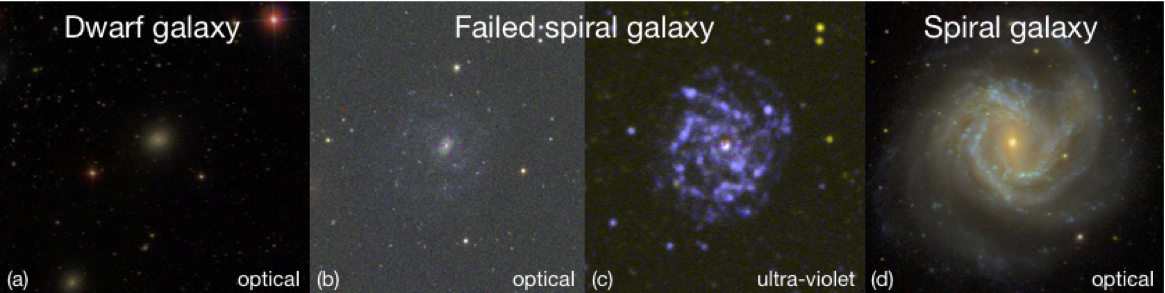
Failed Spiral Galaxy (IMAGE SOURCE)
Ice-Volcanic Activity of Jupiter's Moon Europa (J. Schmidt):
Europa is one of the large moons of Jupiter. It is believed to harbor an ocean of water beneath its ice crust and it is the scientific target of the NASA Europa Clipper Mission, that will explore its habitability. Recently, two independent observations suggest that Europa is also active, expelling a plume of water vapor and other gases to space from an ice-volcano on its surface. This bachelor project will explore and review the literature on this topic and it will summarize the major scientific questions. In additions, a simple model for the ejection and the pattern of falling back plume material on the surface will be developed.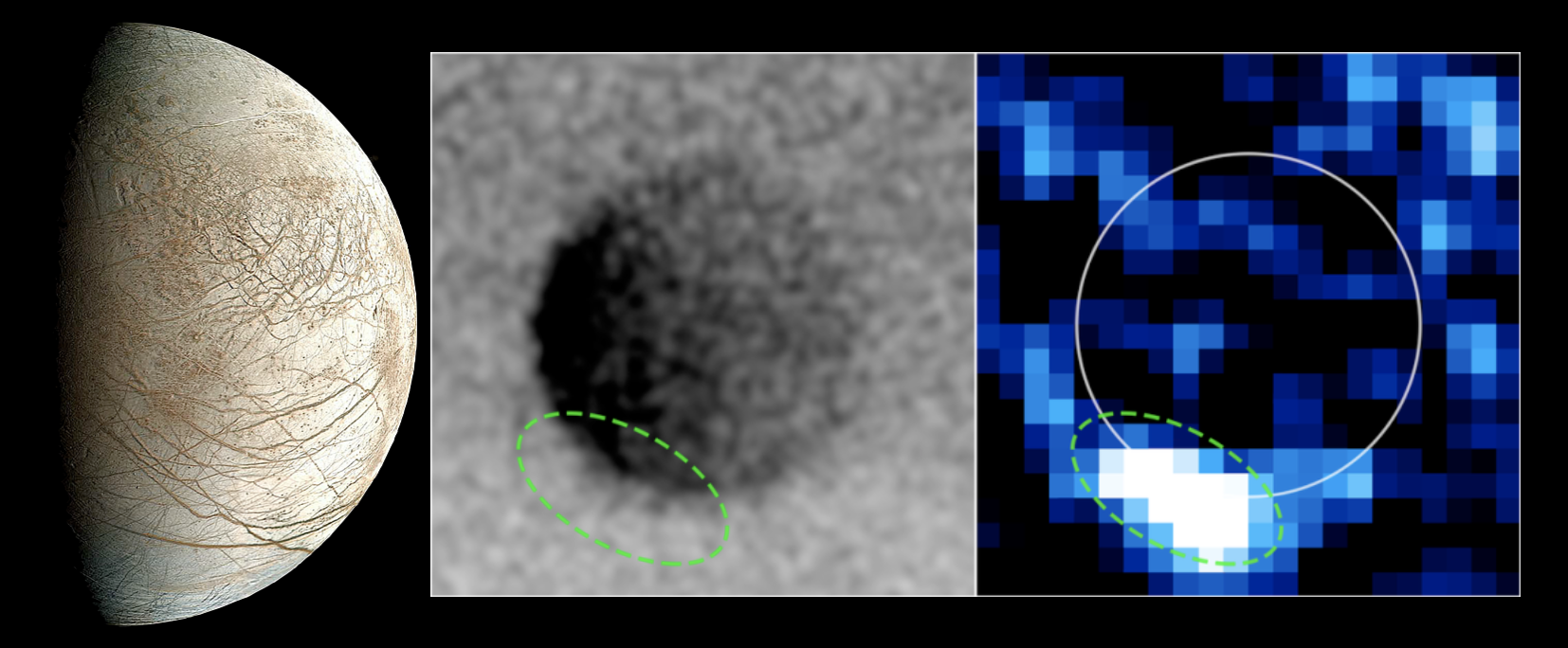
Left panel: Europa from the NASA Galileo Mission. Hubble Space Telescope observations, indicating ice-volcanic activity on Europa (Sparks et al., 2016, middle, Roth et al., 2013, right).
Mass distribution of black holes and neutron stars in X-ray binaries (V. Neustroev):
Black holes and neutron stars are the end point of massive star evolution. Most of them are thought to have been formed in supernova explosions due to the collapse of the massive stellar core. It is to be expected that the masses of the resultant compact remnants correlate with the masses of their progenitor stars which have a smooth distribution in the range from the heaviest to the lightest stars. Surprisingly, the observed distribution of black hole and neutron star masses seems to have a gap in the range between 2 to 5 solar masses. This gap, whose existence was fairly well established some time ago, has become a significant challenge to our understanding of compact object formation. However, in recent years, the measurements of masses of compact objects in several new binaries were obtained, and for a few others the masses were refined. The goal of this project is to update the mass distribution of black holes and neutron stars using the current sample of the mass measurements. Does the mass gap still exist? The presence or absence of the mass gap is a critical clue in understanding the formation of neutron stars and black holes and the engine behind supernova explosions.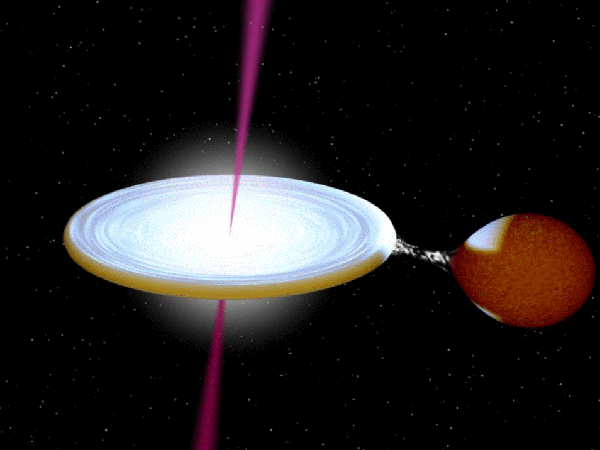
X-ray binary GRS 1915. The black hole absorbs material from a companion star, which is heated by friction, emitting X-rays. (Picture: Rob Hynes)
Diffuse Ionized Gas in Star-Forming Galaxies (A. Watkins):
Almost all star-forming galaxies contain large amounts of diffuse gas traceable by recombination lines (light emitted when electrons stripped off their host atoms by energetic photons recombine with said atoms), alternately known as 'diffuse ionized gas' (DIG) or the 'warm ionized medium' (WIM). While the discovery of this gas dates back almost half a century, the source of the ionization energy remains mysterious. This project would involve making a summary of the current state of research on DIG, with a possible extra project to make a comparative study of the DIG fractions (the fraction of ionized gas in a galaxy found in DIG vs. that found in compact star forming regions) in two interacting systems --- M51 and M101 --- using the deepest available narrowband imaging of these two galaxies.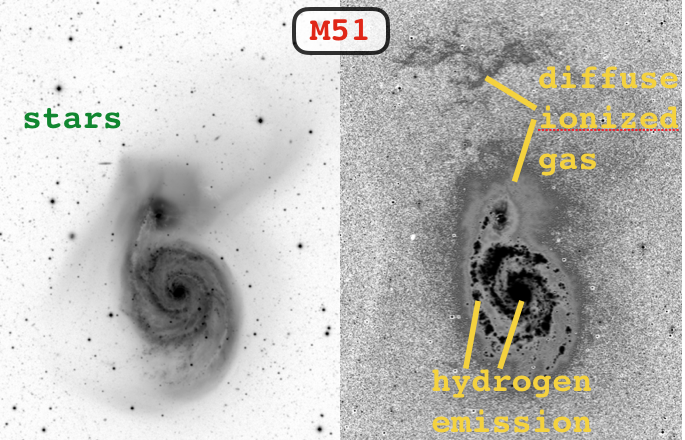
Left: Optical image of galaxy M51. Right: Distribution of diffuse ionized gas and hydrogen. (IMAGE SOURCE)
Saturn's Ring Moons (X. Liu):
The moon Pan is located in the inner system of Saturn, and its orbit is in the Encke Gap within Saturn's A ring. One of the surprising discoveries of the Cassini mission in 2017 was that Pan has a very peculiar shape, a bit like a walnut or a ravioli. Besides, in the Encke gap, there are also three ringlets that are associated with the orbits of Pan. This bachelor project will review the previous research on the formation scenario of the moon Pan and the three ringlets.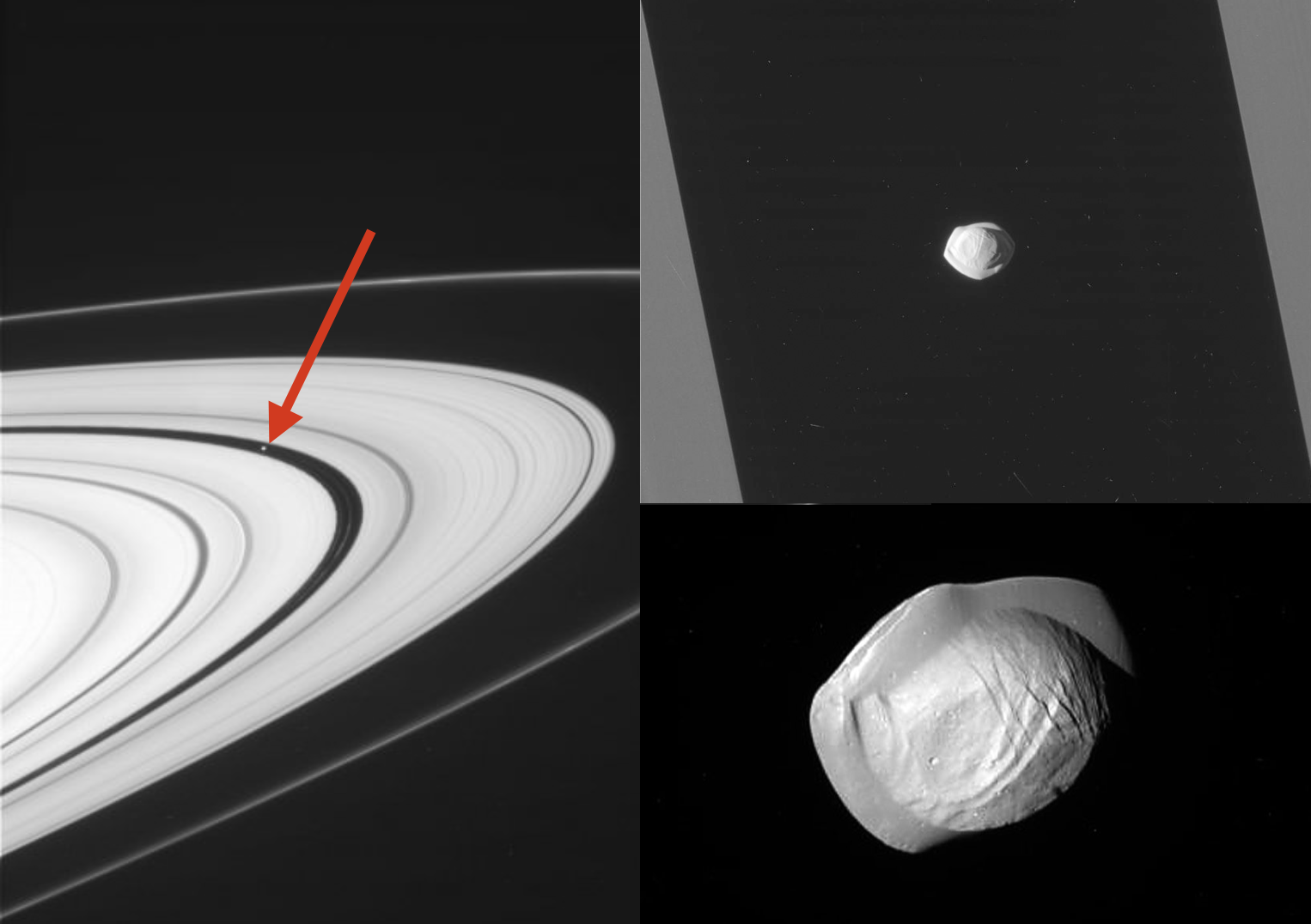
The moon Pan embedded in Saturn's rings (IMAGES: NASA/JPL)
2D spectroscopy: What can we obtain from it? (S. Comeron)
If we want to know how and when galaxies have formed, we need to use spectroscopy. For instance, spectroscopy allows us to measure the stellar kinematics and the stellar populations of galaxies outside the Milky Way. The advent of Integral Field Spectroscopy allowed us to produce 2D maps of spectroscopically-derived quantities in the galaxies around us. However, extracting information from spectra is not easy and requires dedicated software. In this project the student will perform a literature search on software that studies spectra and on what information can be extracted. It will be possible to do some additional work with stellar/gas velocity and velocity dispersion maps provided by the supervisor.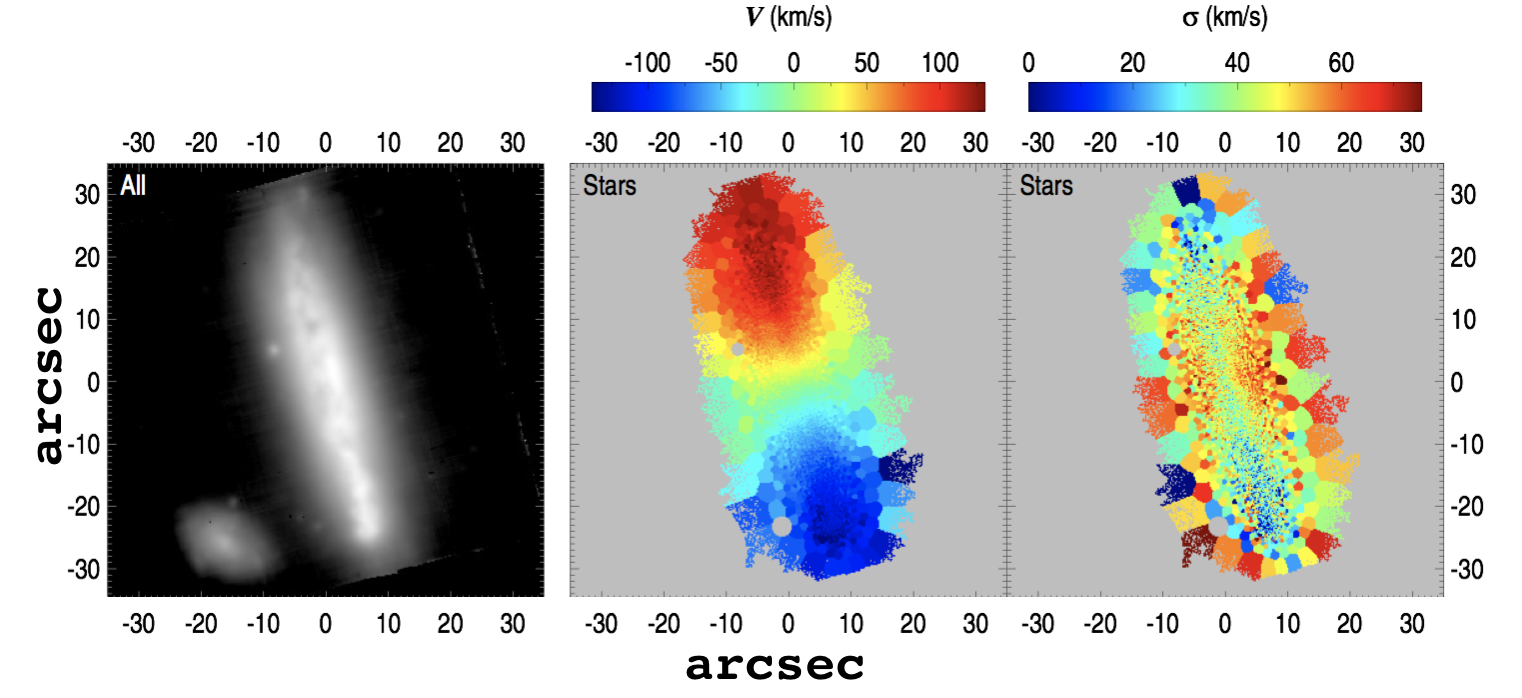
(Comeron et al, in preparation)
Jupiter's Gossamer Rings (X. Liu, J. Schmidt):
The giant planet Jupiter has a system of faint dust rings. Among these are the so-called gossamer rings, which were discovered in an image taken by the Voyager spacecraft, and later explored in more detail in images taken by the Galileo orbiter mission and earthbound observations. The gossamer rings are believed to be formed by dust that is ejected from two small moons of Jupiter, Amalthea and Thebe. This bachelor project will explore and review the literature on this topic.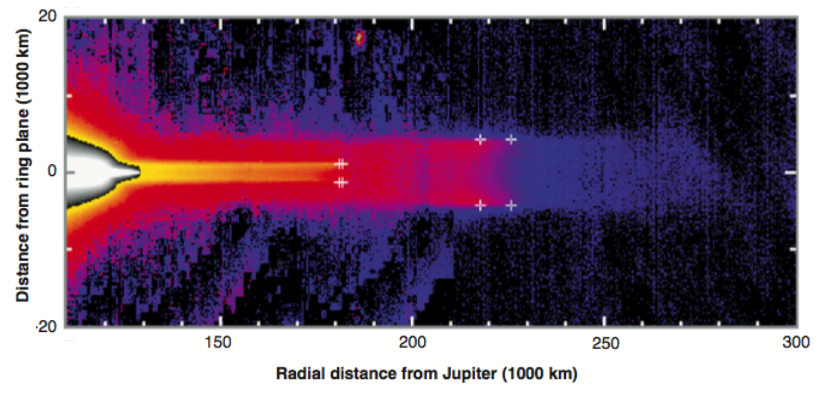
Edge-on image taken from the NASA Galileo spacecraft showing Jupiter's dusty gossamer rings. (Image modified from Burns et al., 1999, Science.)
Main Belt Comets (J. Schmidt):
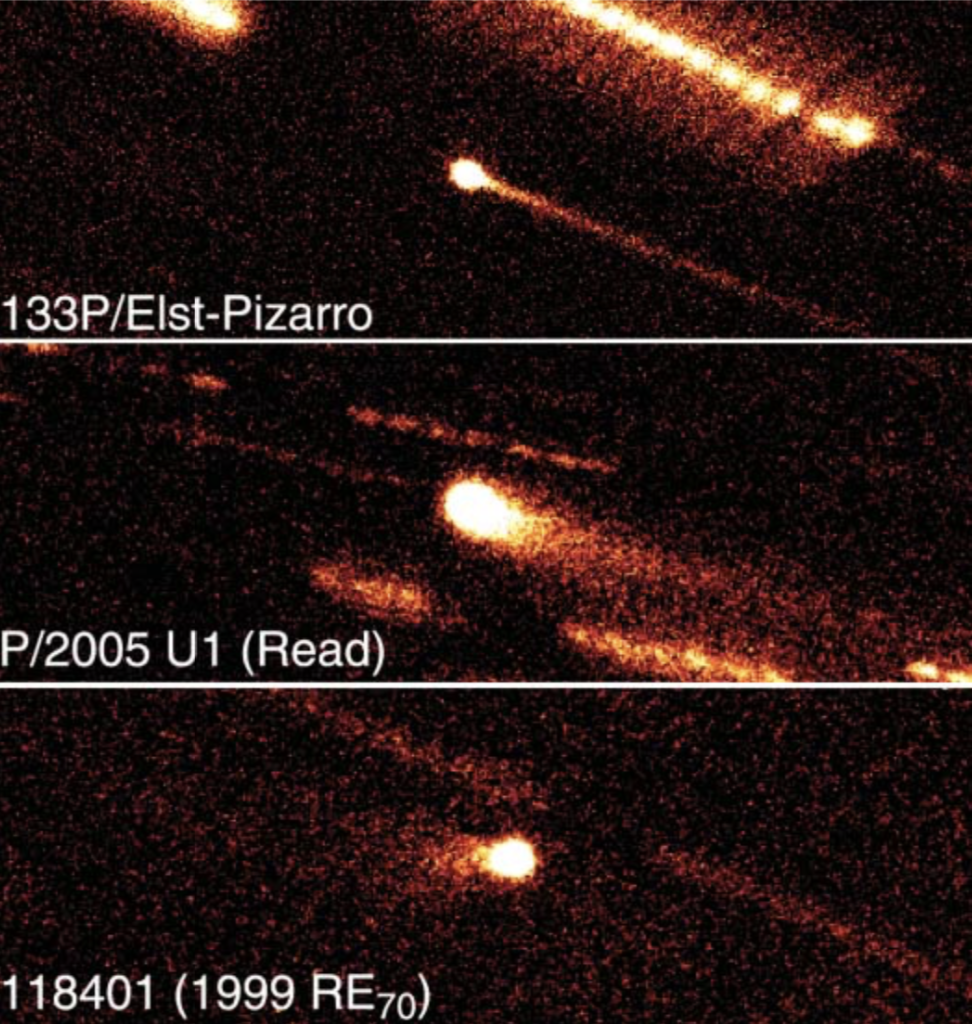
Until recently, it was believed that asteroids and comets are fundamentally different types of solar system objects. This picture was put into question by the discovery of objects in the asteroid belt of the solar system that show clear signs of comet-like activity. Apparently some process leads to the release of dust streams from these asteroids, which form a tail, in a very similar way like comets. This bachelor project will explore and review the literature on this topic.