![(*1*)Solve[Exp[x] 2, x] Solve[Sqrt[x * x - 1] 1/2, x] ᡝ ... 62513;2}, {x, y}] Solve[x Exp[x] 1, x] Solve[x Exp[Exp[x]] 1, x]](../HTMLFiles/ex02_solutions_173.gif)
Solution
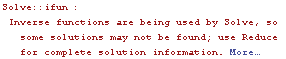
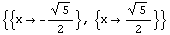
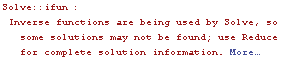
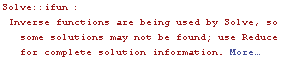
Solve can not in general solve non-polynomial equations. It might give a false answer, or at least leave some solutions out. It will give a warning message when that might be the case.
In[69]:=
Out[69]=
![{{xLog[2]}}](../HTMLFiles/ex02_solutions_175.gif)
Out[70]=
Out[71]=


Out[72]=
![{{xProductLog[1]}}](../HTMLFiles/ex02_solutions_181.gif)
Out[73]=
![Solve[^^x x1, x]](../HTMLFiles/ex02_solutions_183.gif)
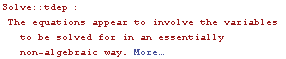
Note that the last equation couldn't be solved at all. See the help file for ProductLog if you wish.
In[74]:=
![(*2*)Reduce[Sin[x]^2 + Cos[x] 0, x] Reduce[Exp[2x] + 2Exp[x] - 30, x]](../HTMLFiles/ex02_solutions_184.gif)
Out[74]=
![C[1] ∈Integers&& (x -2 ArcTanh[(-2 + 5^(1/2))^(1/2)] + 2 ` ... [(2 + 5^(1/2))^(1/2)] + 2 π C[1] || x2 ArcTan[(2 + 5^(1/2))^(1/2)] + 2 π C[1])](../HTMLFiles/ex02_solutions_185.gif)
Out[75]=
![C[1] ∈Integers&& (x2 π C[1] || x π + 2 π C[1] + Log[3])](../HTMLFiles/ex02_solutions_186.gif)
Reduce never makes approximations. The output corresponds with logical exactness to the input.
In[76]:=
![(*3a*)Plot[Cos[x] - x, {x, -8, 8}] FindRoot[Cos[x] x, {x, 0.5}]](../HTMLFiles/ex02_solutions_187.gif)
![[Graphics:../HTMLFiles/ex02_solutions_188.gif]](../HTMLFiles/ex02_solutions_188.gif)
Out[76]=

Out[77]=

In[78]:=
![(*3b*)Plot[Log[x] - 1/x^2, {x, 0.5, 3}] FindRoot[Log[x] 1/x^2, {x, 1.5}]](../HTMLFiles/ex02_solutions_191.gif)
![[Graphics:../HTMLFiles/ex02_solutions_192.gif]](../HTMLFiles/ex02_solutions_192.gif)
Out[78]=

Out[79]=

In 3.c), since the interval is allready given, we wouldn't have to plot the function to find the initial guess, but let's plot it anyway.
In[80]:=
![(*3c*)Plot[BesselJ[0, x], {x, -10, 10}] FindRoot[BesselJ[0, x] 0, {x, 5, 6}]](../HTMLFiles/ex02_solutions_195.gif)
![[Graphics:../HTMLFiles/ex02_solutions_196.gif]](../HTMLFiles/ex02_solutions_196.gif)
Out[80]=

Out[81]=

The following function has infinitely many zeros, which you can see by increasing the range of x. Let's find the smallest root.
In[82]:=
![(*3d*)Clear[x] g[x_] = Exp[x Sin[x]] - x ; Plot[g[x], {x, -8, 8}, PlotRange {-8, 12}] FindRoot[g[x] 0, {x, 2.5}]](../HTMLFiles/ex02_solutions_199.gif)
![[Graphics:../HTMLFiles/ex02_solutions_200.gif]](../HTMLFiles/ex02_solutions_200.gif)
Out[84]=

Out[85]=

| Created by Mathematica (April 10, 2007) |  |