![(*1*)Integrate[Sin[x], {x, 0, 2Pi}] NIntegrate[Sin[x], {x, 0, 2Pi}]](../HTMLFiles/ex04_solutions_77.gif)
Solutions
In the first excercise, NIntegrate complains about something. This is just due to the fact that the exact value of the integral is zero.
In[63]:=
Out[63]=


Out[64]=

In[65]:=
![(*2*)Integrate[Log[x], x] D[%, x]](../HTMLFiles/ex04_solutions_81.gif)
Out[65]=
![-x + x Log[x]](../HTMLFiles/ex04_solutions_82.gif)
Out[66]=
![Log[x]](../HTMLFiles/ex04_solutions_83.gif)
The next excercise gives a complicated looking answer. You can simplify the integral with the Assumptions option. Normally, you might assume that the limits of integration are real numbers. Here however the expression Integrate[1/(x y),{y,a,b},{x,c,d},Assumptions→{Element[a,Reals],Element[b,Reals],Element[c,Reals],Element[d,Reals]}] leads to a long computation and eventually to the result If[a∈Reals&&c∈Reals&&d∈Reals&&b==0||a∈Reals&&c∈Reals&&d∈Reals&&a==0&&b>0&&a≥0||a∈Reals&&c∈Reals&&d∈Reals&&a==0&&b<0&&a≤0||a∈Reals&&c∈Reals&&d∈Reals&&b>0&&a≥0&&Im[b]≠0||a∈Reals&&c∈Reals&&d∈Reals&&b<0&&a≤0&&Im[b]≠0||a∈Reals&&c∈Reals&&d∈Reals&&a>0&&b>0&&Re[b]>0&&a≥0||a∈Reals&&c∈Reals&&d∈Reals&&a>0&&Re[b]>0&&b<0&&a≤0||a∈Reals&&c∈Reals&&d∈Reals&&b>0&&a≥0&&a<0&&Re[b]<0||a∈Reals&&c∈Reals&&d∈Reals&&a<0&&b<0&&Re[b]<0&&a≤0,(Log[a]-Log[b]) (Log[c]-Log[d]),Integrate[-![Log[c]/y](../HTMLFiles/ex04_solutions_84.gif) +
+![Log[d]/y](../HTMLFiles/ex04_solutions_85.gif) ,{y,a,b},Assumptions→a∈Reals&&b∈Reals&&c∈Reals&&d∈Reals&&!(a∈Reals&&c∈Reals&&d∈Reals&&b==0||a∈Reals&&c∈Reals&&d∈Reals&&a==0&&b>0&&a≥0||a∈Reals&&c∈Reals&&d∈Reals&&a==0&&b<0&&a≤0||a∈Reals&&c∈Reals&&d∈Reals&&b>0&&a≥0&&Im[b]≠0||a∈Reals&&c∈Reals&&d∈Reals&&b<0&&a≤0&&Im[b]≠0||a∈Reals&&c∈Reals&&d∈Reals&&a>0&&b>0&&Re[b]>0&&a≥0||a∈Reals&&c∈Reals&&d∈Reals&&a>0&&Re[b]>0&&b<0&&a≤0||a∈Reals&&c∈Reals&&d∈Reals&&b>0&&a≥0&&a<0&&Re[b]<0||a∈Reals&&c∈Reals&&d∈Reals&&a<0&&b<0&&Re[b]<0&&a≤0)]]
,{y,a,b},Assumptions→a∈Reals&&b∈Reals&&c∈Reals&&d∈Reals&&!(a∈Reals&&c∈Reals&&d∈Reals&&b==0||a∈Reals&&c∈Reals&&d∈Reals&&a==0&&b>0&&a≥0||a∈Reals&&c∈Reals&&d∈Reals&&a==0&&b<0&&a≤0||a∈Reals&&c∈Reals&&d∈Reals&&b>0&&a≥0&&Im[b]≠0||a∈Reals&&c∈Reals&&d∈Reals&&b<0&&a≤0&&Im[b]≠0||a∈Reals&&c∈Reals&&d∈Reals&&a>0&&b>0&&Re[b]>0&&a≥0||a∈Reals&&c∈Reals&&d∈Reals&&a>0&&Re[b]>0&&b<0&&a≤0||a∈Reals&&c∈Reals&&d∈Reals&&b>0&&a≥0&&a<0&&Re[b]<0||a∈Reals&&c∈Reals&&d∈Reals&&a<0&&b<0&&Re[b]<0&&a≤0)]]
That just means that the conditions yield a simpler form in the domain of the complex numbers. A better (though of less generality) assumption is employed below. By the way, the assumption Element[a,Reals] can be written in a shorter form a∈Reals by a-Esc-el-Esc-Reals. Note also that in multiple integrals, the first variable is integrated over last as with the D command.
In[67]:=
![(*3*)Clear[a, b, c, d] Integrate[1/(x y), {y, a, b}, {x, c, d}] Integrate[1/(x y), {y, a, b}, {x, c, d}, Assumptions {a>0, b>0, c>0, d>0, a<b}]](../HTMLFiles/ex04_solutions_86.gif)
Out[68]=
![(-a + b) If[Re[a/(a - b)] ≥1 || Re[a/(-a + b)] ≥0 || Im[a/(-a + b)] ≠0, -( ... onsIm[a/(-a + b)] 0&&Re[a/(a - b)] <1&&Re[a/(-a + b)] <0]]](../HTMLFiles/ex04_solutions_87.gif)
Out[69]=
![Log[b/a] Log[d/c]](../HTMLFiles/ex04_solutions_88.gif)
Note the notation in the next excercise. This is reminiscent of hand-written notation, where
x(t)=x(0)+![Overscript[Underscript[∫, 0], t]](../HTMLFiles/ex04_solutions_89.gif) (v(0)+
(v(0)+![Overscript[Underscript[∫, 0], t ']](../HTMLFiles/ex04_solutions_90.gif) a(t'')dt'')dt'
a(t'')dt'')dt'
could be written for the position at time t. Here we assume that x=0is the stakeout place of the police car. The formula
 [t_]=Integrate[Integrate[
 [t],t],t]
gives the same result, but violates the formalism!!!
In[70]:=
![(*4*)v_1[t_] = 15 ; a_2[t_] = 10 ; x_1[t_] = Integrate[v_1[ti], {ti, 0, t}] ... Integrate[Integrate[a_2[tii], {tii, 0, ti}], {ti, 0, t}] Solve[x_1[t] x_2[t], t]](../HTMLFiles/ex04_solutions_93.gif)
Out[71]=

Out[72]=

Out[73]=

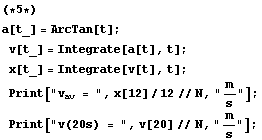
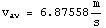
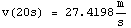
The average velocity of a particle is

where Δx is the displacement in the time interval Δt. The basic syntax of Integrate automatically assumes x[0]=0. Fractions are typed Ctrl-/.
In[74]:=
| Created by Mathematica (April 10, 2007) |  |