![(*1*)Clear[n, t, ϵ, β] ; ϵ = Table[i, {i, 0.1, 1, 0.1}] ; & ... Neb}]], {t, 0, 10}, PlotStyleTable[Hue[(i - 1)/Neb], {i, 1, Neb}], PlotRangeAll]](../HTMLFiles/ex07_solutions_2.gif)
Solutions
Here is demonstrated the effect of changing the growht factor ε.
In[1]:=
![[Graphics:../HTMLFiles/ex07_solutions_3.gif]](../HTMLFiles/ex07_solutions_3.gif)
Out[6]=

You can find a steady state solution by setting the right hand side of the equations to zero at time t=0:
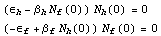
This can be solved for  (0) and
  (0) to obtain the stability conditions
 (0)=
(0)= and
and  (0)=
(0)=
Below is an example of a steady solution. A variation of the parameters leads to oscillatory behaviour. The function Unset can be used to clear variables which have super- or subscripts (regular Clear doesn't work).
In[21]:=
![(*2a*)deq1 = N_h '[t] (ϵ_h - β_hN_f[t]) N_h[t] ; deq2 = ... 4;All] Unset[ϵ_h] ; Unset[ϵ_f] ; Unset[β_h] ; Unset[β_f] ;](../HTMLFiles/ex07_solutions_12.gif)
![[Graphics:../HTMLFiles/ex07_solutions_13.gif]](../HTMLFiles/ex07_solutions_13.gif)
Out[25]=

Again the stable situation can be analytically discovered to be
 (0)=
(0)= , and
, and  (0)=
(0)= .
.
A stable solution could be obtained if one of the above would be zero, but that's not so interesting. Note also that for some values of the parameters stable situations are impossible (the initial sizes of the populations would have to assume negative values).
In[28]:=
![(*2b*)deq1 = N_s '[t] (ϵ_s - γ_sN_s[t] - β_sN_p[t]) N_s[t] ... 13;_p] ; Unset[β_s] ; Unset[β_p] ; Unset[γ_s] ; Unset[γ_p] ;](../HTMLFiles/ex07_solutions_19.gif)
![[Graphics:../HTMLFiles/ex07_solutions_20.gif]](../HTMLFiles/ex07_solutions_20.gif)
Out[32]=

| Created by Mathematica (April 10, 2007) |  |