Thesis in the Astronomy Unit
(Sivun lopussa suomenkielisiä aihekuvauksia - omat ehdotukset myös tervetulleita!)
- Room MA308
- jurgen.a.schmidt@oulu.fi
- phone: +358 (0) 504 318 047
Regulation of star formation and the mystery of a failed spiral galaxy (J. Janz):
In this project you will look at a peculiar galaxy (b) that is located far from other galaxies. This galaxy has a bright central part with similarities to a dwarf galaxy without star formation (a) or the inner part of bright spiral galaxies (d). However, the galaxy as a whole is very different from either, since it features a large faint disk with stars forming, which is just visible on the optical image, but evident at ultra-violet wavelengths (c). The question is: why? In order to answer this question you will learn about mining the wealth of data of the Sloan Digital Sky Survey and look for similar objects to identify common properties.
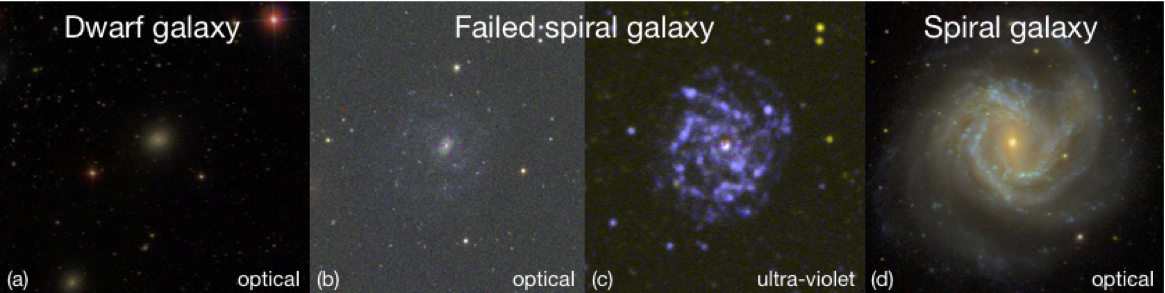
Failed Spiral Galaxy (IMAGES: SDSS and GALEX)
Diffuse Ionized Gas in Star-Forming Galaxies (A. Watkins):
Almost all star-forming galaxies contain large amounts of diffuse gas traceable by recombination lines (light emitted when electrons stripped off their host atoms by energetic photons recombine with said atoms), alternately known as 'diffuse ionized gas' (DIG) or the 'warm ionized medium' (WIM). While the discovery of this gas dates back almost half a century, the source of the ionization energy remains mysterious. This project would involve making a summary of the current state of research on DIG, with a possible extra project to make a comparative study of the DIG fractions (the fraction of ionized gas in a galaxy found in DIG vs. that found in compact star forming regions) in two interacting systems --- M51 and M101 --- using the deepest available narrowband imaging of these two galaxies.
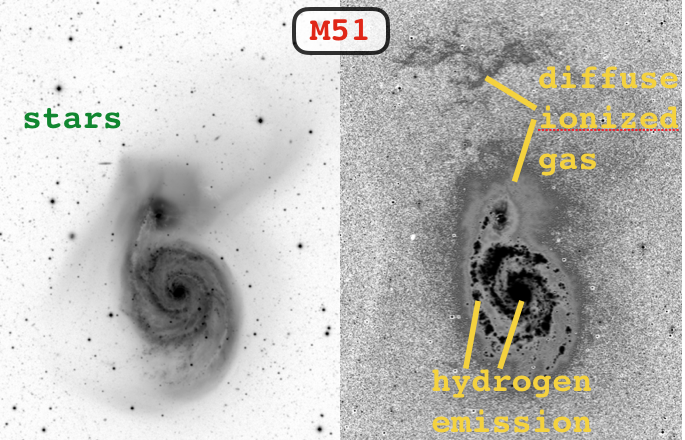
Left: Optical image of galaxy M51. Right: Distribution of diffuse ionized gas and hydrogen. (IMAGES: BST and A. Watkins)
Stellar cannibalism transforms normal stars into brown dwarfs. How does it happen? (V. Neustroev):
Interacting binary stars known as Cataclysmic variables (CVs) consist of a white dwarf as primary and a low-mass star as secondary component. According to standard evolutionary theory, CVs evolve from longer to shorter orbital periods until a minimum period is reached (Pmin~76 min). The properties of the secondary star here are expected to change dramatically. The previously normal donor star becomes of a substellar mass and partially degenerate, resulting in a kind of a brown-dwarf-like object. I have recently initiated a new project to systematically search for such objects by means of photometric and spectroscopic observations. I have already obtained a significant amount of data and more observations will be collected soon. I invite students to help me to analyze these data, using statistical and other methods. Subtopics of the project can be formulated for both Bachelor and Master levels.