“Each of the reduction methods we study has its own role in reducing emissions from the steel industry” - Meet Professor Timo Fabritius
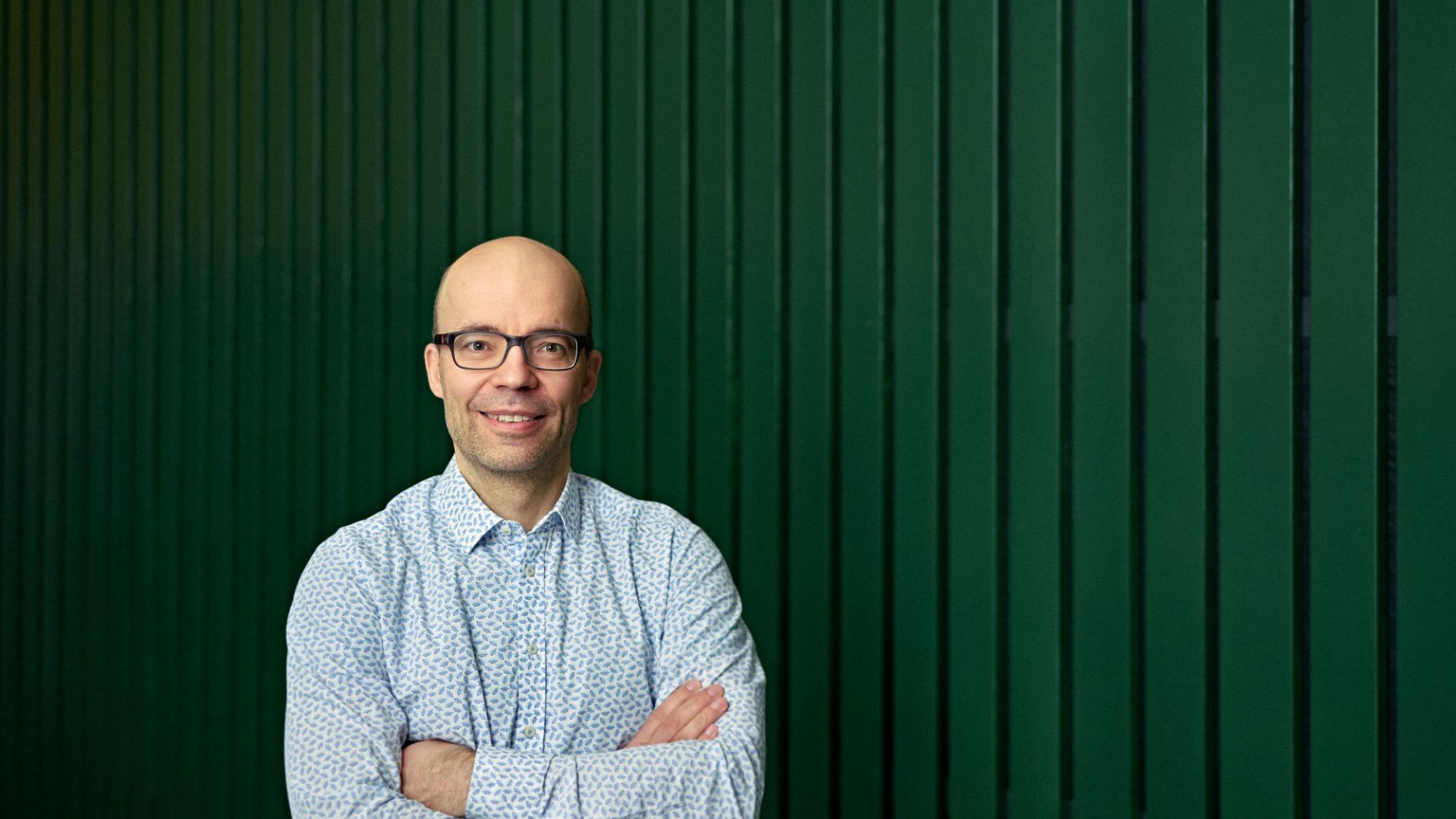
When Timo Fabritius, Deputy Director of the H2FUTURE research programme, began studying process engineering at the University of Oulu in autumn 1992, process metallurgy was a new field of study at the university. Teaching had started the previous year in response to the needs of industry: companies in the sector needed engineering graduates for their plants in places such as Raahe and Tornio. What appealed to Fabritius about metal production was its tangible nature: he could clearly see what was being done in practice.
His studies progressed quickly, and he found a master’s thesis project through a collaboration between the university and Outokumpu. At a research centre in Pori, Fabritius used physical modelling to study flows in a converter used in stainless steel production. He joined the university as a researcher in 1996.
“I had thought I would go into industry, but in the end, I never did,” Fabritius says.
Over time, the need for new innovations in process metallurgy to reduce emissions has proved substantial: the steel industry accounts for around eight per cent of all emissions globally. The close-knit international community has also been an important reason why Fabritius has enjoyed staying in the field. Although process metallurgy has an enormous impact, the research field itself is relatively small.
“Ultimately, ours is quite a small research field, and almost all the researchers know one another.”
The process metallurgy research community has become international – hydrogen drives research forward
During Fabritius’s career, the Process Metallurgy research community at the University of Oulu has grown from fewer than 20 people to more than 50. At the same time, its activities have become increasingly international. According to Fabritius, measured by the scale of its research activities, Process Metallurgy at the University of Oulu is now among the three largest in Europe. At the time of the interview, the unit was involved in more than ten EU-funded projects.
In the 2020s, the focus of the research has increasingly shifted towards hydrogen and its applications. Fabritius sees the metallurgical industry as a potentially major user of hydrogen, particularly in processes where carbon is otherwise difficult to replace.
According to Fabritius, the H2FUTURE programme has played an important role in this development. The recruitment of a new professor through the programme has created connections with suppliers of the high-quality iron-bearing raw materials needed for the research. The programme has also increased the visibility of the research and strengthened the unit’s ability to secure EU funding. The initially rather undefined expectations surrounding hydrogen have gradually given way to a clearer understanding of its potential uses, including on an industrial scale.
Fabritius remembers when hydrogen first began to gain prominence in discussions, while potential partners, technological alternatives and the scale of future activities were still unclear.
“It felt like this was going to be a big thing, but we didn’t really know how, with whom or just how big.”
Transforming the steel industry will take more than one approach
In hydrogen reduction, hydrogen is used to reduce iron oxide to metallic iron. At the University of Oulu, researchers study both hydrogen reduction in shaft furnaces and hydrogen plasma reduction. The former examines, among other things, how pellets made from iron-bearing raw materials behave under changing conditions inside the furnace. The latter could potentially enable the use of lower-grade materials and industrial side streams.
Fabritius does not see the different methods as direct substitutes for one another. The most suitable solution depends on the raw materials, the price and availability of electricity, and the plant’s existing processes and the side streams they generate.
“A technology that remains small on a global scale may be the best option for a particular application. I think we need all of these methods. Each has its own role.”
Alongside new technologies, Fabritius believes that research should also look at ways of reducing emissions from existing blast furnaces, for example by using hydrogen-rich gases. He expects blast furnaces to still be operating around the world twenty years from now. As an experienced researcher, he is cautious about expectations that emissions from steelmaking could be brought close to zero within that time. In his view, even halving emissions would be a good achievement.
Iron could also be used to store energy
One of the research directions that currently interests Fabritius combines hydrogen reduction with energy storage. The idea is to produce hydrogen and reduce iron when renewable electricity is available. At a later stage, oxidation of iron with steam could be used to release the stored energy. In this way, electrical energy could be stored in chemical form with the help of hydrogen.
Another area of interest is the potential of Finnish iron-bearing raw materials and mining side streams for steelmaking. Fabritius also sees opportunities related to security of supply in using these resources. Finding solutions to these research questions could connect industry’s need for raw materials with broader societal needs.
“There’s no need to stand on your head” – don’t make a difficult situation even harder
When asked about the highlights of his career, Fabritius finds it difficult to single out an individual achievement of his own. Instead, he thinks of major research funding secured through joint efforts and of seeing the doctoral researchers he has supervised complete their theses, sometimes after challenging stages along the way. For him, advancing research is above all a collective effort.
When faced with difficult situations, Fabritius is known to say: “There’s no need to stand on your head.” The idea is not to make something that is already difficult even harder yourself. This is also a message he would like to pass on to younger researchers: to be a little kinder to themselves and patient when things do not immediately move forward.
Fabritius also emphasises the importance of taking a long-term view when planning research. There should be time to consider what is worth pursuing and how new research can build on existing expertise. The direction can change, but research activities should not be driven solely by whatever funding calls happen to be open at the time.
“There will always be a place for chance and luck, of course, but if you try to do things as wisely as possible in the long run, things usually work out.”
Professor Timo Fabritius | At a glance
Role: Professor of Process Metallurgy and Head of the Process Metallurgy Research Unit; Deputy Director of the H2FUTURE research programme, University of Oulu.
Research field: Iron- and steelmaking processes, with particular expertise in heat and mass transfer phenomena, thermodynamics, chemical equilibrium and reaction kinetics in high-temperature processes.
Research career: Fabritius completed his doctorate in 2004 and was appointed professor in 2010. Since then, he has also headed the research unit. More than 200 scientific articles and 150 conference publications. Has supervised around 120 master’s theses and 29 doctoral theses. Has served as principal investigator in ten EU projects, several national projects and eight large national research programmes.
Outside research: To unwind from work, Fabritius reads crime fiction as well as non-fiction and history books, goes running and spends time at his summer cottage. Above all, he values time spent with his family.
You might be interested
A new research project led by the University of Oulu and SSAB will develop the entire steel production chain.