Oulu student team reaches final of EuMW Student Design Competition
This year’s task, titled “The GaN Challenge: mastering OFDM radar under real PA nonlinearities”, asked teams to work with real measured data from a gallium nitride (GaN) power amplifier. Modern radar systems, and systems that combine radar sensing with wireless communication, increasingly use wideband signals based on orthogonal frequency-division multiplexing (OFDM), the same family of waveforms used in 5G and Wi-Fi. Real amplifiers distort these signals in ways that standard radar detection filters can’t correct. The teams had to design a single adaptive filter that compensates for the distortion across a range of bandwidths and operating conditions, and show that it works on measured data rather than only in simulation. A technical committee selected the finalists based on the rigour of their approach, their choice of performance measures, and how much they improved receiver performance on the experimental data. The winning team receives €1,000 from Emerson, and the challenge is supported by researchers from Vrije Universiteit Brussel, Cranfield University, the University of Strathclyde and Emerson.
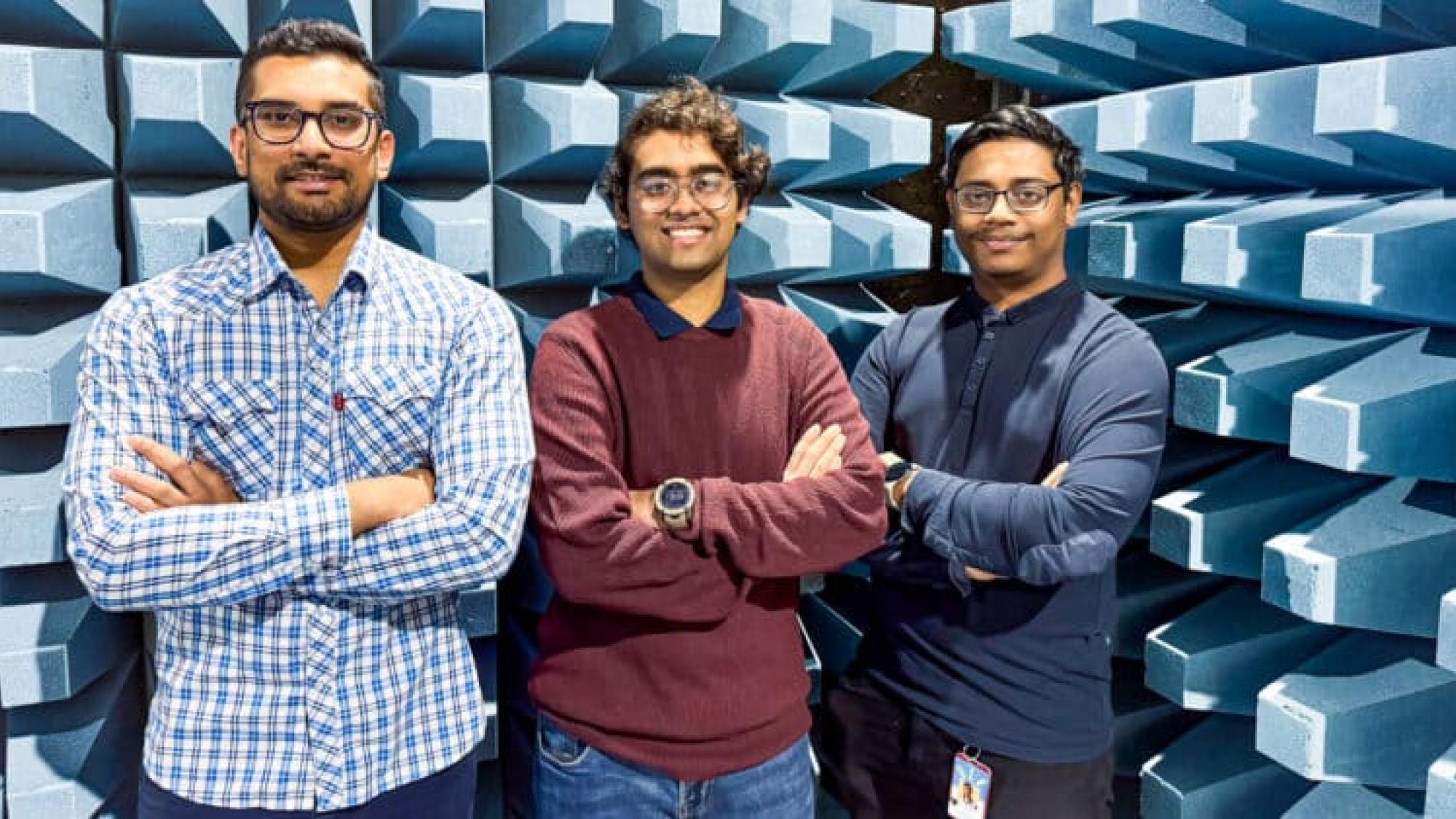
The team brings together Dimuthu Lesthuruge, a final-year doctoral candidate in communications engineering, and Aprotim Paul and Ahmed Jabir Zuhayr, both first-year master’s students in wireless communications engineering specialising in radio engineering. Between them, their backgrounds cover radio engineering, power-amplifier modelling, radio-frequency (RF) linearisation, AI-assisted digital predistortion, and baseband signal processing, which is the mix the task calls for.
It’s not Paul’s first recognition this year. In January he was part of a group, including Nuutti Tervo, an assistant professor at CWC, that won the Joint Best Demo Paper Award at the IEEE International Symposium on Joint Communications & Sensing (JC&S 2026) in Ponte di Legno, Italy, for a demonstration of a D-band system that combines wireless communication with environmental sensing over a single sub-terahertz radio link. The EuMW challenge poses a different kind of technical problem, centred on radar signal processing rather than sensing hardware.
The team will learn whether it has won the competition when it presents its solution in London in October.