Design Creativity
The Design Creativity (DC) team focuses on understanding, supporting and empowering fundamental human capabilities and behavioral traits in the creative design of interactive artifacts and environments.
Research group information
Contact information
Research group leader
Research group description
The Design Creativity (DC) team focuses on understanding, supporting and empowering fundamental human capabilities and behavioral traits in the creative design of interactive artifacts and environments.
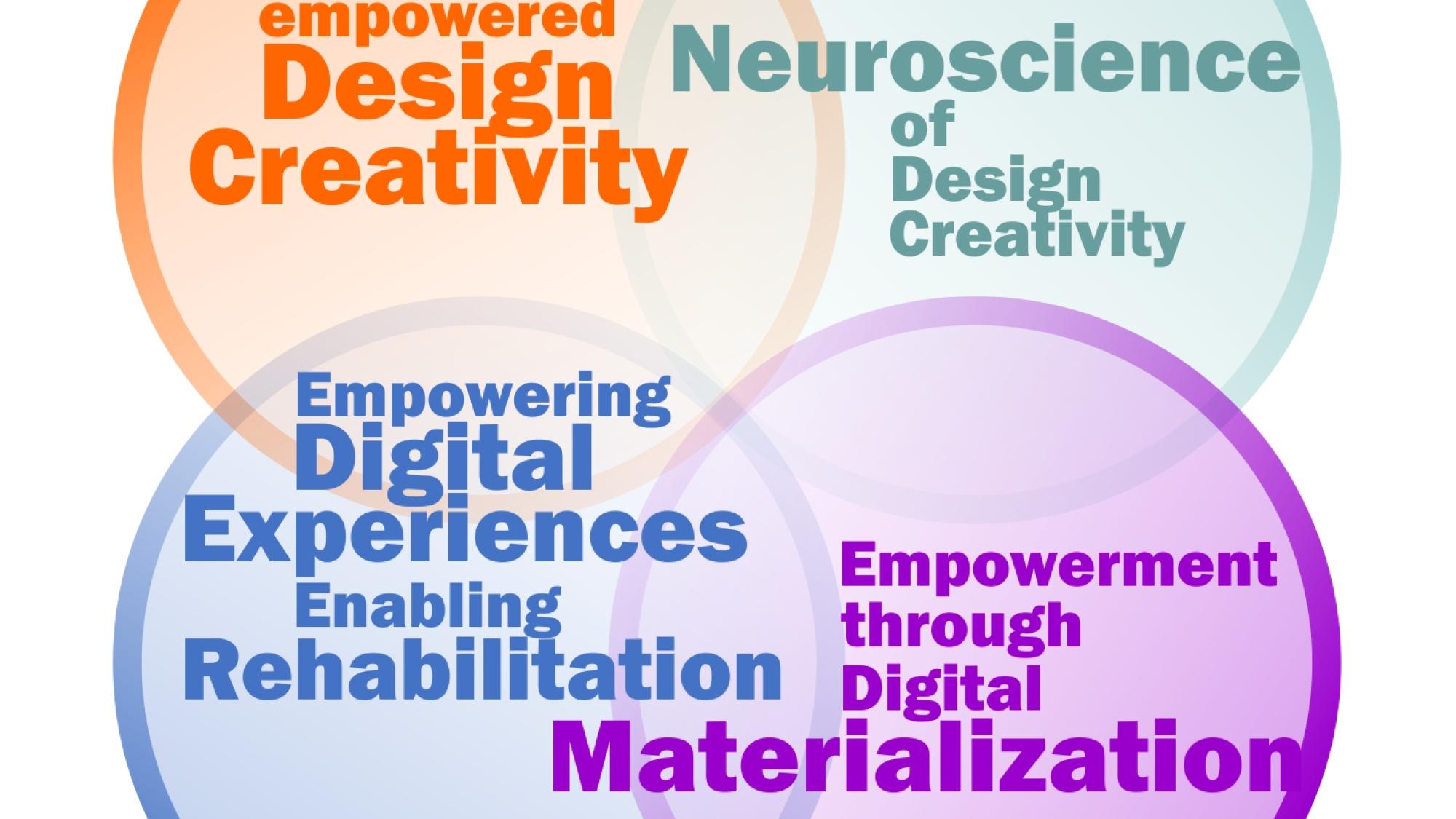
The DC team's research addresses five main research dimensions:
- The human-AI creative collaboration dimension explores the utilization of generative AI as tools or means to enhance novelty, practicality, and surprise at the early stages of design.
- The empathic and cognitive design innovation research dimension concerns ideation (idea generation), an essential and undervalued aspect in today’s highly technological society. Ideation is the first step leading to creativity and innovation, critical to the success of digital solutions, artefacts, products, services, and systems.
- The rehabilitation technology and healthcare innovation research dimension explores the support of experiences of patients, designers of healthcare technology, healthcare providers, and other stakeholders in digital technology-enabled rehabilitation and activities of daily living (ADLs). The dimension encompasses a range of cognitive and/or physical conditions, such as post-stroke recovery, which pose an increased challenge for contemporary society.
- The neurocognition of design creativity research seeks to link ideation's neurocognitive bases with design education, cognition, and collaborative design practices. Particular interest is in instructional practices and enhancing performance in the design process.
- The technology-enhanced learning and digital fabrication (digital materialization) research dimension concerns sustainability, performance, quantification, and trans-disciplinary integration of all stakeholders (other backgrounds, schoolers, local businesses/communities) in materializing and prototyping utilizing makerspaces.
Currently, DC team s responsible for identification and development of educational competences for wearables for rehabilitation in the EDUWEAR Erasmus+ KA Action project. Previously, in the PRIME-VR2 project funded by H2020 the DC group was responsible for the design and digital fabrication of controllers for VR-based rehabilitation.