Decoding health and disease
The purpose of this blog is to present, discuss and share knowledge on topics related to population health and medical research. Blog posts are written mainly by researchers from the Faculty of Medicine.
What is a Polygenic Risk Score?
In our previous blog post we discussed how a single genetic variant can sometimes lead to major changes in an individual's characteristics and cause disease. In most cases, however, disease susceptibility is influenced by a large number of genetic variants located throughout the genome. As a result, examining a single gene or genomic region rarely provides a reliable estimate of an individual's overall disease risk.
A method known as a genome-wide association study (GWAS) can be used to identify disease-associated genetic variants. For example, in a previous blog post we explored the genetic basis of lumbar disc herniation by examining the relationship between millions of DNA variants and disease susceptibility. GWAS studies provide a comprehensive overview of the genetic factors contributing to disease risk, but they also generate the information needed for downstream analyses that can estimate an individual's inherited predisposition to disease.
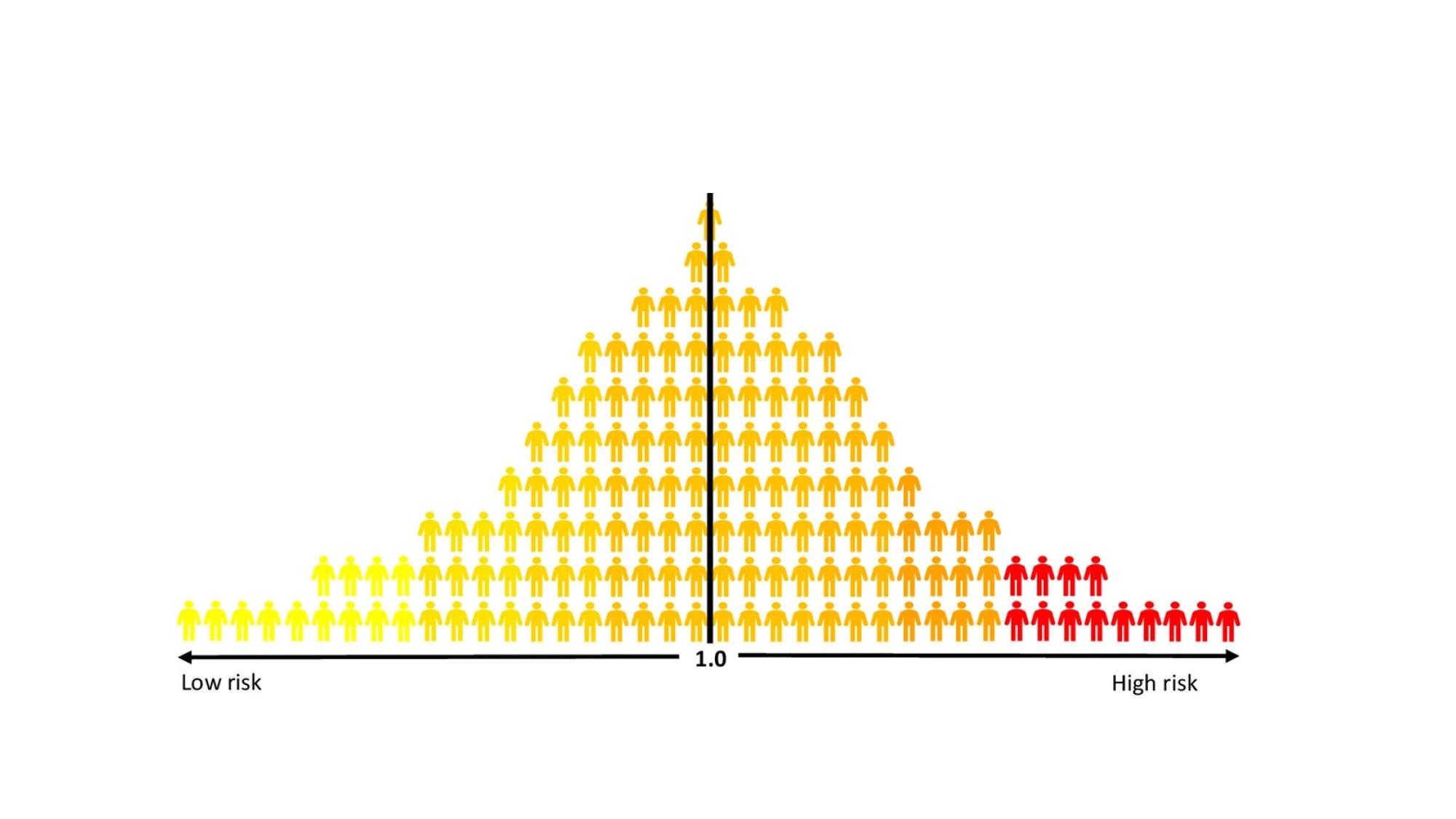
The basic principle of a polygenic risk score (PRS) is straightforward. A PRS is a single numerical value calculated by combining all genetic variants in an individual that have been associated with a particular disease in previous GWAS studies. Each variant is weighted according to the strength of its association with disease risk.
For example, a Finnish study utilizing data from the FinnGen project calculated polygenic risk scores for several cardiovascular and metabolic diseases. Individuals whose coronary artery disease PRS belonged to the top 2.5 percent of the population had approximately twice the disease risk of the general population. For prostate cancer, individuals in the top 2.5 percent had approximately a fourfold increase in risk.
PRS as a tool for disease prediction
One of the clearest applications of PRS is disease prevention. Individuals identified as having a particularly high genetic risk might benefit from more intensive monitoring or preventive interventions.
At the same time, it is important to recognize that even when a PRS indicates a substantially elevated relative risk, the absolute risk of disease still depends on factors such as age, sex, and lifestyle. In the FinnGen study mentioned above, lifestyle factors had a greater impact on disease risk than the currently measurable genetic predisposition.
A well-known example of a preventive risk assessment tool in Finland is the FINRISKI calculator, which estimates an individual's risk of suffering a heart attack or stroke within the next ten years based on personal health information. Incorporating a polygenic risk score into such prediction models may further improve their predictive accuracy.
Polygenic risk scores can also complement traditional genetic testing approaches that focus on individual disease-causing variants. In addition, PRS may prove useful in identifying disease subtypes, selecting the most effective treatments, and predicting the risk of related diseases. In the Finnish GeneRISK study, awareness of elevated genetic risk was also found to encourage positive lifestyle changes.
The performance of a polygenic risk score depends directly on the statistical power of the GWAS studies used to develop it, which largely reflects the sample sizes available for those studies. For rare diseases, sufficient statistical power may not yet exist to develop an accurate and reliable PRS.
Most GWAS studies have been conducted in populations of European ancestry, meaning that the resulting scores often do not transfer equally well to other populations. Furthermore, interpreting PRS results requires expertise from healthcare professionals as well as integration into clinical information systems.
Available from your nearest genetics clinic?
Many international companies already offer PRS services for consumers that provide customers with personalized risk estimates for a wide range of diseases. Some individuals may find such information useful, particularly if they can interpret the results appropriately and use them as motivation for healthier lifestyle choices. On the other hand, these reports are often incomplete. They may focus primarily on genetic predisposition while overlooking important clinical risk factors and environmental influences. In many cases, professional guidance is needed to interpret the results properly. It is important to remember that while polygenic risk scores offer many opportunities at the population level, such as improving disease prediction models, their practical significance for any individual remains relatively limited.
Despite the challenges associated with their implementation, polygenic risk scores may become part of routine clinical practice in the future. Rather than replacing existing methods based on clinical risk factors and laboratory measurements, polygenic risk scores should be viewed as a new type of laboratory measurement that can provide valuable additional information. They have the potential to improve risk assessment and support more personalized healthcare.
Author:
Jaakko Tyrmi
The purpose of this blog is to present, discuss and share knowledge on topics related to population health and medical research. Blog posts are written mainly by researchers from the Faculty of Medicine.