Decoding health and disease
The purpose of this blog is to present, discuss and share knowledge on topics related to population health and medical research. Blog posts are written mainly by researchers from the Faculty of Medicine.
The research questions in population health research are often related to causality: Does high blood pressure levels affect the risk of stroke? Or Does chronic inflammation have an impact on heart disease risk?
A simple comparison of ”exposed” (such as those with high blood pressure levels) and “non-exposed” (those with normal blood pressure levels) individuals in the study population is not a good idea, because confounding and other research biases make this comparison unreliable.
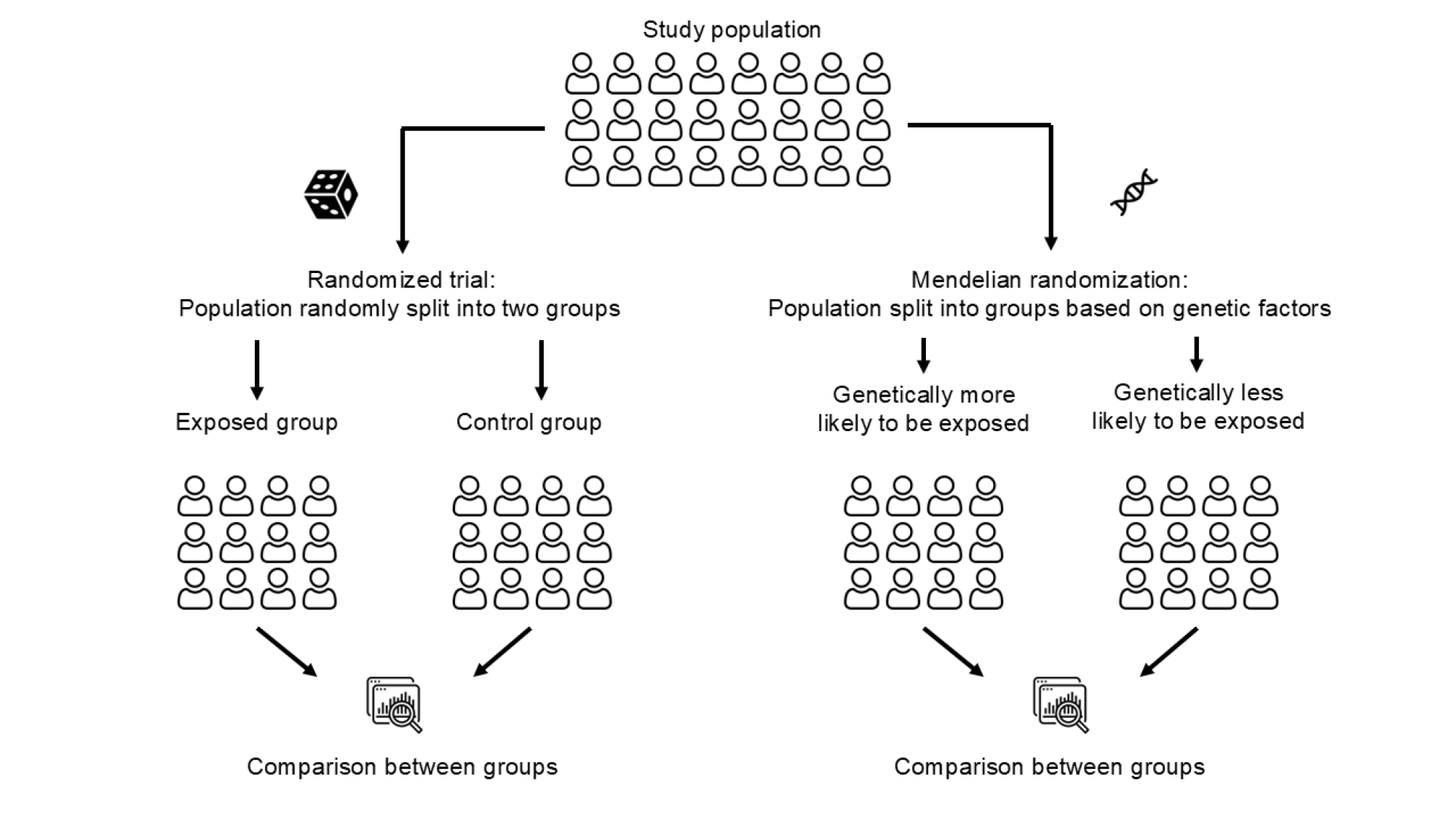
The best tool to assess causality is a well-conducted randomized trial, where the study population is randomly divided into exposed and control (non-exposed) groups. In this case, a statistical comparison at a group level can provide high-quality information on the potential causality.
However, it should be obvious that randomization is not always feasible – in the blood pressure example, it is impossible to randomize individuals into a high blood pressure group and a control group. In these cases, researchers have to rely on different statistical methods to get around the issue of confounding. One of these methods is Mendelian randomization.
Mendelian randomization is a quasi-randomization method, which is based on Mendel’s Laws in genetics. Gregor Mendel (1822–1884) was an Augustinian friar who lived in the area of modern-day Czechia, and conducted famous hereditary studies using pea plants. The conclusions of his results have been later confirmed on a molecular level.
Humans have two copies of each gene, and the offspring will inherit one allele (a specific form of a gene) from each of their parents. Because genes affect different human characteristics – such as blood pressure levels – different alleles explain part of the variation in the characteristics within a population. According to Mendel’s Laws, the allele inherited by the offspring from each parent is determined randomly and independently of environmental factors or other characteristics. The random and independent inheritance is the key idea in Mendelian randomization.
If there are one or more genetic factors that can be linked to the exposure (such as high blood pressure levels), these genetic factors can be used to create a quasi-randomized study setting.
This setting can be viewed as an analogy to a randomized trial: while the latter relies on randomly allocating the population into exposed and control groups, in Mendelian randomization the allocation is to those who are “genetically more likely to be exposed” and “genetically less likely to be exposed” (Figure). Information on the genetic factors that are linked to different exposures can be obtained from genome-wide association studies, which have been previously discussed in our blog.
Mendelian randomization is an established method in health sciences, and its popularity has grown as the understanding of genetic factors and their effects on health and disease have improved. The results from Mendelian randomization have given evidence that “bad” LDL-cholesterol increases the risk of heart disease. As another example, a Mendelian randomization study suggested that tocilizumab – a drug originally used for treating rheumatoid arthritis – was linked with reduced risk of severe COVID-19. This finding was confirmed in other study designs, and the drug has been now licensed to also treat COVID-19 patients.
How about the effect of high blood pressure on stroke risk, or the effect of chronic inflammation on heart disease risk? For both of these study questions, the results from Mendelian randomization have suggested an affirmative answer.
It is important to remember that Mendelian randomization is but one method among others, and has its own limitations. The main limitation is pleiotropy, which is the direct effect of a genetic factor on multiple characteristics. Additionally, Mendelian randomization cannot be used to assess the effects of various non-biological phenomena, such as air pollution or climate change.
To paraphrase an old saying, every statistical method is a good servant, but a bad master – definitive answers to causal questions cannot be obtained by only looking at the numbers or by using a specific method. In Mendelian randomization, it is essential to understand the exposure and the outcome of interest and their biology. All things considered, if correctly used, Mendelian randomization is an excellent tool in a health researcher’s toolbox.
Author: Ville Karhunen
The purpose of this blog is to present, discuss and share knowledge on topics related to population health and medical research. Blog posts are written mainly by researchers from the Faculty of Medicine.