
Ambivalences of Global Resilience: Attention to Marginalization and Global Injustice through Critical Human Rights Education

The FRONT research progarmme´s interdisciplinary approach to global resilience got me to think about the various approaches that intersect with resilience – societal, educational, ecological, psychological, and economic. As a researcher drawing on critical social sciences, I approach the concept of resilience from an ambivalent perspective, writes Dr. Tuija Kasa, Postdoctoral Researcher at the University of Helsinki.
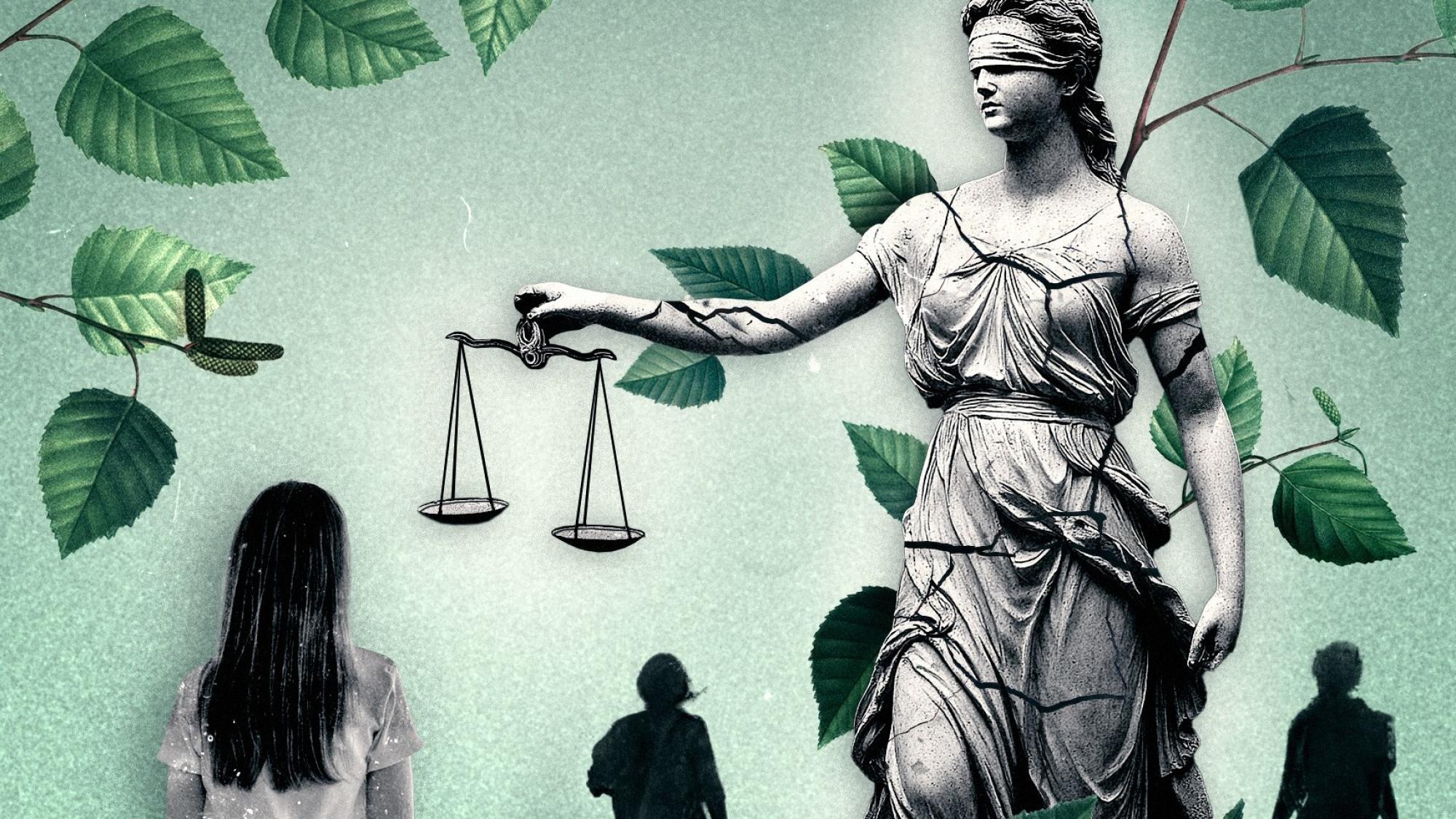
Crumbling Themis and children around. Cover picture of Tuija Kasa’s PhD Unveiling Injustices: Revisiting Human Rights Education’s Legal, Political and Moral Ideals in a Nonideal World. Picture credit: Tuomo Parikka.

I had the opportunity to visit the Frontiers of Global and Arctic Resilience (FRONT) program at the end of 2025 for two weeks, hosted by Professor Elina Lehtomäki and Postdoctoral Researcher Oona Piipponen. During this time, I familiarized myself especially with the socio-ecological approaches to global resilience and had interesting discussions with staff and students at the University of Oulu. The interdisciplinary approach to global resilience got me to think about the various approaches that intersect with resilience – societal, educational, ecological, psychological, and economic. As a researcher drawing on critical social sciences, I approach the concept of resilience from an ambivalent perspective. In this blog, I will illustrate this ambivalence to uphold critical discussion as well as unfold possibilities of inter- and transdisciplinary discussion on global resilience.

Northern Lights in green color on the sky in Rovaniemi rural area
Northern lights during the Finnish Educational Research Association Conference Rovaniemi visit in November 2025 (credit: Henri Kulmala).

Interdisciplinary human rights (education) and attention to inequality: Eroding human rights

Human rights are a phenomenon that require interdisciplinary approach; they involve law, politics, and morality. In my research, I have been especially interested in the promise of education in the process of realising human rights. We are currently living in an era in which human rights are being attacked and criticised from various perspectives. Many have described disillusionment after the optimistic era of the 1990s. The increasing human rights law and commitments made by states have not managed to dismantle global inequalities.

However, we tend to overlook progress or take issues such as human rights for granted when they realise. The lack of human rights education leads to a situation where people are not always aware of all the progress nor the persistent problems. Furthermore, rising authoritarianism, nationalism, and threats to democracies have resulted in serious setbacks of rights.

Minorities and women’s rights have taken steps backward. I utilised an interdisciplinary approach in my PhD to human rights education where I drew on educational sciences, human rights law, and moral philosophy. I have been interested in drawing on critical and feminist perspectives to center especially inequalities and marginalisation that our systems produce. Persistent inequalities are produced in education and society, and in my view, unveiling these inequalities and injustice can help us to enhance a more just society.

Ambivalence of global resilience: critique and necessity amid global crises

This position creates the ambivalence of resilience: on the other hand, many critical social scientists have underlined the problematic neoliberal tendency to promote resilience of subjects amid challenges. The problem is that societal and global problems are often attributed to the responsibility of an individual to improve themselves. This can be cruel. It turns the broad problems toward individuals, who are required to be more resilient and endlessly flexible, without paying enough attention to the structural problems that cause the problems in the first place. This is especially suitable for capitalistic logic. Furthermore, an enormous inequality issue is that typically marginalised and minoritised groups and individuals are burdened with the requirements of resilience. Thus, requirements to be resilient are not equal. Thus, we need to be critical of the endless requirements of individual resilience in societies.

Simultaneously, because of our collective failure to address the threats of climate change appropriately, we are heading to an era where resilience – societal, ecological, and individual are already and will be increasingly required. Many scientists have said that we need to move from prevention to adaptation. In this adjustment phase, we will need to confront crises.

The Finnish Human Rights Centre published a report in 2023 on human rights foresight, resilience and preparedness, which offers several human rights scenarios for the future; Do we want to proceed toward a world of climate emergency, accelerated competition, or cooperation? We will need collective responsibility and action to meet the increasing climate migration, people losing their livelihoods, and to deal with the irreversible losses and grief of environmental destruction. In this sense, taking resilience seriously is a realistic necessity.

Moreover, specifically, global resilience is crucial here. If we talk about global resilience, we will need to talk about global responsibility and abilities to strive for shared political goals beyond our differences. The original idea of human rights has been to protect the oppressed from the unbound use of power. This core idea is something that needs to be always invented anew. Despite its shortcomings, the human rights system is a crucial part of global resilience in the sense that it already forms an existing institutional system of protection. Here, human rights education has a lot to offer.

Forefronts of climate action, resistance, and socio-ecological intertwining: Activism and Indigenous perspectives

During my visit, I listened to interesting presentations on resilience and sustainable tourism, language inclusion, and Indigenous perspectives. Ecological damage and civil disobedience were discussed in the movie night of the FRONT programme, where we watched Kapina elämän puolesta [Resistance for life] document. It follows Extinction Rebellion (Elokapina) members. It illustrates how activists put themselves, their bodies on the frontline of potential harassment and rage. The pressing message is ”we don’t want to be here, we are doing this for all of us” to secure a liveable environment. The document illustrates the socio-ecological intertwining of efforts for a sustainable future. If activists' right to demonstrate is suppressed, it has serious consequences for democracy, citizens and a sustainable future. If regular means of influencing the policies become useless, civil disobedience becomes necessary.

Furthermore, a central issue to address concerning global and climate justice is Indigenous rights and perspectives across the world. I had a great opportunity to visit the Giellagas Institute’s Veli-Pekka Lehtola’s excellent history lecture on Saami culture, history, and activism. One critical human rights issue in Finland is enhancing a broader understanding of Saami culture, and this is an important and often overlooked educational task. It is also a central recommendation in the recent Truth and Reconciliation Process report.

Practical pedagogical materials for teachers are available in Oktavuohta.com website. Also, one education package was produced in cooperation with the Sámi Parliament of Finland, the Human Rights Centre, and the University of Helsinki, which addresses topics like self-determination, climate change, language and cultural rights, and support for teachers. For Finnish readers, I recommend Lehtola’s novel book Kenen maa, kenen ääni? Saamelaisten ja suomalaisten suhteet esihistoriasta nykypäivään [Whose land, whose voice? Relations between the Saami and Finns from prehistory to the present day].

Potential of education to enhance global social justice

Human rights education is part of global education and intersects with global and social justice. Instead of being only a hypothetical ideal, human rights are a real part of societal structures included in national and international law. They are already part of several institutions. To fully realise their potential, there is an urgent need for human rights education.

In my PhD, I illustrated how human rights education has not been carried out systematically in teacher education in Finland, nor in several international comparisons. Especially in our time, the connections between human rights, sustainability and climate change need to be highlighted; climate justice will require human rights considerations. Also, the criticisms of human rights (education) need to be taken seriously to evolve it in a direction that truly considers inequalities, marginalisation and our interconnectedness with the more-than-human and environment properly. In this, critical social science can help. Involving teachers, children, youth, and students in the process is important.

Shifting attention to marginalisation and inequality is an endless process in our nonideal world. When power is used and institutions are formed, they produce hidden inequalities. Here, education has an important role in enhancing societal critical imagination and attention. Critical human rights education is a way that can help in enhancing political and moral imagination that addresses inequalities, which is the theme of my postdoctoral research.

At the end of my visit, we organized a symposium on Global Social Justice and Resilience in the Finnish Educational Research Association’s 2025 conference in Rovaniemi. Oona Piipponen chaired the discussion. Joffy Connolly, Oona Piipponen, and I gave presentations, and Elina Lehtomäki responded to our presentations. We addressed the perspectives of global justice from decolonial, human rights, and school community and leadership perspectives. In our discussion, all the perspectives intersect in various ways.

We concluded that now is the critical moment to rethink and prioritise issues in education for us to confront the pressing inequalities and sustainability problems. We also organised a Global Education Research in Finland yearly meeting with new participants and reflected on the future of global education research in Finland with new ideas to enhance cooperation. Organising for shared goals gives hope amid dark times. I wish we choose to strive toward a world of cooperation instead of a climate emergency and accelerated competition.

Fiurther reading:

Kasa, T. (2025). Unveiling Injustices: Revisiting Human Rights Education’s Legal, Political and Moral Idealsin a Nonideal World. [Doctoral Thesis, University of Helsinki]. University of Helsinki.

Writer of this blog is Dr. Tuija Kasa, a Postdoctoral Researcher at the University of Helsinki. Her postdoctoral research addresses enhancing imagination through sustainability, moral and human rights education. Currently, she does research on arts and sustainability education in the Art of Knowing project and how to address pressing sustainability and human rights problems in education.

Created 9.3.2026 | Updated 9.3.2026