Rethinking Arctic resilience through community and indigenous knowledge

In Arctic communities, resilience is often framed as the ability to respond to crises and adapt to rapid change. Yet for many Indigenous and local communities, resilience is not about survival – it is about sustaining relationships, languages, cultures, and ways of life. Resilience is not a neutral concept; it raises critical questions: resilience for whom, and on whose terms? This blog post dives into these questions, written Pigga Keskitalo, Professor in Arctic perspectives in education and Leader of the Arctic Change and Adaptation Research Community, from University of Lapland.
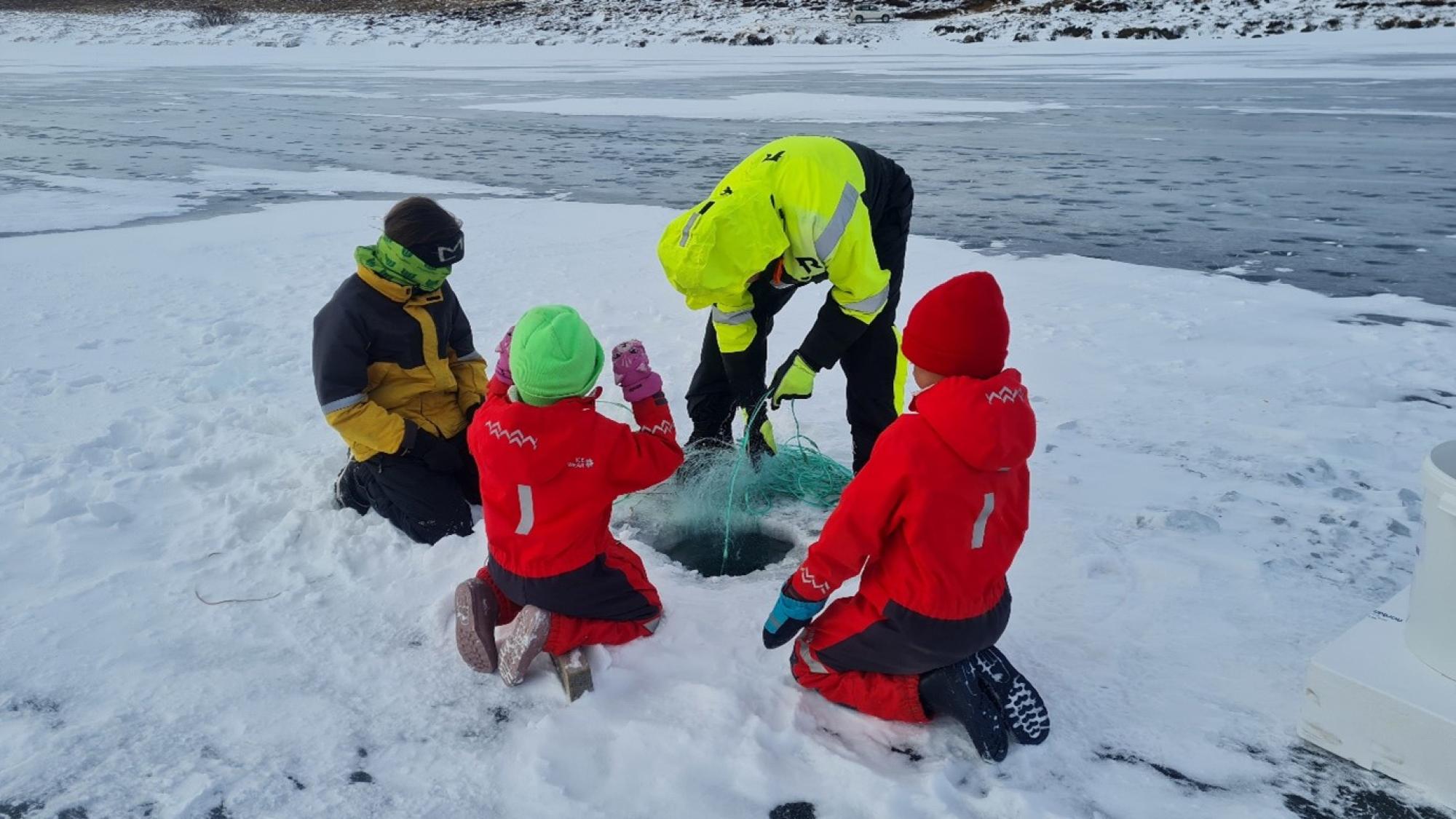
People on the ice of a river ice hole fishing.
Photo: Interreg NPA CAP-SHARE, Cécile Chauvat

In discussions with Arctic communities and youth, one recurring concern has been that resilience is too often framed through external policy perspectives rather than through locally grounded realities and priorities.

In my recent work within the CAP-SHARE project, I argue that resilience in the Arctic must be rethought through capacity sharing—a collaborative and relational approach that brings together communities, youth, scientists, and policymakers. In practice, this may mean workshops where youth, elders, researchers, and policymakers work together to identify locally meaningful responses to environmental change.

Beyond adaptation: the need for relational resilience

Traditionally, resilience has been understood as the ability to adapt to change or recover from disturbance. While this ecological perspective has been useful, it can also unintentionally place the burden of adaptation on communities—especially Indigenous communities—who are already facing structural inequalities.

In Arctic contexts, resilience must instead be understood as relational and grounded in lived realities. Indigenous perspectives emphasise connections between people, land, language, and culture. Resilience is not only about coping with change but about sustaining cultural continuity, strengthening community ties, and enabling self-determination.

I have observed that discussions on resilience often become too narrowly focused on adaptation measures, while questions of cultural continuity, language, and belonging receive less attention.

Capacity sharing as a foundation for change

The CAP-SHARE project responds to a growing challenge: the disconnection between communities, scientists, and policymakers. This gap limits effective responses to biodiversity loss and climate change. Capacity sharing offers a way forward by focusing on mutual learning, dialogue, and co-creation.

Rather than transferring knowledge in one direction, capacity sharing recognises that all actors bring valuable knowledge. Local and Indigenous knowledge systems, scientific expertise, and policy perspectives must be brought into meaningful interaction. This requires building trust, creating inclusive spaces, and ensuring equitable participation.

The role of youth: from participation to influence

A key focus of our work has been the role of young people. Despite being directly affected by environmental and societal changes, youth are often excluded from decision-making processes. This is particularly evident in biodiversity governance.

Engaging youth is not only a matter of inclusion—it is essential for sustainable futures. Participation strengthens young people’s sense of belonging, builds skills and networks, and supports community development. Importantly, youth engagement must go beyond symbolic participation. It should enable real influence, from local initiatives to policy processes.

In discussions with Arctic youth, many have expressed a strong desire not only to be heard, but to participate meaningfully in shaping the futures of their communities.

In our workshops and collaborations across Arctic regions, we have seen how youth bring new perspectives, challenge established assumptions, and contribute to innovative solutions. When combined with intergenerational dialogue—bringing together youth and elders—this creates powerful opportunities for knowledge continuity and renewal.

Indigenous knowledge and decolonising resilience

Another critical dimension is the recognition of Indigenous knowledge. Sámi and other Indigenous ways of understanding land, water, and community offer alternative approaches to resilience and sustainability. These perspectives challenge dominant, often technocratic frameworks and highlight the importance of relational, place-based knowledge.

One recurring concern in Arctic collaboration is that Indigenous knowledge is sometimes acknowledged rhetorically, while Indigenous communities remain excluded from actual decision-making processes.

At the same time, working with Indigenous knowledge requires careful attention to ethics and power relations. It involves recognising historical injustices and ongoing colonial structures in research and governance. Capacity sharing must therefore be grounded in respect, responsibility, and genuine collaboration.

Towards shared Arctic futures

What, then, does resilience mean in the Arctic today? It is not simply the ability to adapt. It is about creating conditions for communities to thrive on their own terms. It is about strengthening relationships—between people, generations, knowledge systems, and environments.

Capacity sharing provides a practical and ethical framework for this work. By fostering collaboration, supporting youth engagement, and recognising Indigenous knowledge, we can move towards more inclusive and sustainable Arctic futures.

Ultimately, resilience is not something that can be imposed from outside. It must be co-created—rooted in local contexts, shaped by diverse voices, and guided by a shared commitment to justice and sustainability.

Further reading:
About Building Bridges of Shared Capacity between Scientists, Policymakers, and Communities - CAP-SHARE project (funded by Interreg Northern Periphery and Arctic 1.8.2024-31.7.2027). Lead partner Icelandic Museum of Natural History. Partners University of Lapland and Arctic Frontiers, Norway.

Writer of this blog post is Pigga Keskitalo, Professor in Arctic perspectives in education and Leader of the Arctic Change and Adaptation Research Community, University of Lapland.

Created 30.4.2026 | Updated 30.4.2026