Library Blog
Stories and tales from the library world, the fascinating information resources and collections it has to offer, and how they came to be. Welcome to the official blog of Oulu University Library!
I would venture to say that every Finn knows the name Elias Lönnrot and is aware that he was the compiler of our national epic, the Kalevala. Living in the nineteenth century, Elias Lönnrot is regarded as the second father of written Finnish, immediately after Mikael Agricola. However, he was also a physician, explorer, passionate botanist, hymn writer and editor, among many other things. The list of what Lönnrot managed to accomplish during his 81 years is staggering, and his immense significance to Finnish culture and the Finnish language is beyond dispute.
Of course, one might argue that he lived in a time before the internet and social media, when people had the time and energy to do things other than move from one screen to another. Information was certainly not as readily available as it is today. Acquiring and gathering knowledge required real effort, whereas now much of the same information can be accessed with just a few clicks. For Finns, a great deal of that knowledge consists of things that Elias Lönnrot either created, collected, or profoundly influenced. For example, did you know that it was Lönnrot who established the letter d in written Finnish and coined such words as kirjallisuus (literature), kuume (fever), muste (ink), kieltolaki (prohibition), and äänioikeus (suffrage)?
There was also a tragic side to Elias Lönnrot’s life. One family tragedy followed another. In 1849, Lönnrot married Maria Piponius, the daughter of a master dyer from Oulu and the housekeeper of the Kajaani sawmill. They had five children. Their eldest son, Elias, died of meningitis at the age of two. Their daughters Maria and Tekla died of tuberculosis, while Elina died of diphtheria, all between the ages of eighteen and twenty-one. Maria, Lönnrot’s wife, also succumbed to tuberculosis at the age of forty-five. Only their daughter Ida lived to nearly sixty years of age, despite having suffered from tuberculosis in her youth. She never married or had children and ultimately died in Siena, Italy, at the age of fifty-nine, exhausted by the aftereffects of illness. Elias Lönnrot himself died of old age in 1884 at the age of eighty-one, and thus his family line ended with his children.
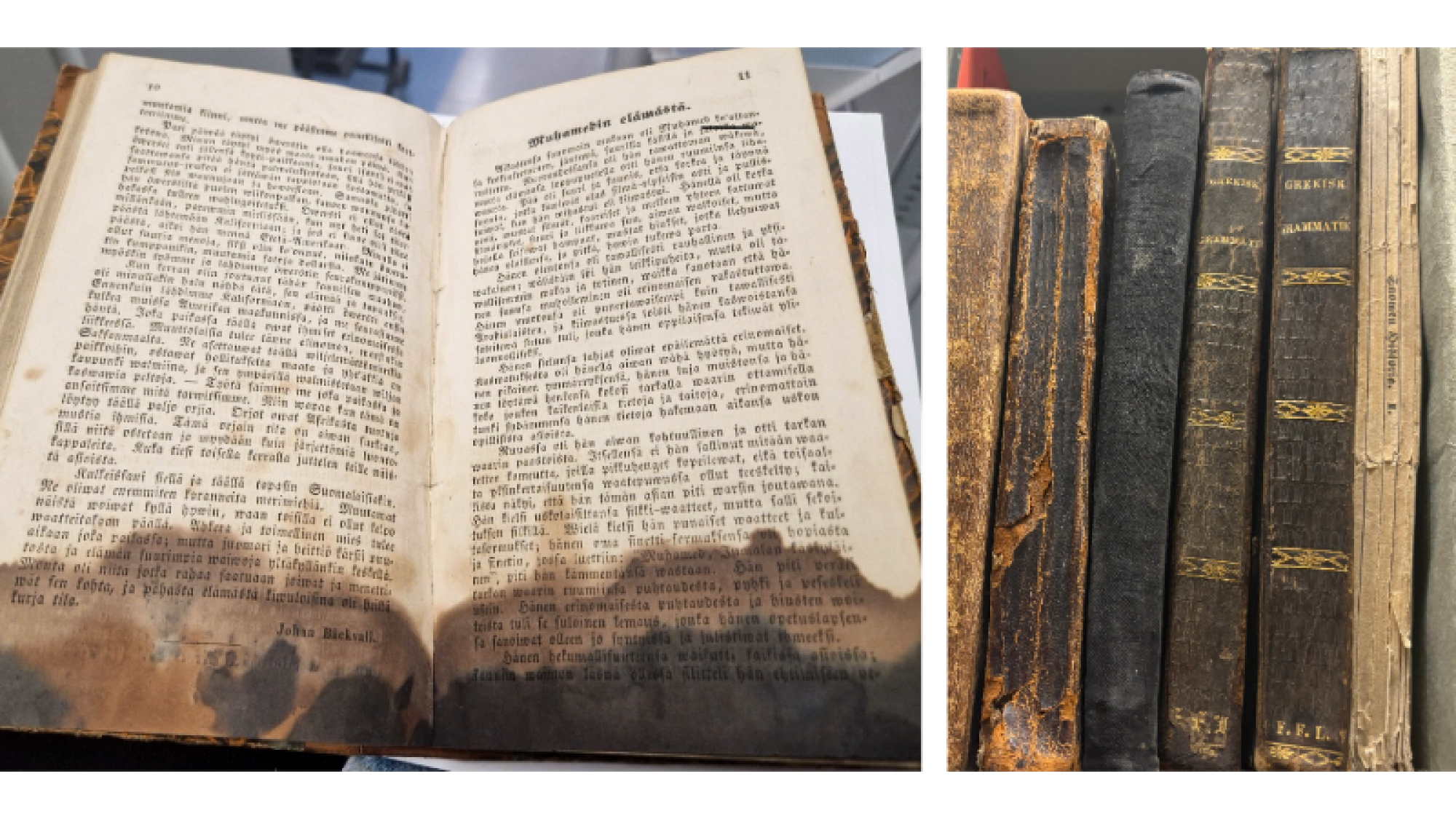
Lauri Lounela (1889–1970) was Elias Lönnrot’s brothers Henrik Johan Lönnrot’s great-grandson. Lounela was a lecturer at the Kajaani Lyceum, a teacher of Finnish and Latin, and an enthusiastic collector of dialect material. In 1997–1998, his heirs donated a substantial collection of family books to the Lönnrot Institute of the University of Oulu. The Lönnrot-Lounela Collection comprises approximately 37 shelf metres of old linguistic, ethnographic, and religious literature. The collection contains more than 2,000 works, including textbooks, almanacs, novels, biographies, dictionaries, Bibles in various languages, and local histories of Northern Ostrobothnia and Kainuu region. Information about the collection can be found in Oula-Finna.
The collection was transferred to the Kajaani City Library in the summer of 2012, when the university campus in Kajaani was vacated and university operations moved to Oulu. In the spring of 2026, the collection was permanently relocated to the University of Oulu Library due to an upcoming renovation of the Kajaani City Library. Most of the collection has been placed in the library’s storage facilities, while the oldest publications from the seventeenth and eighteenth centuries were transferred to the vault. Eventually, the nineteenth-century books containing handwritten notes by Elias Lönnrot were also placed in the vault.
It was known that some nineteenth-century books in the collection contained handwritten annotations by Elias Lönnrot, but as far as I am aware, these had never been systematically documented. Since the collection had now come into my hands, I thought it might be a good opportunity to undertake such work in the name of cultural heritage preservation. I was curious to learn what kinds of notes the books contained and how many annotated books there might be altogether.
I had never conducted this kind of research before, but I began by compiling an Excel spreadsheet of all nineteenth-century books in the collection. There were more than 400 suitable volumes. As Elias Lönnrot lived from 1802 to 1884, it was naturally impossible for books published after those years to contain annotations in his own hand. Nevertheless, I also examined books published between 1885 and 1899, assessing their condition and looking for other markings. I also searched online for samples of Lönnrot’s handwriting so that I would at least have some idea of what it looked like.
Armed with my printed list, I ventured into the storage stacks. Wearing gloves and a mask, I examined the books one by one, as many were fragile, dusty, and in poor condition. Some practically fell apart when opened. The work proved rewarding, however, as I identified 27 volumes containing handwritten annotations by Elias Lönnrot for closer examination.
I also encountered numerous nineteenth-century books bearing the signatures of Lönnrot’s nephew Frans Fredrik Lönnrot, his wife Sofia Amanda Lönnrot (née Snellman), or their son Eljas Lönnrot. The books also contained signatures from members of the Castrén family and other representatives of the Lönnrot family, such as Wilhelmiina Lönnrot.
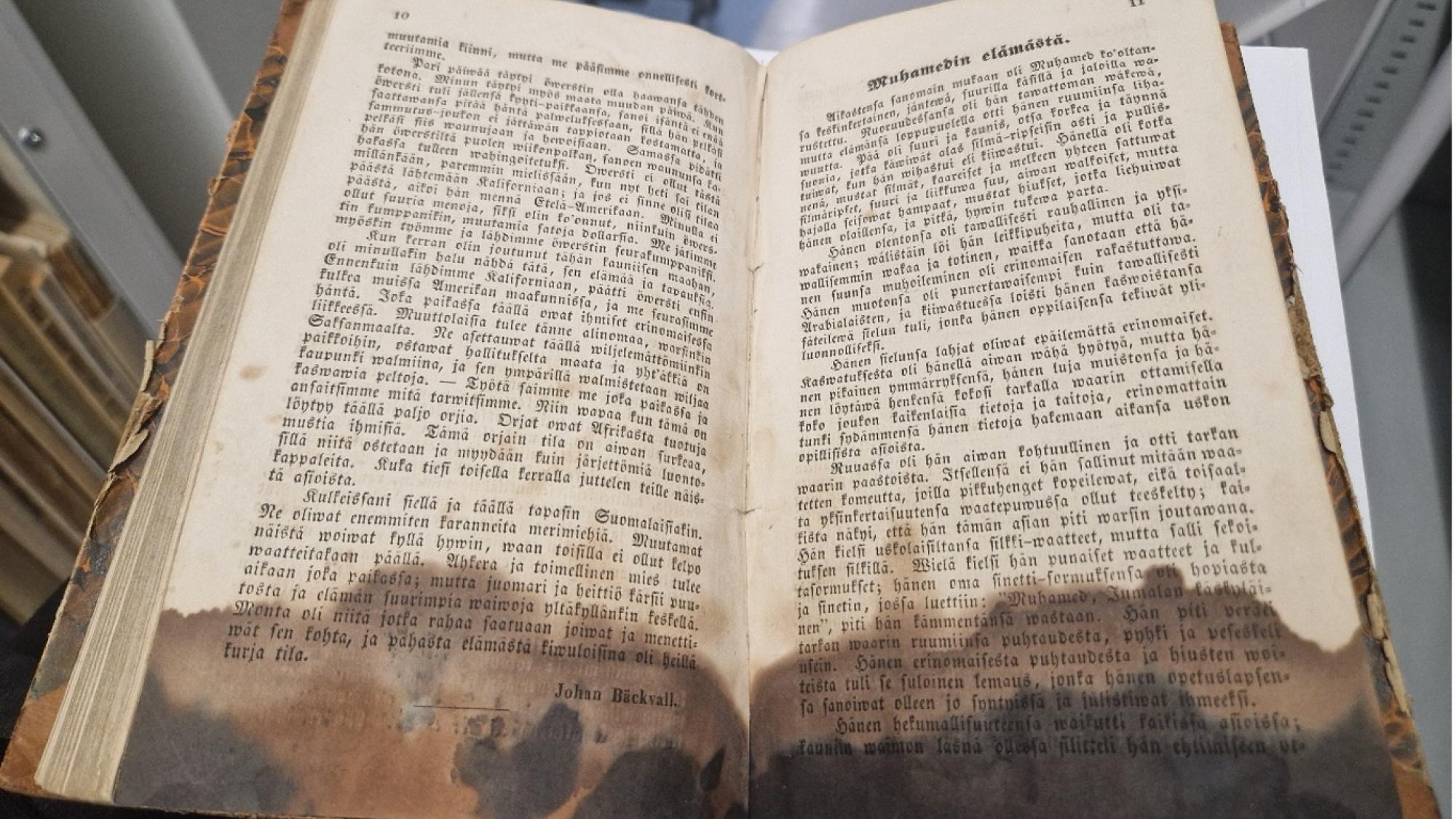
Most of these handwritten markings consisted of Elias Lönnrot’s signature accompanied by a year, serving as proof of ownership. There were, however, a few more unusual inscriptions. In one book, alongside Lönnrot’s signature, the inside cover bears the note:“Price bound: 80 pennies. Certified by: Elias Lönnrot.” Another volume contained a more personal inscription shedding light on family relationships: “To Amanda Sofia Lönnrot, as a keepsake, 1881. Elias and Ida Lönnrot.” Thus, Elias Lönnrot and his daughter Ida had purchased the book as a gift for his nephew’s wife. In yet another book, beneath Lönnrot’s signature, appears the note: “A New Year’s gift from S.A.L. 1872.” S.A.L. most likely refers to Sofia Amanda Lönnrot, indicating that the book was a New Year’s gift from her to Elias Lönnrot.
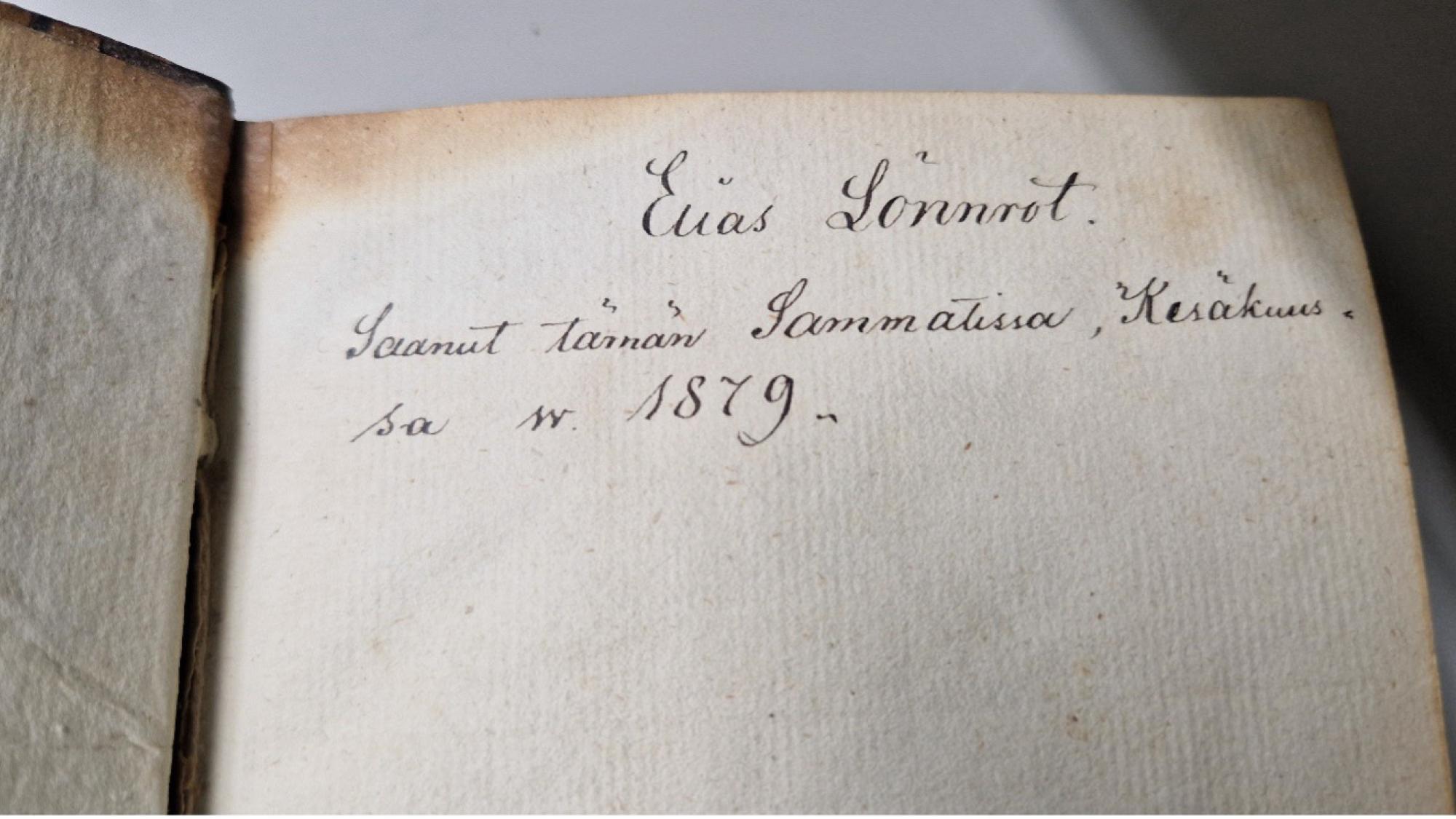
Along the bottom edge of a bound volume bearing Elias Lönnrot’s signature, what appears to have been an overturned inkwell has left its mark. The lower portions of many pages are stained a mottled dark brown-black. In some places, the ink has soaked into the paper so deeply that the text is completely obscured. Who suffered this mishap, one wonders. Surely not Elias Lönnrot himself...?
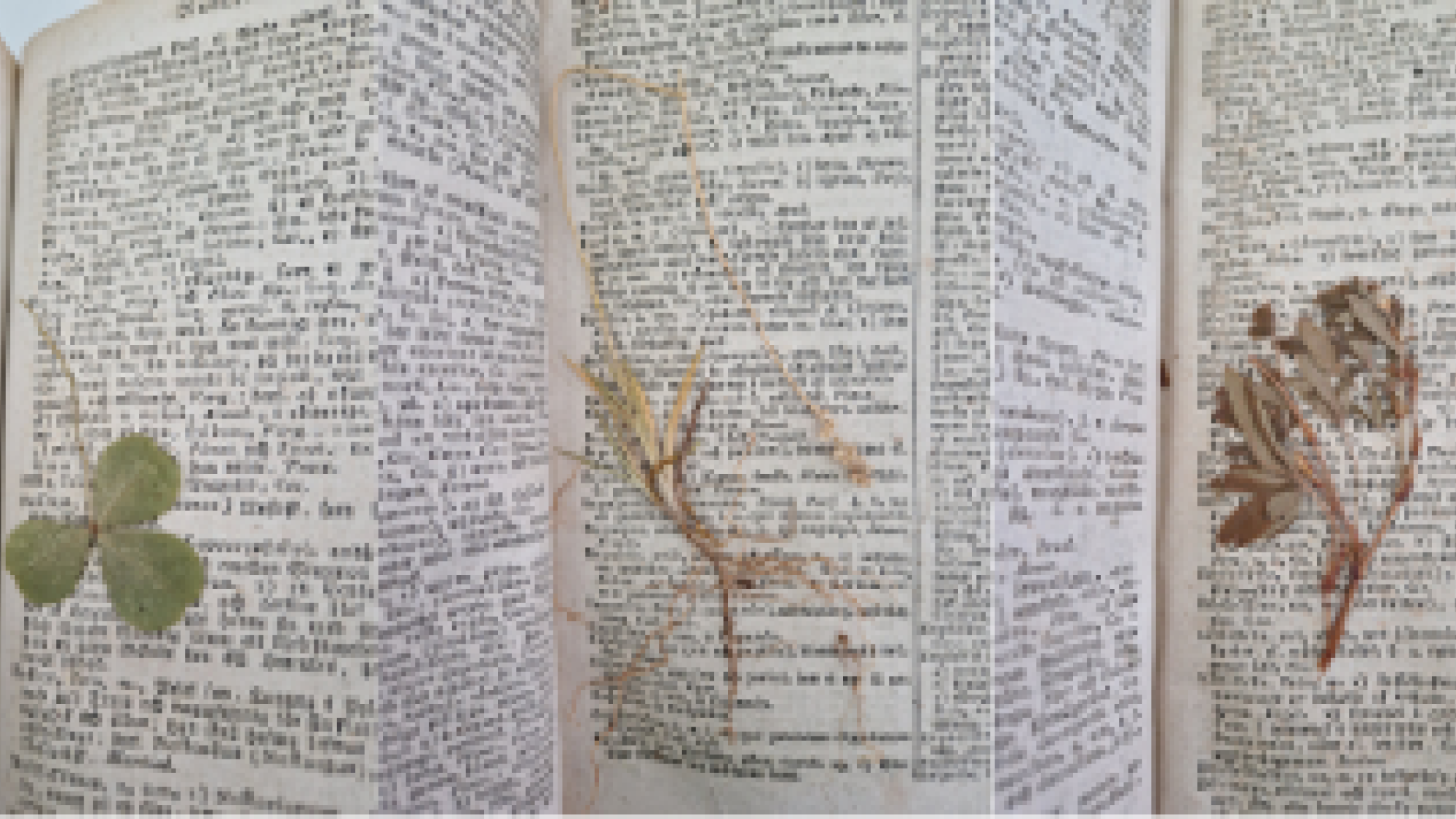
One book containing a handwritten signature by Elias Lönnrot dated 1872 held a surprise between its pages. While leafing through Immanuel Johann Gerhard Scheller’s massive Latin-Swedish dictionary, published in 1828 and spanning more than 1,200 pages, I discovered several beautifully preserved dried plant fragments and even an entire plant complete with roots. Among his many pursuits, Elias Lönnrot was known as a pioneering botanist. In 1860, he compiled and published Flora Fennica, the first flora written in Finnish. This fact tempts me to romanticize the discovery. I imagine Elias Lönnrot himself collecting these plants, carefully drying and pressing them between the pages of a hefty Latin dictionary. As a passionate linguist, perhaps he even smiled at the thought of placing plants inside a dictionary.
Still, one must remain realistic. Over the course of history, the book passed through many hands, and anyone could have inserted the plants during the past century or more. Yet it is remarkable that they survived between the pages for so long, even through several major relocations. And Elias Lönnrot truly did own this book, so perhaps my speculation is not entirely without foundation. We will probably never know for certain. The plant specimens remain preserved between the pages of the book, now resting in the cool conditions of the vault. They have caused no damage to the volume, so I consider the plants themselves to be part of our cultural heritage.
For more information about the library’s special collections, please visit the Special Collections LibGuide (available only in Finnish).
You should also take a look at the continuously updated virtual tour of the library vault, created with ThingLink (available only in Finnish).
Writer
Alisa Tirroniemi, Information specialist
Oulu University Library
Sources:
Majamaa, Raija: Lönnrot, Elias. Kansallisbiografia-verkkojulkaisu. Studia Biographica 4. Helsinki: Suomalaisen Kirjallisuuden Seura, 1997– (viitattu 5.6.2026)http://urn.fi/urn:nbn:fi:sks-kbg-002836
Stories and tales from the library world, the fascinating information resources and collections it has to offer, and how they came to be. Welcome to the official blog of Oulu University Library!