Northern Pedagogy
The Northern Pedagogy blog provides a window into everyday teaching practices and the ongoing development of education at the University of Oulu.
This article presents the “snow lantern method,” which was piloted in a second-year geoinformatics course. In this model, students build their final grade incrementally, assignment by assignment, throughout the course. The method increases the transparency of assessment, supports self-directed learning, and provides an alternative to traditional assessment based on a final examination. The approach is flexible and can be adapted to different disciplines and a wide variety of course formats.
The idea grew out of a desire to move away from a single final exam and toward an approach that rewards commitment throughout the whole course, rather than a single end-of-course performance. The name comes from a snow lantern, which is built by stacking snowballs one at a time – much like students build their grade task by task.
Each completed task earns up to two “snowballs”. The fuller the lantern, the higher the grade (Figure 1). Students choose their target grade at the start of the course and can track their progress toward it throughout.
Our course consisted of five thematic weeks, each offering a lecture-based mini-task and a computer-exercise-based applied task. Tasks were graded with one or two snowballs depending on their difficulty. Reaching a given grade required a minimum number of both task types,so neither category could be skipped entirely. Tasks were assessed weekly with brief feedback.
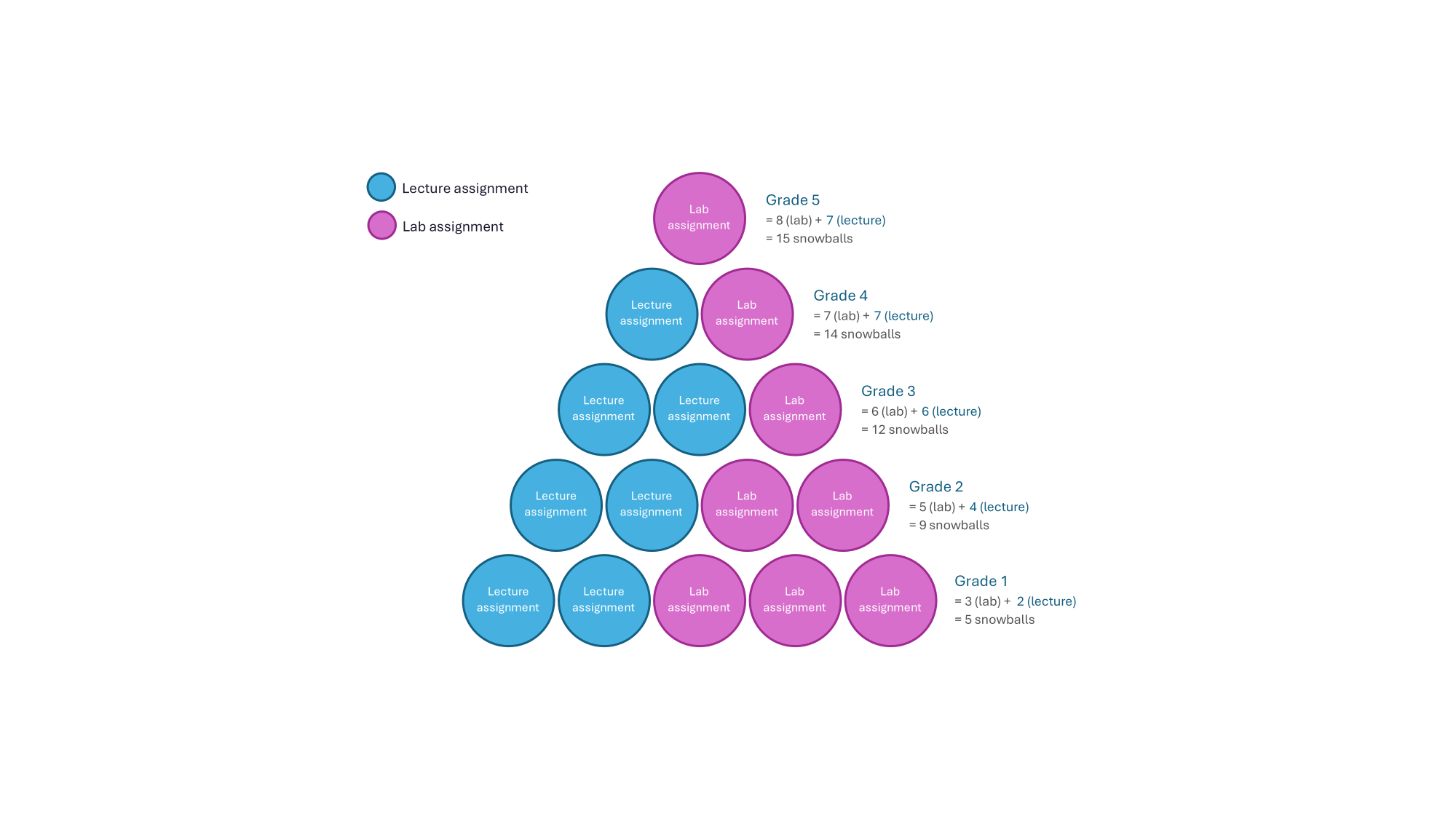
Student reactions were mixed, which is fairly typical for any assessment method. The grade distribution was normal, but experiences varied. Many students found the transparency motivating, as they could watch their progress accumulate week by week. Others struggled once a particular grade became out of reach, which could dampen motivation. Disappointment over a lost grade was also sometimes difficult to process. The transparency of the method also felt genuinely new to many students.
The method connects naturally to several well-established pedagogical frameworks. Continuous, task-specific feedback aligns with the principles of formative assessment, since feedback is given while there is still time to act on it (Black & Wiliam, 1998). Choosing a target grade and tracking one’s own progress, in turn, reflects the idea of self-regulated learning (Zimmerman, 1990).
The criteria for awarding points – or in our case, snowballs – need to be defined carefully in advance, and tasks must be assessed on schedule so students can track where they stand. It is also worth accounting for the motivational tension tied to “losing” a grade, for example, by adding extra tasks to the mix so that a single weak performance doesn’t shut the door on the top grade. The order of tasks matters too, since the lowest rows effectively set the minimum requirements for the course. When simpler tasks are placed lower and more demanding ones higher up, students aiming for the top grades also end up doing more demanding work.
Developing a new assessment method inevitably raises plenty of questions, and the checklist developed by the TILT project, for example, offers a good starting point for thinking them through.
The snow lantern method ended up as a two-year pilot on our course, since weekly assessment for a class of 60 students turned out to be too demanding and time-consuming. On a course with a looser schedule, though, I would definitely try the method again, and I would also encourage you to consider how snow lantern assessment might work for your own course
Maija Toivanen
Faculty of Science
Black, P. & Wiliam, D. (1998). Inside the black box: Raising standards through classroom assessment. Phi Delta Kappan, 80(2), 139–148.
TILT Higher Ed (2026) Transparent Methods, website. Accessed 17.8.2026. https://www.tilthighered.com/transparent-methods
Zimmerman, B. J. (1990). Self-regulated learning and academic achievement: An overview. Educational Psychologist, 25(1), 3–17.
The Northern Pedagogy blog provides a window into everyday teaching practices and the ongoing development of education at the University of Oulu.