
My internship journey in Japan: learning, breaking, creating

Energy efficiency, energy management, and energy economics have always been central to my studies and early career as an electrical engineer. Shimizu Corporation in Japan brought me back to a familiar field, this time with a completely fresh perspective. Instead of approaching energy systems only with an engineering mindset, I began to see them through the lens of a researcher, which opened new ways of thinking and understanding.
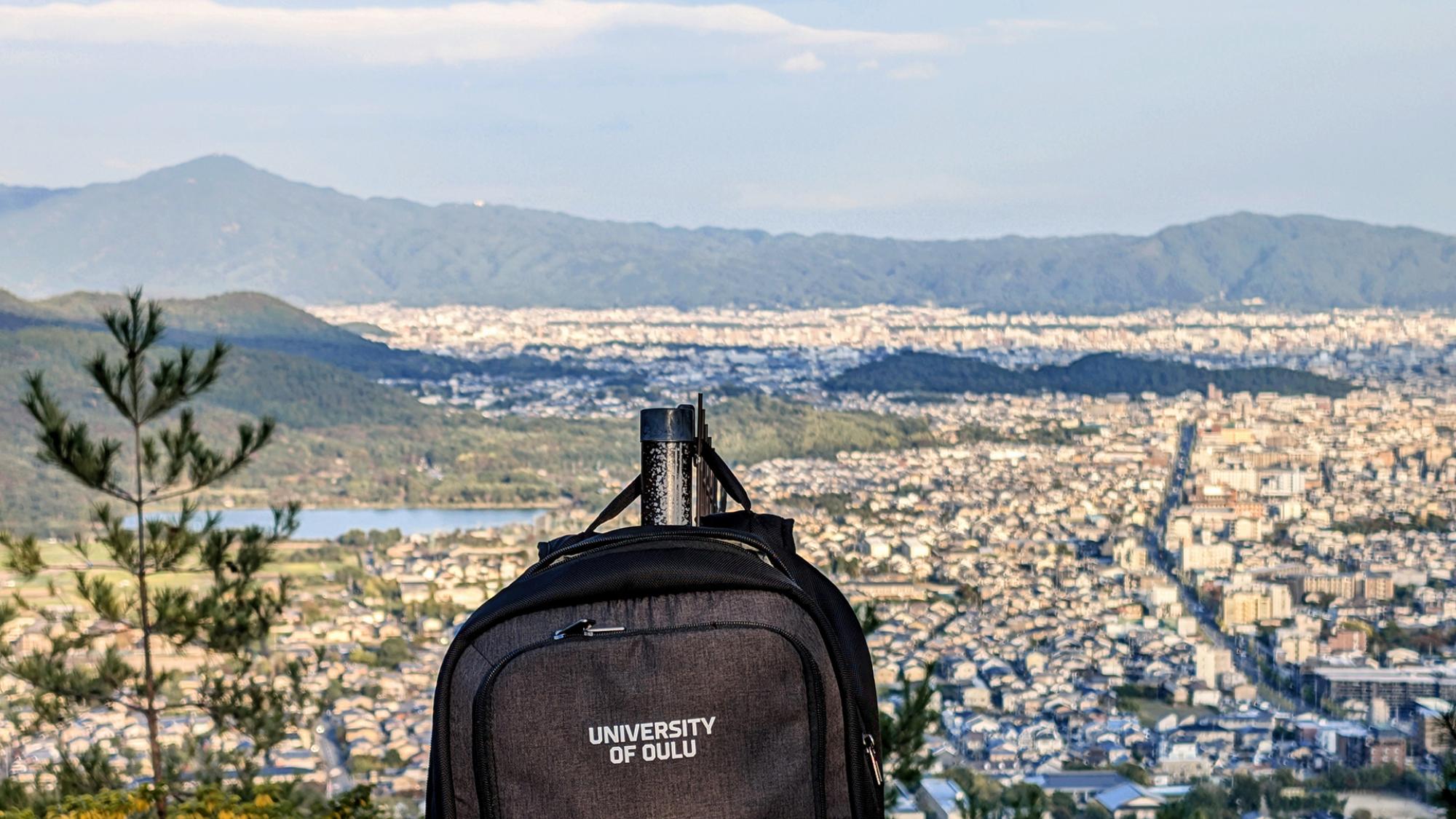
Landscape with houses, lake and mountains, with University of Oulu backpack in the foreground
Landscape above the Kyoto city.

Discovering Japan again

This was my second visit to Japan, and once again the country amazed me. This time, I arrived in the peak of autumn, when the roads were lined with golden ginkgo trees and deep red maple leaves. I was based in Tokyo but also visited beautiful cities like Kyoto, Kamakura, and Hakone, each offering its own charm and history.

Many people are familiar with micro-gardening in small glass boxes. In Kyoto, some temple gardens felt like large-scale versions of these miniature worlds. Walking through them, I often felt like a tiny ant wandering inside a giant micro-garden.

Beginning the internship

This internship was funded by STEK ry and the University of Oulu. It was coordinated by the University of Oulu, and hosted by Shimizu, who supported all arrangements throughout our stay there. The journey began in late May 2025, when two visiting researcher positions were advertised under two themes: Energy Efficient Vibrant Society and Vibrant Workspaces with Flexible Private Network Leveraging Local 5G/6G. I was selected for the first theme and later assigned a specific research task:

To optimize the energy and storage systems of the NOVARE building (Shimizu’s Innovation Institute in Shiomi) to reduce cost and CO₂ emissions while improving self-sufficiency.

Special focus was placed on understanding and evaluating their hydrogen power system and how it could be optimized to achieve these targets.

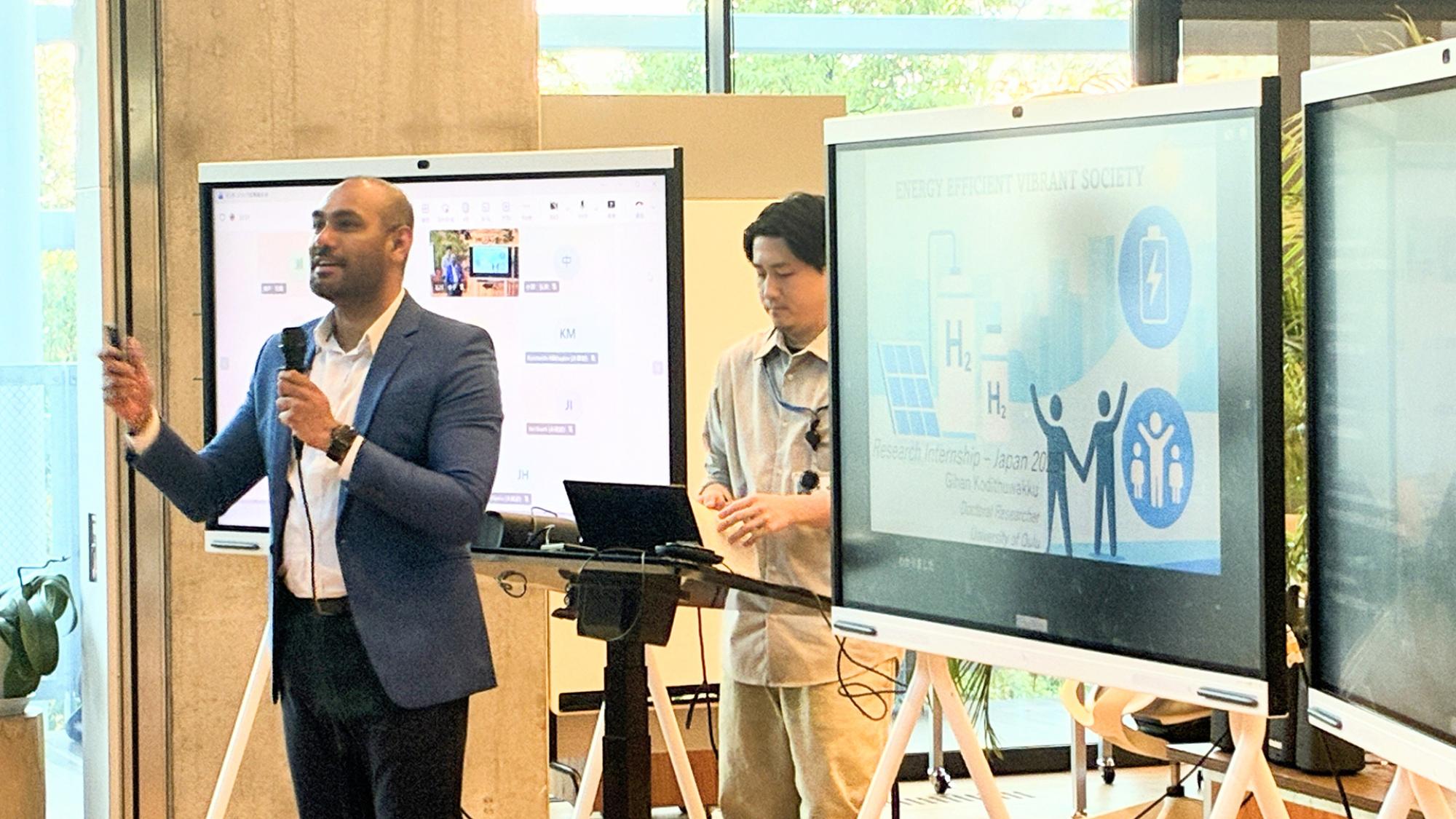
Gihan Kodithuwakku is holding a microphone and there is a presentation on the screen.
Reflecting on my learning outcomes at NOVARE. Photo: Shimizu

The Shu–Ha–Ri journey

The entire internship followed the well-known Japanese learning framework Shu–Ha–Ri — Learn, Break, Create — which helped structure the research process in a meaningful way. The learning phase was especially rich, strengthened by a series of site visits thoughtfully arranged by Shimizu.

I had the opportunity to visit the Kawanishi smart construction site, where ICT is seamlessly integrated into civil construction; the Tokyo Torch project, which is going to be Japan’s tallest building; the Tokyo Dream Park; and several hydrogen-related pilot sites, including Japan’s first hydrogen co-firing boiler in the Aomi Waterfront City.

What impressed me most was Shimizu’s effort to give us full lifecycle exposure to the construction industry, selecting sites at different stages of development.

Besides the site visits, I learned by working alongside colleagues, joining meetings, and participating in team discussions. In simple terms, the goal of this phase was to understand how Shimizu has achieved — or aims to achieve — an energy-efficient, vibrant society.

The Breaking phase is not a separate step — it often happens in parallel with learning and even overlaps with the creating phase. In essence, the purpose of breaking is to question, challenge, and rethink. It involves examining how well Shimizu has already achieved an energy efficient, vibrant society, while also understanding my own strengths and weaknesses. So, I kept asking questions — during site visits, in meetings, while listening to guest speakers, and even afterward in my own reflections.

“Why is it done this way? What else is possible?”

Through continuous analysis of data, experimenting with ideas, and gently challenging assumptions, I gradually moved through the Breaking phase and gained a deeper, more insightful understanding of the current situation and the assigned task, as well as the possibilities it holds for the future.

Finally, I truly believe that this journey allowed me to create something meaningful. I came out with new insights and fresh knowledge, a few ideas on how Shimizu’s EMS could be improved and also some early concepts for future business models. More importantly, this journey helped me build new connections and collaboration opportunities that will be truly helpful for my future research.

Exploring new ideas: the battery circular economy

In addition to this main research task, I also explored opportunities related to the battery circular economy, especially the question:

“Can reused batteries be applied in the construction industry, and what business models might support this?”

This broadened my research perspective and allowed me to gather early empirical insights for my PhD.

Understanding vibrancy through culture

As I mentioned before, my internship theme was “an energy efficient vibrant society.”
While working on this, I found myself drawn to understanding how Japanese people perceive the idea of vibrancy itself.

I discovered a society deeply rooted in many things, such as culture, spirituality, tradition, and history, yet seamlessly connected with modern technology. I saw young women walking along the streets in colorful kimonos, carrying the spirit of centuries, while their traditional hand fans had quietly transformed into small electric ones. This harmony between old and new is, perhaps, the true aspect of vibrancy.

Understanding Japan through literature

One of the best ways to understand a society is through its literature. With recommendations from my colleagues, I found two books that left a strong impression: Bushido: The Soul of Japan by Inazō Nitobe and Before the Coffee Gets Cold by Toshikazu Kawaguchi.

Both books felt deeply engaging, each offering a different window into the Japanese spirit. I enjoyed reading them in quiet corners of train platforms, during long train rides, and while sitting in peaceful parks. I spent those rainy, grey days in the Tsutaya Book Café, reading these books and watching Tokyo Station and the flow of people through the window. The atmosphere made the stories even more vivid and I truly recommend these books to anyone who wants to feel the heartbeat of Japan.

Which country do I prefer?

When the internship came to an end—and even after returning to Finland—both my Japanese and Finnish colleagues asked me the same question:

“Gihan, which country do you prefer the most?”

My honest answer is that each country has its own unique beauty. Each place has shaped me in a different way. Each place has given me something I could not have found anywhere else. Each place has its own strengths and its own challenges, and that is what makes them special and I love this diversity.

I want Japan to stay Japan, Finland to stay Finland, and Sri Lanka to stay Sri Lanka — because their beauty lies in being exactly who they are.

More information on the 'International internships in the energy sector' project

Created 11.12.2025 | Updated 12.12.2025

Authors

Gihan Kodithuwakku
Gihan Kodithuwakku
Industrial Engineering and Management
University of Oulu

Gihan Kodithuwakku has worked as an Electrical Engineer across several industries, including building construction. After completing his master’s degree in Project and Product Management at the University of Oulu, he is now pursuing a PhD focusing on the battery circular economy.