Can AI Be Creative? LuovAIn! Roadshow Brings AI Comedy, Discussion and Community Art to Oulu
AI is already part of everyday life for many creative professionals. It is used for writing, illustration, music composition, editing and developing new ideas. At the same time, its use raises questions about creativity, authorship, professional expertise and responsibility. The LuovAIn! Roadshow will explore what kind of future we want to build and what role humans will play alongside increasingly intelligent technologies. Serious questions will be approached with a touch of humour.
A Comedian Brings AI on Stage
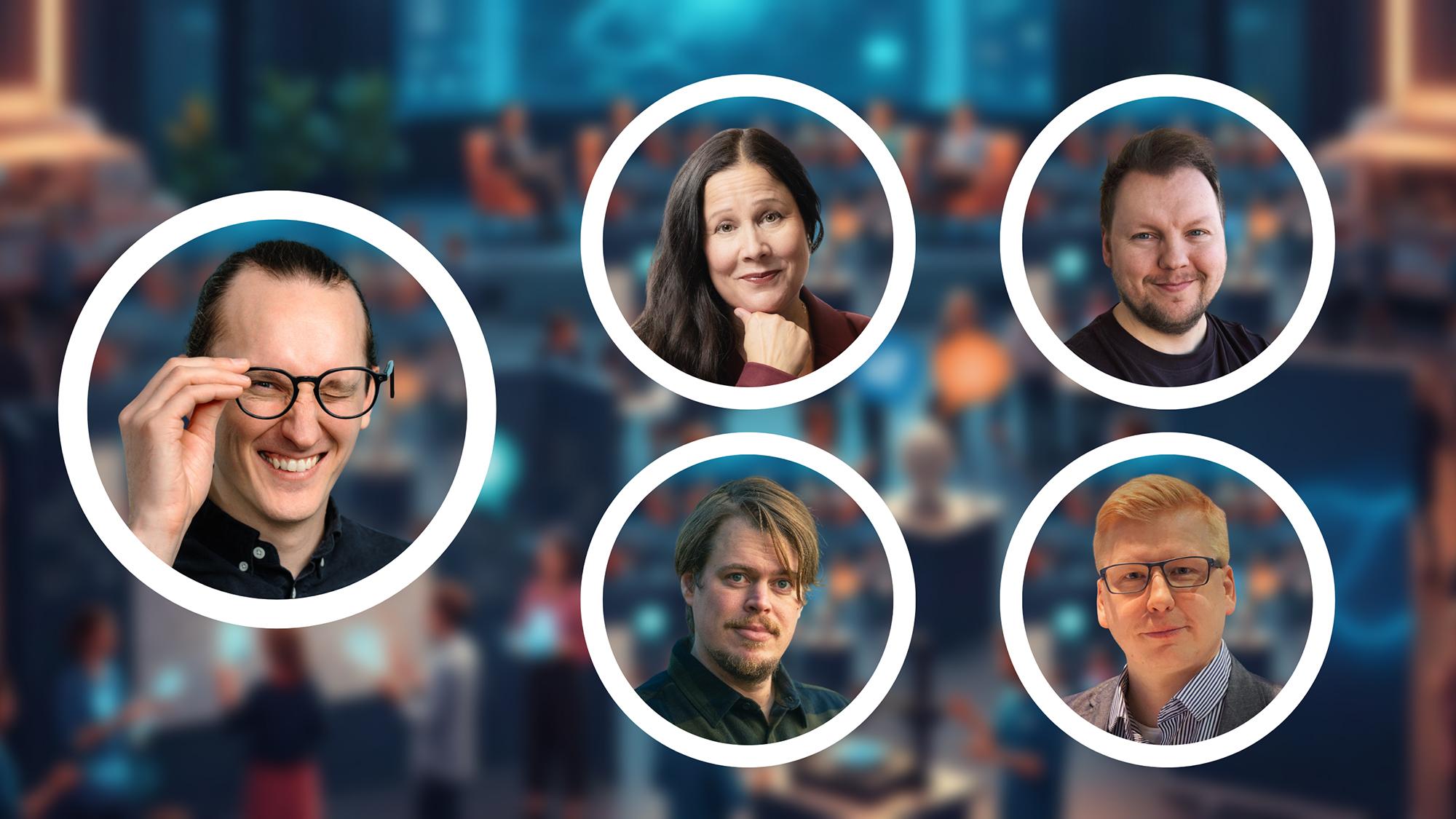
The event will be hosted by serial entrepreneur, stand-up comedian and speaker Joona Kotilainen, who will open the programme with a 45-minute AI comedy performance.
Through practical experiments, Kotilainen has explored whether AI can understand humour or whether it is simply skilled at imitating human comedy. He has developed a performance format in which he improvises comedy together with AI bots. Kotilainen brings AI onto the stage live and engages it in conversation.
The dialogue on stage is not entirely scripted in advance, and the audience can also influence how the performance unfolds. Every performance is different.
According to Kotilainen, AI makes it possible to take personalised comedy further than before, tailoring it to the particular audience and moment.
"The performance offers an opportunity to see what happens when a human and AI try to be funny together. What will be interesting for the audience is seeing which of us comes up with the best ideas," Kotilainen says.
Following his performance, Kotilainen will moderate the panel discussion.
Humans and AI – Creative Together or Separately?
The panel discussion will bring together four different perspectives on AI: public-sector communications, AI technology development, creative entrepreneurship and research.
Harriet Urponen, Communications Director at the City of Oulu, will share her experiences of using AI in public-sector communications. In Oulu, the use of AI-generated images has sparked considerable debate, particularly in connection with the city's year as European Capital of Culture.
According to Urponen, banning the use of AI is not a realistic solution in a large organisation. Instead, responsible practices, clear guidelines and relevant skills are needed.
"We have been asked to stop using AI-generated images in the City of Oulu's operations. In practice, many of my own tasks would take considerably longer without AI. In a sense, knowing how to use AI is becoming both a civic skill and a workplace skill. We all need to learn how to use it," Urponen says.
AI is used for a wide range of tasks in the City of Oulu's communications, Urponen explains. She has also collected data on how other Finnish communications professionals use AI. In her view, it is important to consider when AI-generated content serves communication objectives and when it may undermine the credibility of a message or create distrust.
Synthesis or Something Entirely New?
Mika Rautiainen, CEO of Valossa Labs Oy, will examine AI from the perspective of a technology developer and entrepreneur. Oulu-based Valossa Labs has been developing AI solutions capable of analysing and understanding video content since 2015. The company's technology is used, for example, to analyse and process audiovisual material, including automated content management and advertising applications for television programmes.
Rautiainen sees AI as an enabler of creative work, but he also recognises the risk that easy-to-use technology may encourage superficial thinking and the production of content lacking substance. He believes it is important to consider what we actually mean by creativity.
"AI is not creative in the classical sense. Instead, it synthesises things it has been trained on. But human creativity also consists of synthesising what we have seen and experienced," Rautiainen reflects.
According to Rautiainen, AI can generate new content, but human creativity differs fundamentally in that our actions are guided by personal experiences, emotions and intentions, which also help create meaningful connections through shared experiences.
AI can only imitate emotions. At the same time, it is changing the role of creative professionals: alongside producing content, directing, evaluating and selecting are becoming increasingly important. When used creatively, AI tools can help create new, authentic experiences and connections between people.
Professional Expertise Remains Essential
Eemeli Alanne, entrepreneur behind Taikasatukulma, has first-hand experience of using AI to produce creative content. According to Alanne, Taikasatukulma's audio fairy tales are among the most listened to in Finland, attracting more than 200,000 listens per month on YouTube and Spotify.
At Taikasatukulma, AI is used as part of the creative process, but the company does not want to automate everything. For example, human expression, rhythm and intonation still play a particularly important role in narrating fairy tales.
Alanne also believes that AI does not eliminate the need for professional expertise. Producing high-quality content requires an understanding of what is being created and why. According to Alanne, creative professionals who understand AI can get much more out of these tools and use them to enhance their own creativity.
"If we look, say, ten years into the future, will AI tools be as commonplace as Google has been for a long time? If most creative content is also produced by machines, we will be facing an entirely new debate. What will be the role of human creativity at that point?" Alanne asks.
Alanne hopes that the LuovAIn! Roadshow panel discussion will help people understand that AI is neither simply a threat nor a solution to everything. The key is to recognise where it genuinely supports creative work and where human contribution is irreplaceable. The ability to distinguish AI-generated content from human-created content is also important.
What Makes AI-Generated Content Good?
Markus Sjöberg, a researcher at Tampere University, will bring an academic perspective to the discussion. He is interested in the kinds of value we seek to create through creative work.
"It is important to distinguish between creative work that has intrinsic value and creative work that has instrumental value. If the purpose of creative work is to achieve a particular outcome as efficiently as possible, AI can be a useful partner. But what happens when the act of creating, experimenting and experiencing the creative process is what matters most?" Sjöberg asks.
Sjöberg also wants to encourage discussion about how AI is changing our perceptions of quality, creativity and good taste. When content can be produced rapidly and in almost unlimited quantities, the question of who defines what constitutes valuable and good creative work becomes increasingly important.
"Sometimes viewers may consider low-quality food photographs authentic and appealing. Images that look too perfect can seem inauthentic," Sjöberg says.
According to Sjöberg, it is worth considering whether the growing use of AI will change how we value work created by humans.
AI Becomes a Creative Partner in a Community Art Workshop
The event will offer opportunities not only to discuss AI but also to experiment with it. The AI Community Art Workshop has been developed by media artist Ville-Sakari Kotka from Studio Käpynä Oy and Tampere University researcher Markus Sjöberg.
The workshop introduces AI into collaborative artistic creation, allowing participants to explore human–machine collaboration through hands-on experimentation. The most common way of prompting AI is through written instructions. The interactive AI artwork developed in the LuovAIn! project now invites participants to experiment with alternative ways of interacting with AI: through gestures, movement, images or even simply their presence – or by turning the crank of a barrel organ. The artwork combines several AI technologies, custom-built AI tools and traditional analogue interfaces.
As AI becomes part of the creative process, intriguing questions emerge: Who decides whether the final result is good? Whose idea is the artwork ultimately? And can AI help people discover new ways to express themselves?
LuovAIn! Roadshow in Oulu
Date: 18 November 2026, 12:00–16:00
Venue: Tarkastamo, Saaristonkatu 1 C, Oulu
Tarkastamo Hall (only in Finnish)
12:30–13:15 – Stand-up Comedy with AI / Comedian and entrepreneur Joona Kotilainen
13:15–14:00 – Panel Discussion: Humans and AI – Creative Together or Separately?
Tarkastamo Club (also in English)
12:00–16:00 – AI Community Art Workshop / Media artist Ville-Sakari Kotka from Studio Käpynä Oy and Markus Sjöberg
Further information: Oulu2026 event page
Photos: Harri Säynevirta, Harri Tarvainen, Veera Mahlakaarto, Celina Sjöberg
The Artificial Intelligence in the Creative and Cultural Sector Ecosystem – LuovAIn! project is co-funded by the European Union. The project (2024–2026) is funded through the national ESF+ funding for Innovation Competence in the Creative and Cultural Sectors, as part of the Innovation and Skills in Finland 2021–2027 programme. The project is implemented by the University of Turku, the University of Oulu, Tampere University and LAB University of Applied Sciences.
The event is part of the Lumo Art & Tech Festival and the University of Oulu's programme for Oulu's year as European Capital of Culture 2026.