Grave findings reveal: For Stone Age people, relatives beyond the nuclear family were also close
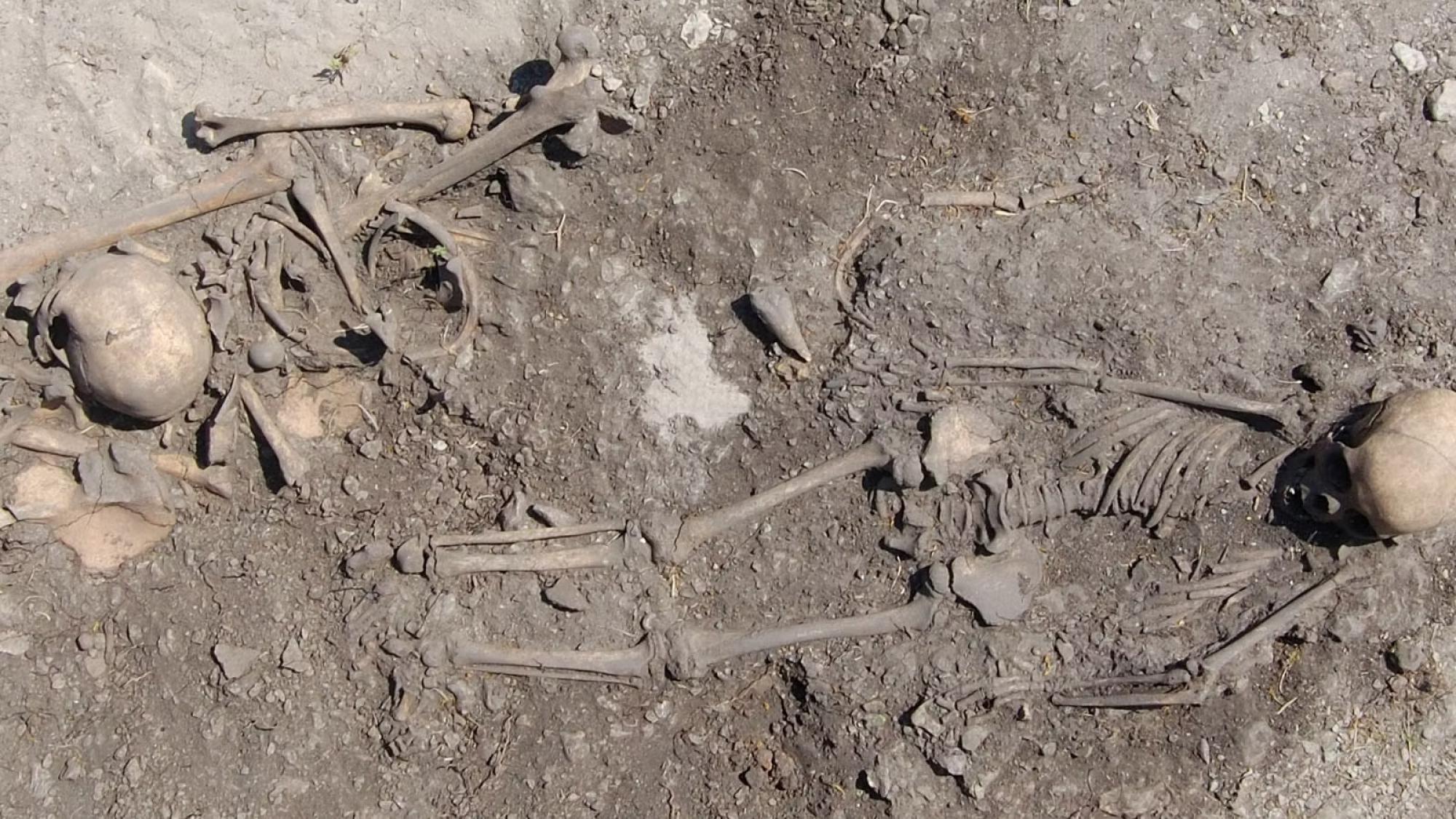
Researchers from the University of Oulu and Uppsala University have reconstructed the family relationships of a 5,500‑year‑old hunter-gatherer community in Ajvide, Gotland, Sweden. DNA analyses of individuals found in four collective graves indicate that people were well aware of their kinship lines and that relationships beyond the nuclear family played a significant role in their lives.
“Surprisingly, the analysis revealed that many of those buried together were second‑ or third‑degree relatives rather than first‑degree relatives such as parent and child or siblings, as often assumed. This suggests that people had a good understanding of their lineage and that relationships outside the nuclear family were important,” says archaeogeneticist Helena Malmström from Uppsala University.
Little is known about the internal genetic structure of Stone Age hunter‑gatherer populations due to the scarcity of available material. This study is among the first large‑scale investigations on the topic.
“Because such hunter‑gatherer graves are rarely preserved, kinship studies of archaeological hunter‑gatherer cultures are limited and typically small in scale,” says population geneticist Tiina Mattila from the University of Oulu and Uppsala University, who led the genetic analyses.
Ajvide on Gotland is one of Scandinavia’s most important Stone Age sites, known for its well‑preserved burials and rich archaeological material. Around 5,500 years ago, the area was inhabited by hunter‑gatherers who relied primarily on seal hunting and fishing. Although farming had already spread across Europe, northern hunter‑gatherer cultures persisted and remained genetically distinct from farming populations.
Most graves contained at least one child
The extensive Ajvide burial ground includes 85 known graves, eight of which contain two or more individuals.
One grave held a woman around 20 years old lying on her back, with two children placed on either side of her—one about four years old, the other around one and a half. DNA shows that the children were full siblings, but the woman was not their mother. She was likely their father’s sister or the children’s half-sister.
Another grave contained a young individual with the remains of an adult man placed beside them, likely transferred from another location. According to the analysis, the young person was a girl and the man her father.
A third grave held a boy and a girl whose relationship was more distant—a third‑degree kinship, likely cousins.
In the fourth grave, a girl and a young woman were buried together. Genetic analysis indicates that they were also most likely third‑degree relatives, possibly cousins.
The researchers were able to determine sex and kinship by analyzing DNA from the teeth and bones of ten individuals. Children’s sex cannot be determined from skeletal remains, but genetic analysis allows this by identifying whether the individual had two X chromosomes (girl) or one X and one Y chromosome (boy).
Kinship was identified by examining the proportion of shared DNA. First-degree relatives (parent–child, full siblings) share about half of their DNA, while second-degree relatives (grandparent–grandchild, half‑siblings) share about a quarter. Third-degree relatives (such as cousins or great‑grandparent–great‑grandchild) share around one-eighth.
The archaeogenetic analysis of the Ajvide collective graves is a pilot study aimed at uncovering family structures in Neolithic hunter‑gatherer communities in Scandinavia. The researchers plan to continue their multidisciplinary work on the remains of more than 70 additional individuals from the burial site. The goal is to gain deeper insight into the social organisation, life histories and mortuary practices of ancient hunter‑gatherer cultures.
The study is published in Proceedings of the Royal Society:
Mattila TM, Fraser M, Koelman J, Krzewińska M, Ivarsson-Aalders M, Götherström A, Jakobsson M, Storå J, Günther T, Wallin P & Malmström H. 2026. Genetic relatedness mattered in the co-burial ritual of Neolithic hunter–gatherers. Proc. R. Soc. B Proc. R. Soc. B 292:20250813. DOI: https://doi.org/10.1098/rspb.2025.0813