ICT Students Demonstrate the Craft of Springineering
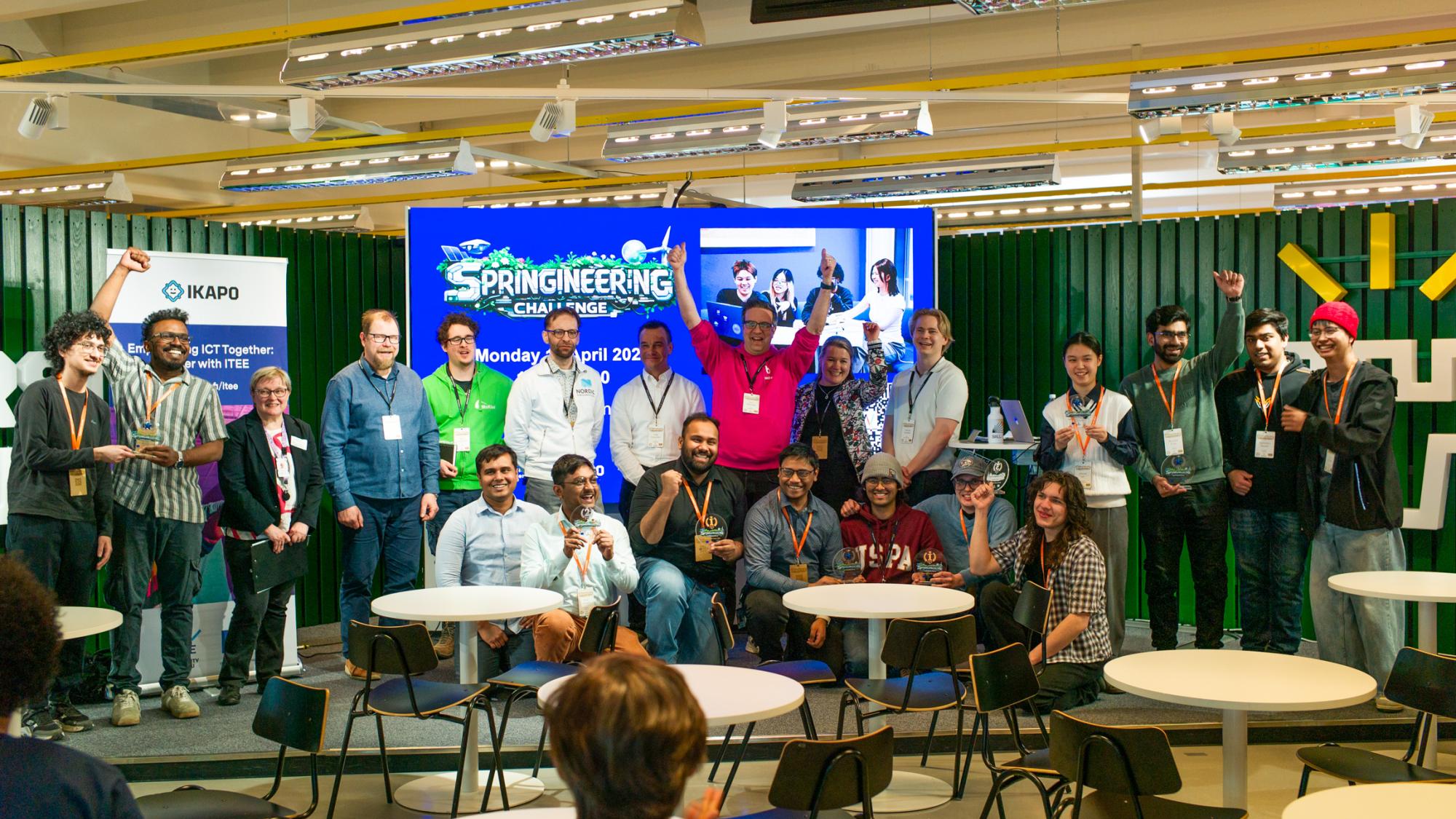
Organised for the first time this year, the Springineering Challenge—as its name suggests—combined spring‑time creativity with the craft of engineering, challenging students not only to explain their ideas, but to demonstrate how they work, why they matter, and who they are built for.
Code, sensors, edge intelligence, wearables, and more came together as student projects stepped out of development environments and into hands‑on demonstrations—competing for awards and recognition from both the industry jury and the audience.
From Coursework to Impactful Engineering
Courses—both with and without formal project components—served as launch pads for the work on display. Many students, however, pushed well beyond course requirements, refining their ideas iteratively and developing them into robust, fully functional demonstrations.
What emerged went far beyond academic exercises. The projects tackled concrete challenges faced by industry, healthcare, and everyday users, spanning areas such as real‑time 5G network intelligence, ultra‑fast edge content delivery, AI‑powered safety systems, wearable rehabilitation technologies, and camera‑based health monitoring.
The teams tackled pressing societal challenges with clear determination—energy efficiency, infrastructure safety, digital healthcare accessibility, and data‑driven decision‑making—showing little hesitation in taking on complex, real‑world problems. Others pursued emerging technologies such as computer vision, edge AI, and VR analytics with equal resolve, pushing them decisively towards deployable solutions. Across disciplines and domains, one ambition was unmistakable: to turn complex technology into practical tools that solve real problems, measurably and responsibly.
Multidisciplinary Dream Teams Fuelled by Use Cases
The use cases naturally shaped how teams formed. Students gravitated towards one another based on shared curiosity and a sense of what was needed to turn ideas into working solutions. The result was a set of “dream teams” that brought together complementary skills to explore innovative technology combinations with real‑world relevance.
Teams combined students from computer science, electrical and communications engineering, biomedical engineering, software engineering, and AI‑focused specialisations, often mixing bachelor’s and master’s level perspectives. Some groups paired embedded systems builders with machine‑learning and data enthusiasts, while others united network engineers with software and systems designers. Alongside these collaborative efforts, several projects were driven by solo teams—individuals who brought together all the required expertise themselves, demonstrating both depth and versatility.
Working under time pressure and demanding goals required flexibility, rapid problem‑solving, and strong teamworking skills—capabilities essential in working life. This diversity of approaches enabled projects to be tackled holistically, bringing together hardware, algorithms, usability, privacy, and scalability into practical, real‑world‑ready solutions.
Industry Experts at the Core of the Evaluation
The breadth and versatility of the showcased solutions called for an equally diverse group of evaluators. Representatives from Boogie Software Oy, EXFO Oy, Medanets Oy, Nokia Oyj, Nordic Semiconductor Finland Oy, Siili Solutions Oyj, VRKiwi Oy, and Ääkköset Oy formed the esteemed company jury, known as the Evaluator Squad. Together, they brought expertise spanning telecommunications and connectivity, embedded and wireless technologies, AI‑driven software and digital services, network testing, digital health, immersive XR, and cybersecurity.
Closely reflecting the multidisciplinary nature of the demos and challenges at the heart of the event, this wide range of perspectives enabled a well‑rounded evaluation—balancing technical depth with real‑world relevance, usability, and deployment potential. The jury was eager to explore the solutions firsthand, with demos deliberately designed not just to be presented, but to be actively tried and experienced.
Built to Be Touched, Tested and Triggered
Across the showcase, solutions were designed to be explored rather than simply observed. Advanced technology was presented in an inviting and accessible way, lowering the threshold to engage, experiment, and ask questions.
Visitors wore, for example, rehabilitation sensors to follow live joint‑angle data, competed in a real‑time heart‑rate challenge, tested natural‑language video search using their own queries, and explored a lunar satellite network simulator illustrating constellation design and signal mapping.
Through dashboards, simulations, and AI‑powered interfaces, complex backend systems became tangible. Hence the conversation expanded from how the technology works to where it could be used next.
Three-Minute Pitches, Live at the Demo Tables
True to the demo‑driven nature of the event, pitches were delivered at the teams’ tables. Teams faced the pressure of distilling their work into an ultimate three‑minute pitch—making their case to the jury while being filmed for the live stream and followed by a large on‑site audience of around 100 people.
The 14 teams, agile and focused, guided the evaluators through live dashboards, working prototypes, wearables, mobile demos, and edge‑based systems—often running in real time. The task was anything but easy: balancing technical solidity, clarity, and perhaps a spark of fun under intense time pressure, all in an effort to truly stand out.
From Rigorous Review to Award‑Winning Solutions
With the live demos still fresh in mind, the Evaluator Squad shifted from rapid, table‑side impressions to careful comparison—assessing not only how the solutions were presented, but how they stood up in substance. The jury, too, operated under time pressure, with less than 30 minutes to deliberate and reach their decisions.
The competition culminated in a rigorous review of the projects’ technical depth, guided by clear criteria. Project implementation carried the greatest weight, complemented by real‑world problem solving, industry relevance, and the ever‑coveted “wow effect”.
Celebrating the Award‑Winning Teams
As the deliberations concluded, the Evaluator Squad took to the stage to announce the winning teams, bringing the intense afternoon of demos and exploration to its finale.
First prize (€800) in the General Category went to Team RehabSense for their Smart Wearable Knee Rehabilitation Tracker, which earned a final score of 82.76. The project stood out for translating complex biosignal measurement into a fully functional, tested wearable, enabling real-time knee angle tracking for rehabilitation. Designed for both physiotherapy and home use, RehabSense showed how human‑centered health technology can move seamlessly from lab concepts to practical, real‑world application.
Second prize (€500) was awarded to Team TheraCoz for Luma‑Baby, their next‑generation baby monitoring solution. The project impressed the jury by transforming ordinary cameras into clinical‑grade wellness tools, enabling real‑time heart‑rate and breathing monitoring without wearables or invasive sensors. By processing data locally on the device, Luma‑Baby combined privacy, immediacy, and sustainability in a human‑centered health technology application.
Third prize (€300) went to Team Power Rangers for PowerSurge, an intelligent electrical safety solution aimed at reducing e‑waste and preventing device failures before they occur. Using edge AI to analyse power consumption in real time, the system detects anomalies such as phantom power and efficiency degradation, demonstrating how embedded intelligence can turn everyday infrastructure into proactive, safety‑enhancing technology.
A defining feature of Springineering Challenge was its emphasis on tangible interaction, highlighted by the Specific Category: Best Hands‑on Demo (€200), judged entirely on how effectively teams enabled visitors to test their solutions. Team Power Rangers swept the category with PowerSurge, convincing the jury with a vivid live demo that included e.g. an electric mixer deliberately driven into unstable operation—its whirling motion making electrical risk instantly visible.
Audience Favourites: Where Technology Meets Everyday Use
Visitors to the Springineering Challenge—both on site and via the live stream—also cast their votes in four audience categories, highlighting the importance of usability, communicability, and real‑world relevance alongside technical excellence.
Team Power Rangers was voted Most Impactful for Society / Sustainability for PowerSurge, winning its third prize. Hence, they received one trophy for each of the three team members.
The award for Most Scalable Solution went to Team Codzilla for Telco‑Edge CDN, which impressed audiences with a working, resilience‑focused content delivery system. Visitors could trigger traffic spikes, monitor performance in real time, and see how the edge‑based network recovered from failures—making the benefits of faster, more reliable digital services tangible in everyday use.
Team High Heart Rate captured Most Exciting Project with PulseRace, winning over voters through immediate engagement and a strong wow effect. By allowing participants to compete and see their heart‑rate data update in real time, the project highlighted how wearable sensing can motivate physical activity and transform health data into something personal, playful, and accessible.
The title of Most Promising Future Idea was awarded to Team ArcTeek Donkeys for Aegis‑RF. Audiences recognized the project for its strong vision and anticipated relevance in future wireless and sensing technologies, underlining its potential significance as intelligent radio systems become increasingly embedded in everyday infrastructure and services.
Together, the audience awards reinforced a central takeaway of Springineering Challenge: the projects that resonated most were those that made advanced technology understandable, meaningful, and clearly connected to real‑world use—whether improving safety, sustainability, health, or the digital services people rely on every day.
Beyond Awards: Community, Dialogue and Future Paths
The winning teams received distinctive, one‑of‑a‑kind trophies designed and handcrafted by volunteers in the university’s Fab Lab—mirroring the hands‑on creativity that defined the event. The Springineering Challenge itself was made possible through the EU co‑funded IKAPO project and the commitment of dedicated volunteers whose behind‑the‑scenes work brought the day to life.
Beyond the awards, informal discussions between students and the Evaluator Squad emerged as one of the most valuable outcomes. Conversations around the demo tables enabled clarification, direct feedback, and reflection on the showcased solutions, fostering a strong sense of shared learning and genuine interest.
Together, these exchanges highlighted the Springineering Challenge as a true community‑building platform—one that successfully showcased excellent student projects and also opened doors to future collaboration, inspiration, and growth well beyond a single afternoon.