The MEQAL project gains insights from real-world measurements
The MEQAL project (Methane Quantization and Localization) is led by researchers at the FSCN Research Center at Mid Sweden University, in collaboration with the University of Oulu and Lapland University of Applied Sciences in Finland. The aim is to develop and test methods that can both locate and quantify methane emissions in different environments.
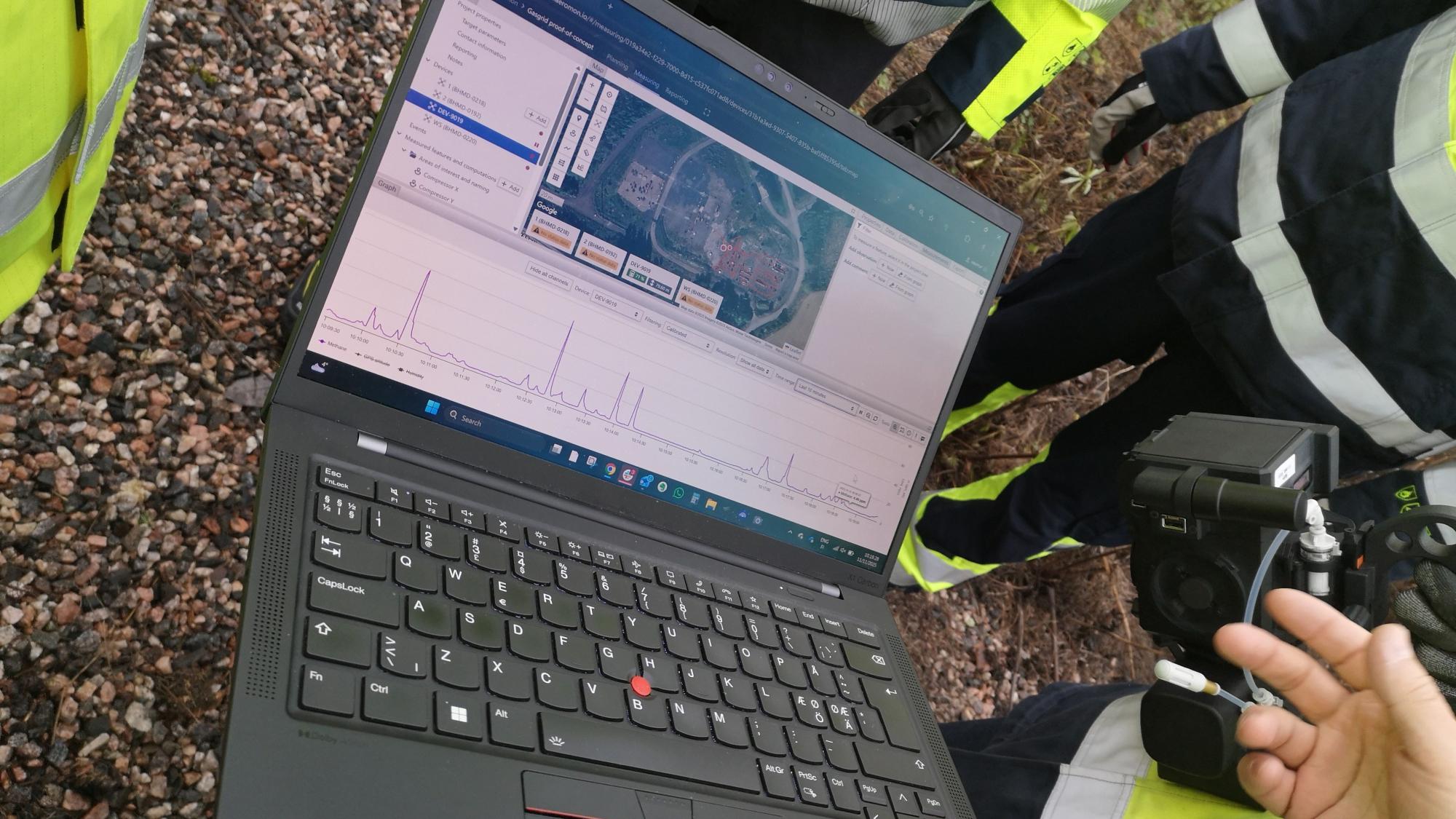
As part of the project, the research team has conducted several study visits to facilities in Finland. One of the stops was Gasgrid in Mäntsälä, where natural gas is transported through pipelines at high pressure—around 40 bar. During the visit, the project team observed the company Aeromon, which carried out measurements using drones equipped with advanced sensor technology.
”Gasgrid’s and Aeromon’s experiences with the practices and challenges of methane measurement, as well as observing Aeromon’s measurements on-site, gave us valuable insights. We saw how a site-specific methane leak concentration measurement is carried out using a drone, how weather conditions affect the measurement, and how the amount of potentially leaking gas is calculated and presented,” explains Katri Kukkola, project manager and researcher from the University of Oulu.
Methane emissions are both a climate challenge and a resource issue. By detecting and quantifying leaks early, emissions can be reduced while ensuring that more of the gas is used for its intended purposes.
“Our work focuses both on identifying where leaks occur and on developing methods to assess the actual size of the emissions. Both aspects are essential for creating effective and cost-efficient measurement techniques,” says Göran Thungström, researcher at Mid Sweden University and project manager for MEQAL.
The project group has also visited a former landfill, a peat bog, and an industrial site with digestion chambers. These visits have helped the researchers identify various facilities where the need to detect and measure methane emissions is particularly high.
The insights gained from these study visits will now contribute to the development of the project’s upcoming test facility in Rovaniemi.
“It is important for us as researchers to understand the environments and technical challenges that the equipment must be able to handle. These study visits give us a clear picture of the needs, and we are now taking this knowledge with us as we build our test environment,” says Göran Thungström.