Rector Petteri Alahuhta highlights the long-term value of science and education
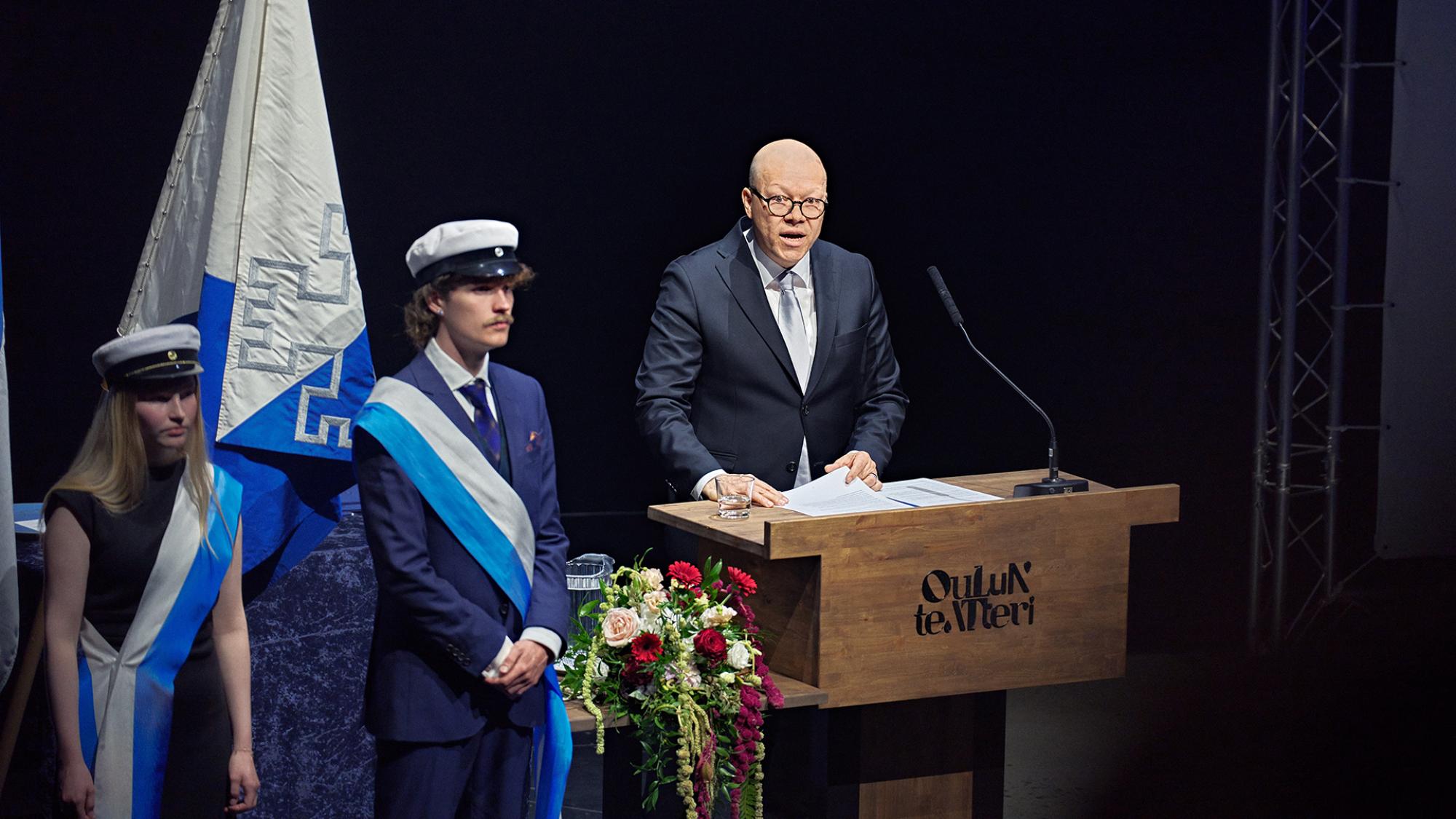
Petteri Alahuhta’s opening address at the University of Oulu Opening Ceremony of the Academic Year 8 September 2026:
What benefit does humanity gain from a bumblebee's problem-solving?
Why is it worth studying teachers' playfulness?
Why must we understand the mechanisms of ageing, or what research-based knowledge about women's health means for working life?
Distinguished guests, members of the university community, and representatives of the city and the cultural sector,
Science helps us find answers to questions that later form the basis for medical decisions, the education of children, and the development of technology. The value of research is not always recognised when the work is being done. It is recognised when the knowledge is needed.
A very warm welcome to the opening ceremony of the University of Oulu's academic year.
It is a pleasure to gather this year in the heart of culture, here at Oulu Theatre. In Oulu, the European Capital of Culture, science, art and education coexist in the same city and often in the lives of the same people. In both art and science, what matters most is not how the story ends, but that the journey changes the way we see the world.
Today, I would like to speak about three things.
First, that the work carried out here matters, both globally and in people's everyday lives.
Second, that the greatest challenges of our time do not respect disciplinary boundaries, and that is why we are building interdisciplinary research in a new way. I will also share some news on this subject.
Third, that Finland needs more highly skilled people, and that we must persuade them to stay.
Let me begin with what is done here.
Some of it is the sort of thing that cannot be built quickly or replaced with money.
At the Sodankylä Geophysical Observatory, continuous measurements of the Earth's magnetic field have been carried out for more than a century, and our researchers play a prominent role in the international EISCAT community. Space and atmospheric research helps us understand northern conditions and the environment in which society's critical systems operate.
In October, Oulanka Research Station will celebrate its 60th anniversary. Its oldest environmental and climate change measurement series are almost as old as the station itself.
The value of both lies in the same thing. Long-term data series cannot be bought with money. They come into existence only because someone has carried out the work every day for decades, without knowing who would eventually need the information.
Much of our impact, however, can be seen closer to home.
We work closely with the Wellbeing Services County of North Ostrobothnia. We have joint professorships in which the same individual conducts research, teaches, and treats patients. In this way, research findings are transferred into clinical practice without a decade-long delay. When research is undertaken here into breast cancer risk factors or the early detection of neurological diseases, the fundamental question is who receives the right treatment in time.
Not all impact can be measured by the same yardstick.
Our research also gives rise to new businesses. The start-up company Zun-H is commercialising technology that produces clean hydrogen directly from sunlight and water.
The impact of teacher education or Sámi culture research is visible in different ways and over different timescales.
In today's fast-paced public debate, this is easily forgotten, and there is no longer a self-evident consensus about the value of science. Defending its place is our responsibility, even when it does not produce immediate benefits.
Distinguished guests,
Major challenges such as climate change, geopolitical tensions, population ageing, and the loss of biodiversity do not follow disciplinary boundaries. Answers cannot be found from a single perspective.
Let me take comprehensive security as an example, a subject that is often discussed in public primarily as a technological issue.
The reliability of critical systems is a matter of technology. Identifying information influence operations is a matter of the humanities. Crisis communication and community behaviour during emergencies are matters of social science. The ability to distinguish fact from rumour is a matter of education.
Education lies at the heart of comprehensive security just as much as engineering does.
We have all these disciplines within the same university. However, interdisciplinarity can only be built on the foundation of strong expertise within individual disciplines.
Let me highlight two examples.
Network technologies. We lead a programme that develops 5G and 6G network technologies for defence applications. Nearly five million euros of funding from the Ministry of Defence is taking this work from the laboratory into Arctic and operational environments. Our partners are VTT, Nokia Defence and Telia.
Educational sciences. The ability to recognise manipulated content and to ask where information comes from does not emerge naturally. It is taught. We educate a significant proportion of Northern Finland's teachers, and they will bring these skills into classrooms for the next forty years. No network technology can function in a society that can no longer distinguish information from rumour.
These examples may appear different, but they address the same challenge. One strengthens the technical capabilities of society, while the other strengthens people's ability to act on the basis of reliable information. Comprehensive security requires both.
Interdisciplinarity is not a new idea for us.
Biocenter Oulu was established in 1986. It marked the beginning of a series of multidisciplinary research centres, and we have been building that expertise ever since through research programmes, centres and institutes.
A review completed this spring revealed another reality. Collaboration across disciplines too often emerges by chance, dependent on the networks of individual researchers. As a result, our impact falls short of what we could achieve. Raising the level of interdisciplinarity, as promised in our strategy, requires structures and resources.
That is why a new institute will begin operating during this academic year.
It will be built upon the work accumulated over the past forty years, not in place of it. Its mission is to bring together the work of our multidisciplinary research centres and to elevate our interdisciplinarity to the level where it should already be.
The institute now has a name. I am pleased to announce it here today: Integra, the Institute for Integrative Studies
Distinguished guests,
Let me immediately offer one example of the kind of challenge for which such an institute is needed. Artificial intelligence is changing the way people learn faster than education systems can adapt. There is now an overabundance of text. Answers are available in seconds.
At Oulu, this is being studied through the concept of hybrid intelligence. Led by the Faculty of Education and Psychology, the Hybrid Intelligence Research Programme starts from the premise that the intelligence of the future will arise neither from machines nor from humans alone, but from their interaction. Its central research question is this: Do we shape artificial intelligence, or does artificial intelligence shape us?
This is not primarily a technological question. It is as much about learning, psychology and education as it is about algorithms.
The role of the university is to teach people to ask where information comes from, what it leaves unsaid, and on what grounds it can be trusted. This skill becomes even more important at a time when answers are more readily available than ever before.
Our task is to ensure that a university degree continues to represent genuine expertise.
Even in the age of technology and artificial intelligence, we must remember that people make all of this possible. That is why the university's most important task remains the same today as it was during our first year of operation almost seventy years ago: to educate the experts that this country and the world need.
Distinguished guests,
Finland needs more highly skilled people, and we must persuade them to stay.
The Vision for Higher Education and Research 2040 sets a target that 60 per cent of young adults should hold a higher education degree. Currently, the figure is below 40 per cent, and Finland has fallen below the OECD average. The gap is substantial, and it will not be closed within the lifetime of a single government.
At the same time, North Ostrobothnia is one of the engines of Finland's economic growth. That is good news, but it is also a challenge.
Research and development funding is increasing, while the real value of university funding has been declining for years. Raising educational attainment requires expanded educational capacity, and that cannot be created overnight. We are increasing our contribution as rapidly as we responsibly can, and we will speak out when limits are reached.
People from around one hundred countries study and work here. Whether they stay is not decided within the university alone. It depends on whether they can find employment in the region's companies, hospitals and public organisations after graduation, and whether this city feels like home on an ordinary Tuesday in November.
Responsibility for this does not rest solely with us. It also belongs to every employer and partner represented in this hall today. We cannot afford to lose a single skilled individual.
A large part of our community studies and works in English. Therefore, I would like to address the following words directly to our international students and colleagues.
Dear guests, and in particular those of you who came to Oulu from somewhere else.
You are not guests at the University of Oulu. You are the University of Oulu. The range of languages and backgrounds in this community is wider than any number of nationalities can capture.
We have invested in Finnish language learning, because language opens doors that nothing else can open. But belonging is not only a matter of language or policy. It is a matter of whether this city feels like yours on an ordinary day, and that is something all of us here are responsible for.
So let me be clear. The University of Oulu does not tolerate racism. Saying that here is easy. The true test is what happens on the days when no one is listening, and that test belongs to all of us in this room, myself included.
This year Oulu is the European Capital of Culture. A city earns that title through the people who live in it, and an increasing number of them came here from somewhere else.
Together, we are building the future of Oulu.
Distinguished guests,
One final word to our new students, those of you who began your studies here only a few weeks ago.
You have joined an institution where the questions are more difficult than the answers, and where saying "I don't know" marks the beginning of the work rather than its failure. Learning to tolerate uncertainty is both the most difficult and the most important skill in academic study.
Make this university your own. It was built for you.
At the start, I said that what matters most is not how the story ends, but that the journey changes the way we see the world.
Science and art are not funded because we know what the outcome will be. They are funded precisely because we do not.
Whether the question concerns a bumblebee's problem-solving, a teacher's playfulness, or the relationship between artificial intelligence and human beings, learning and enlightenment arise from the willingness to ask questions even when the answers are not yet known.
We do not know which of today's research questions will prove to be the most important in 2036.
We do not know which of this autumn's new students will solve the greatest challenge of the future.
Nor do we know what may appear small today but later change the world.
One thing we do know.
This work is carried out here with care, openness and collaboration, even when it is not easy.
That is precisely why universities are needed.
I wish you all a successful academic year.