Research: Preparing for a business transfer involves more than finding a buyer

A peer-reviewed study by the MicroENTRE Micro-Entrepreneurship Centre at the University of Oulu’s Kerttu Saalasti Institute examines business transfer readiness in rural micro and small enterprises from the perspective of business advisors working in public advisory organisations.
Challenges to business transfer readiness form three interconnected areas
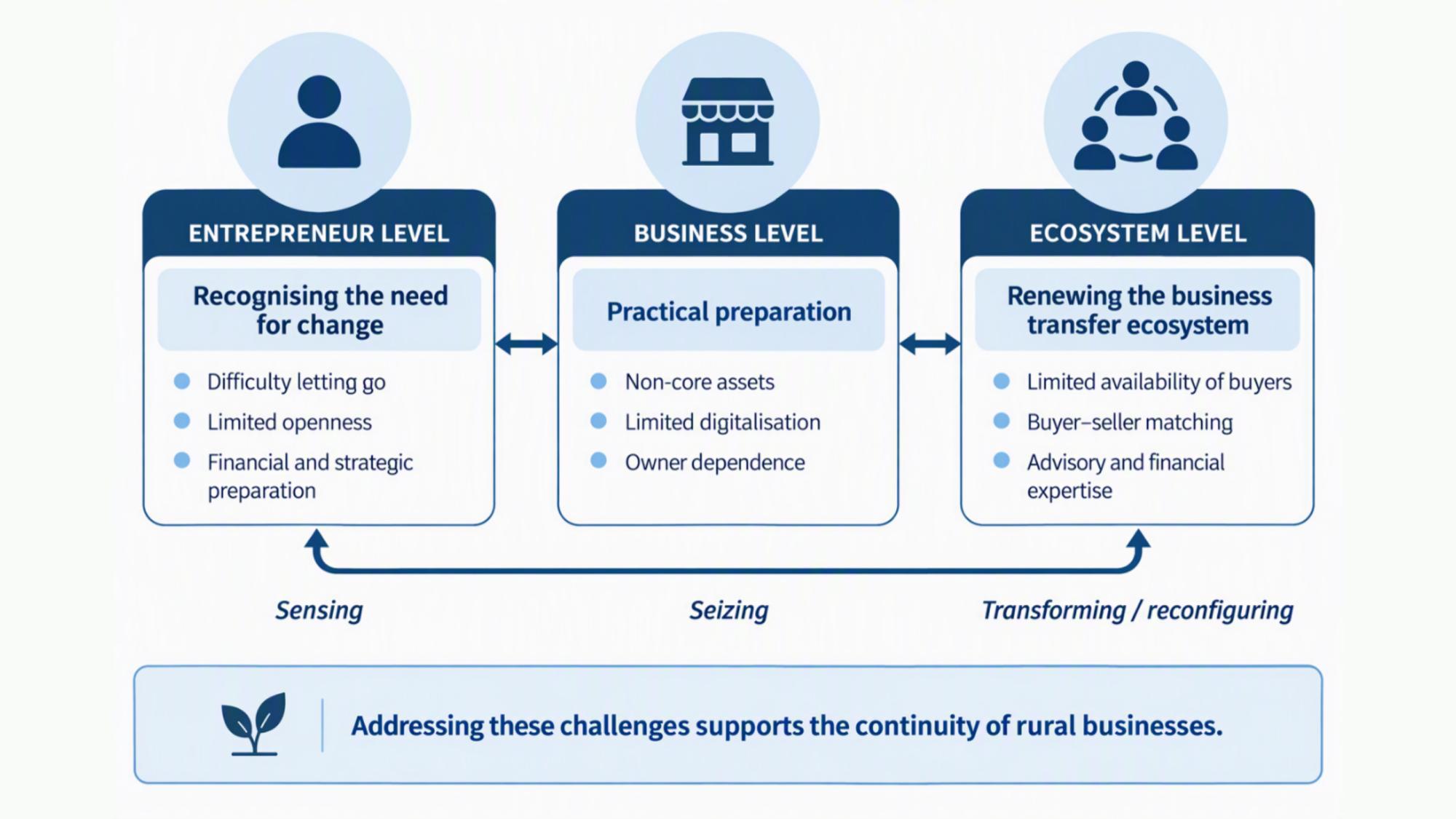
According to the study, the challenges that hinder business transfer readiness fall into three interconnected areas: recognising the entrepreneur’s need for change, preparing the business in practical terms and renewing the rural business transfer ecosystem. At the entrepreneur level, recognising the need to let go and to prepare is essential. At the business level, financial, digital and operational preparation is required. At the ecosystem level, solutions are needed to support the matching of buyers and sellers and the availability of specialist and financial expertise.
The challenges were interpreted using the dynamic capabilities framework. The analysis focused on recognising the need for change (sensing), acting on practical opportunities (seizing) and renewing business operations and the supporting ecosystem (transforming/reconfiguring). This perspective highlights that business transfer readiness does not depend on a single decision or on arrangements made only shortly before a transaction.
Letting go, owner dependence and a shortage of buyers challenge continuity
At the entrepreneur level, challenges related to recognising the need for change include difficulty in letting go, limited openness about business transfer intentions and poor recognition of the need for financial and strategic preparation. These challenges may delay the start of preparations and make it more difficult to bring the business to a state of transfer readiness.
At the business level, practical preparation is hindered by assets unrelated to the core business, diverse business activities, limited digitalisation, shortcomings in electronic financial management and owner dependence. These factors may reduce the transparency, assessability and transferability of the business and complicate valuation and financing. Owner dependence can be reduced by documenting processes and transferring knowledge and expertise within the business.
At the ecosystem level, the challenges include the limited availability of buyers, weak matching between buyers and sellers, fragmented information flows and limited access to specialist advisory and financial expertise. Addressing these challenges requires practices that support the matching of buyers and sellers and strengthen access to advisory services and financial expertise.
Preparation should begin early
According to the study’s practical implications, early advisory support should strengthen entrepreneurs’ ability to recognise needs related to a business transfer. Businesses’ digital and financial readiness should also be improved, owner dependence reduced and the matching of buyers and sellers supported.
These measures can support the continuity of rural businesses. However, the findings should be interpreted as observations conveyed by business advisors: the study is based on a small qualitative dataset and its findings cannot be statistically generalised. Nevertheless, the study provides valuable research-based knowledge to support business advisors’ observations and the development of the business transfer ecosystem.
Publication details:
Veikkola, L., Virkkala, P. & Saarela, M. (2026). Business transfer readiness in rural micro and small enterprises: challenges identified by public business advisors. The Bottom Line, 1–17.
Laura Veikkola and Peetu Virkkala work as project researchers, and Martti Saarela as Research Director, at the MicroENTRE Micro-Entrepreneurship Centre of the University of Oulu’s Kerttu Saalasti Institute.
Photo: Pexels, Pavel Danilyuk
Figure: Laura Veikkola, Peetu Virkkala & Martti Saarela