Succeeding together: Physicist Miika Nieminen and Radiologist Mika Nevalainen develop a method to unlock the full power of MRI
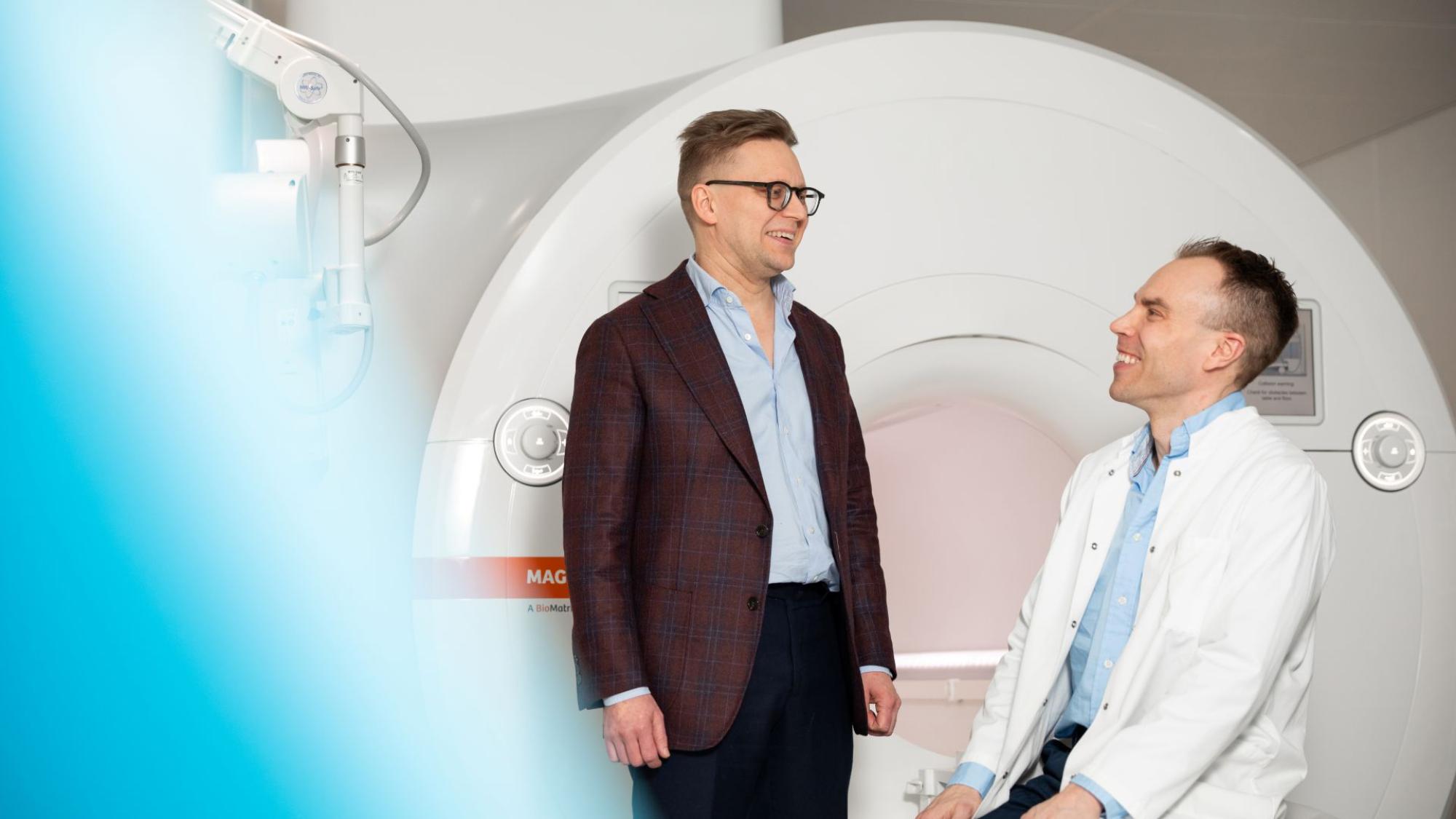
With the MRI methods currently used in hospitals, several series of images must be taken of the body part being scanned. By interpreting these together, a doctor gains an understanding of the nature of the injury. This requires the patient to lie still inside the scanner for anywhere from ten minutes to an hour.
Mika Nevalainen, professor of radiology at the University of Oulu, and Miika Nieminen, chief physicist at Oulu University Hospital, wanted to streamline the imaging process. Together, they have developed a new kind of MRI method for hospital use that utilizes artificial intelligence.
Thanks to this close collaboration, the data needed to form the magnetic resonance images can be obtained from a single five-minute scan.
"The time required for imaging is currently a bottleneck. With the technology we’ve developed, a significantly higher number of patients could be scanned during a single day compared to the present," Mika Nevalainen explains.
The duo’s method is based on Magnetic Resonance Fingerprinting (MRF), a technique originally developed in the United States, which they have further advanced in Oulu.
"In the MRF method, we don’t take direct images. Instead, we collect sparse but versatile data needed for image reconstruction. AI is then used to produce the necessary image series for the doctor to interpret," says Miika Nieminen, who researches and develops imaging methods.
According to their recent study, the quality of these new images already matches conventional methods in areas such as knee scans. Patients will be able to be scanned with this new, more efficient method in a few years.
A practical man keeps the focus on the patient
The collaboration between Nieminen and Nevalainen began when Nevalainen returned from the United States and was looking for a new research topic. The eager young researcher ended up talking with Simo Saarakkala and Miika Nieminen, sparking a close research partnership with the physicists.
The joint work between Nieminen and Nevalainen deepened further as the development of the MRF method progressed.
"I had been looking for an experienced doctor in Oulu to partner with, someone who could help bring the new MRI methods we develop into clinical use. Finding this collaboration has been a really big deal," Nieminen says.
The partnership between a physicist and a doctor ensures that the research and the development of new methods remain focused on what truly matters.
From time to time, it is Nevalainen’s job to pull Nieminen and his group back from the depths of technology and computational models to the practical level, reminding them of what is essential for patient work.
"Even though we are conducting high-level scientific research, I want our work to serve doctors in practice," Nevalainen says.
In the development of the new method, the physicists and engineers are responsible for data collection and image reconstruction, which means creating the final image for the doctor’s eyes. Doctors are needed to evaluate whether these images are accurate enough to diagnose patient ailments.
Nieminen’s group has been responsible for interpreting the data collected for MRF imaging and optimizing the AI models. Based on feedback from Nevalainen’s team, the method has been continuously improved.
"Without the professional expertise of doctors, the work would remain halfway finished. Mika lets us know if a certain structure isn’t visible enough in the image, allowing us to improve the image reconstruction," Nieminen explains.
Working with heart
Creating something new requires ambition and genuine enthusiasm. When two passionate and busy researchers work closely together, occasional conflicts are inevitable. When disagreements arise, the duo talks things through and then moves forward in good spirits.
"The fact that emotions occasionally surface shows that these things are important. We both work with our whole hearts, and that’s why we get so much out of our collaboration," Nieminen reflects.
Dialogue and openness have been key.
"We both have a strong drive to push new ideas forward, but we have to remember to share them with our research partner. Our cooperation is truly fruitful, and working together is fun," says Nevalainen.
The partnership has also taught the researchers new skills for their daily work. Nieminen, an experienced writer of funding applications, has helped Nevalainen refine his applications to be more effective. Nieminen, in turn, has adopted a more delegatory working style from Nevalainen.
"You don’t have to do everything yourself; you can and should involve other experts," Nieminen says.
The pair has pushed their work forward with great success, and they intend to shift into an even higher gear. Their next goal is to delve into modifying the MRI pulse sequences so that the imaging method becomes independent of the device manufacturer.
Recruitment for the follow-up project is underway, and a good team will soon grow even better.
The Achievers:
Miika Nieminen
Work: Chief Physicist at Oulu University Hospital, Professor of Medical Physics at the University of Oulu.
Education: PhD in Medical Physics, Specialized Hospital Physicist.
Motto: Eyes on the horizon, move boldly forward without fearing setbacks.
Mika Nevalainen
Work: Professor of Radiology at the University of Oulu, Director of MRC Oulu (a joint research center of the Wellbeing services county of North Ostrobothnia and the University of Oulu), and part-time Chief Physician.
Education: Doctor of Medicine, Specialist in Radiology.
Motto: Less is more.