Guiding Sustainable Manufacturing in an AI-Driven Industry

Imagine a factory where machines predict their own failures, production lines optimize themselves, and decisions are guided by real-time data. This is no longer a distant vision. Artificial intelligence is already reshaping manufacturing, from simulation and predictive maintenance to adaptive production control.
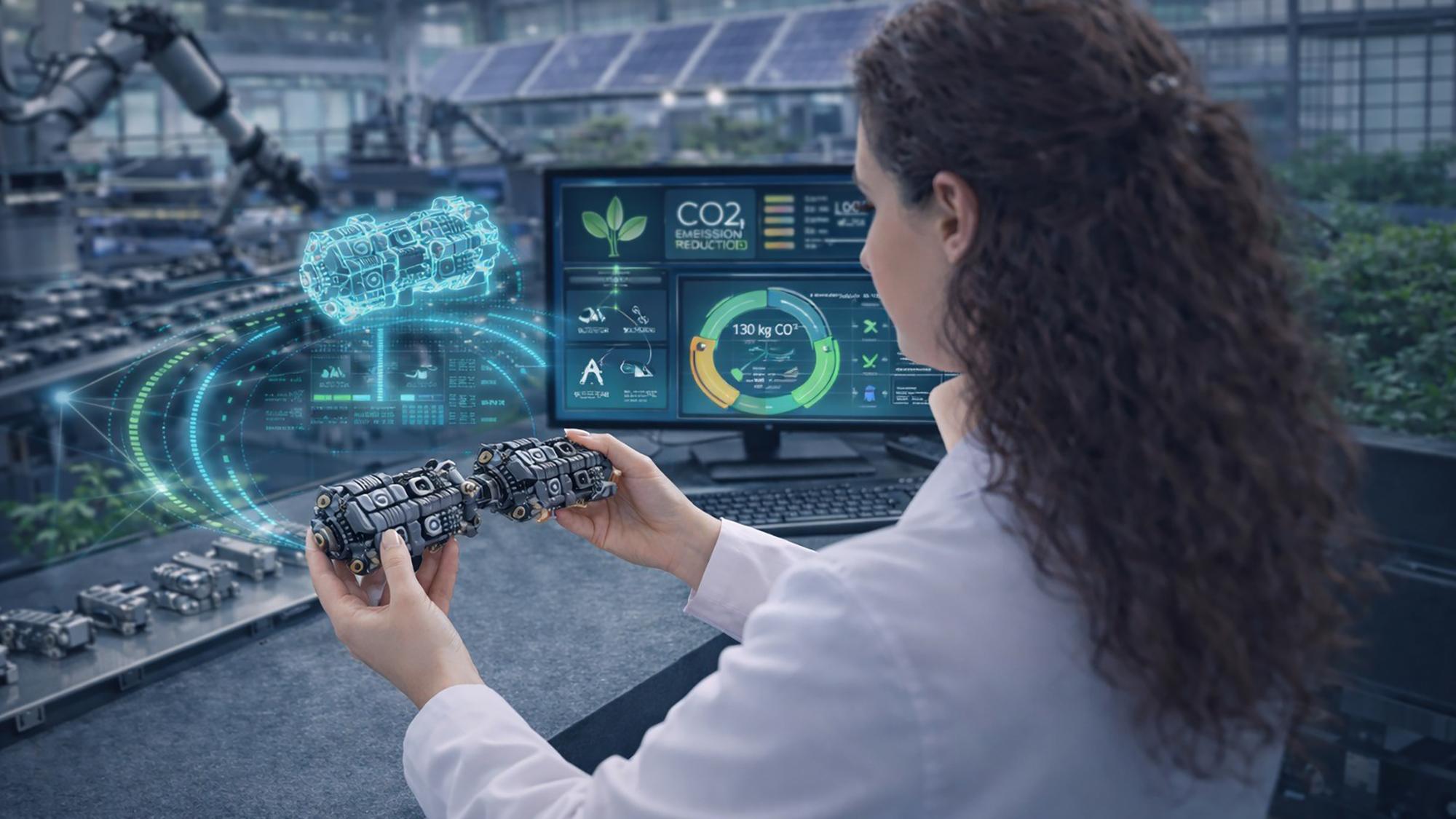
tekoälykuva naisesta teknologian ääressä

Yet efficiency alone does not equal sustainability. The real challenge is not whether AI can optimize production, but how we ensure it optimizes for the right goals.

Guiding AI toward sustainability

Modern manufacturing generates vast amounts of data. When intelligently analyzed, this data can uncover hidden inefficiencies, improve material utilization, reduce energy consumption, and prevent unexpected breakdowns.

In practice, this means longer equipment lifetimes, fewer defects, more stable processes, and less material waste. Digital modelling and simulation can also reduce the need for physical prototyping, lowering resource use during product development. However, these benefits support sustainability only if environmental performance is embedded directly into decision-making. AI systems optimize what they are instructed to optimize. If the objective is purely cost or throughput, sustainability remains secondary.

True sustainable manufacturing requires lifecycle thinking, measurable environmental indicators, and long-term responsibility integrated into operational control.

A materials perspective on intelligent manufacturing

As a materials scientist with a PhD and postdoctoral experience in manufacturing research, I have seen how early design and process decisions shape not only performance and cost, but also environmental impact over decades. Material selection, durability, processing routes, and production parameters directly influence energy consumption, waste generation, and product lifetime.
This perspective is one reason why AI-driven manufacturing interests me. Intelligent systems create an opportunity to combine materials knowledge, process expertise, and real-time data into decisions that account for sustainability from the outset. My motivation is to contribute to manufacturing systems where AI does not merely accelerate production, but actively supports durability, resource efficiency, and long-term resilience.

When sustainability becomes a defined optimization target, not an afterthought, AI transforms from a technical tool into a strategic instrument for responsible industry.

From research to real-world implementation

At the Future Manufacturing Technologies research group at the University of Oulu Kerttu Saalasti Institute in Northern Finland, research aims to translate digital advances into practical industrial solutions. FMT connects production technologies, materials research, and automation with the real needs of regional and national industry.

One example is the national PaJarvis initiative (ERDF-funded), coordinated by FMT. The project develops an integrated AI assistant system for machine shops, accelerating the practical use of generative AI and machine learning in Finnish manufacturing. PaJarvis supports production guidance, quality assurance, and safety directly on the shop floor, showing how AI can improve operational efficiency and resource use. The project also emphasizes secure, company-specific knowledge bases and safe interaction with production equipment, demonstrating that AI solutions are ready for practical, real-world environments.

In parallel, FMT contributes as a partner in the Horizon Europe proposal HARMONY, Human centred Adaptive Real time Manufacturing with self Optimising iNtelligent sYstems. HARMONY advances a human-centred, AI-native manufacturing ecosystem where distributed AI agents and digital twins enable real-time reasoning and adaptive optimization from planning to shop-floor execution.

A central objective is to explore ways to embed sustainability as an operational control variable, for example by integrating automated life-cycle assessment (LCA) and product carbon footprint (PCF) calculations into the optimization loop. This means production decisions can be guided not only by cost and productivity, but also by energy efficiency and environmental impact. By integrating deep learning, large language models, digital twins, and synthetic data within EU-aligned trustworthy AI frameworks, the initiative places FMT at the forefront of next-generation digital and sustainable manufacturing.

Choosing the direction of progress

Technology will continue to evolve. Algorithms will become more powerful, and industrial data ecosystems will expand. The decisive factor is not capability, but direction.

Sustainable manufacturing in an AI-driven industry depends on consciously aligning digital transformation with environmental responsibility. When materials science, manufacturing expertise, and intelligent systems are developed together, with sustainability as a core control variable, innovation gains both competitiveness and purpose.

AI will shape the future of manufacturing. But it is up to us to define what that future optimizes for.

Author:
Originally from Morocco, Yousra El Jemri holds a PhD in Physico-Chemistry of Materials, Environment and Energy, with a background in Chemical and Process Engineering. His research combines functional materials and bioactive compounds, applying surface engineering, coatings, and biochemical studies with experimental design to develop and optimize materials for technological, biomedical, and biological applications. During his research visit (1.9.-28.12.2025) at the Future Manufacturing Technologies research group at the University of Oulu Kerttu Saalasti Institute, in collaboration with the Faculty of Medicine, he investigated PVDF-based coating techniques for 3D-printed titanium alloys and stainless steel to enhance their surface properties and biocompatibility. He then evaluated these coatings through in-vitro testing, an experience that deepened my understanding of how materials science and biofunctional research can support more sustainable and advanced manufacturing solutions.

Photo: AI

Created 27.3.2026 | Updated 27.3.2026