
The northernmost stop – LuovAIn! Roadshow in Rovaniemi explored the role of AI in creative work today and in the future

For about two years, the LuovAIn! project’s roadshow has travelled across Finland from south to north, exploring the relationship between artificial intelligence and creativity. Held at the Faculty of Art and Design at the University of Lapland in Rovaniemi on 23 April 2026, the roadshow brought together creative professionals, students, entrepreneurs and experts to discuss the impact of AI on creative work. The seminar and workshop formed a multifaceted and thought-provoking programme. A strong message ran throughout the event: AI is not a replacement for creativity, but a tool, a collaborator and an opportunity.
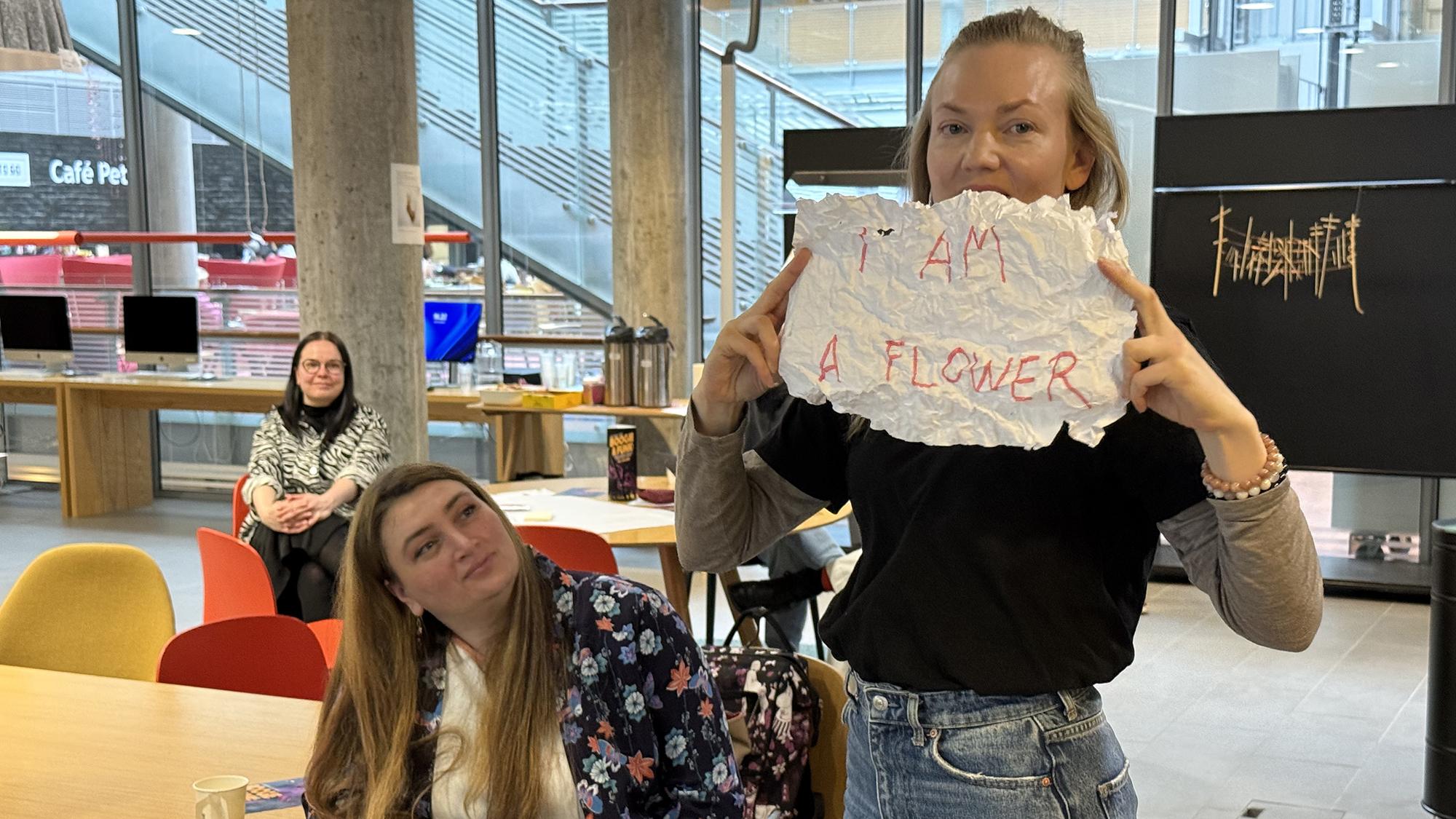
nainen pitelee paperia, jossa lukee "I am a flower"

The presentations, discussions and workshop sessions offered perspectives on how AI is transforming creative processes – but above all, on how people can retain creative leadership amid this transformation.

AI as a partner in the creative industries

Satu Miettinen, Dean of the Faculty of Art and Design at the University of Lapland, emphasised that AI is rapidly becoming an integral part of creative work processes and can no longer be viewed as an external phenomenon. It is seen as opening up new opportunities and making work more efficient, while also creating new competence requirements.

The university is responding to this transformation by integrating AI into teaching as a cross-cutting theme and ensuring that education remains research-based, giving students an up-to-date understanding of AI development and its impact on working life. The aim is to educate professionals who not only know how to use AI but also understand its possibilities and limitations.

Threat or opportunity? AI and the transformation of the creative economy

Julius Oförsagd, Design Director at Arctic Factory and Chair of the Lapland Creative Industries Cluster, raised a question that is on many people’s minds: will AI take over the market for creativity?

His perspective was realistic but encouraging. Although AI challenges traditional business models by producing content quickly and inexpensively, the answer lies in adaptation. The value of the creative industries will increasingly come from understanding people, creating meaningful experiences and connecting creativity with context.

Oförsagd also emphasised that AI can free up capacity for thinking. As some routine tasks become automated, people have more space to focus on what they do best: thinking, questioning and creating something new.

Greater efficiency and new flows of ideas in design work

Ville Kemppainen, Industrial Designer at Lappset, described AI as a “modern and powerful tool” that, when used effectively, can multiply the efficiency of design work. According to Kemppainen, AI works best as an assistant and a sparring partner.

The design process can become a dialogue: the human starts, AI continues, and the interaction proceeds iteratively towards the final solution. This way of working can generate new and unexpected perspectives and enrich ideation.

Kemppainen nevertheless stressed the importance of critical thinking. AI makes mistakes and can draw incorrect conclusions. It can inspire and accelerate the process, but responsibility for the final decision remains with the human.

Automation is changing the rules of the game

Markus Sjöberg, a researcher at Tampere University, examined the impact of AI from the perspective of automation. He presented his personal project, which resulted in Tyhjä sivu (“The Blank Page”), a novel written entirely by AI.

According to Sjöberg, AI does not merely support creative work; it can also replace parts of it. Some tasks that can be automated are routine elements of creative work, while others touch directly on its core. As a result, some tasks may disappear or change significantly.

A key message was that not everyone working in the creative industries needs to use AI – but everyone needs to understand how it affects the market. In craft-based work, for example, authenticity, uniqueness and the human touch can be emphasised as distinguishing qualities.

Creative leadership remains with humans

John Collingswood, Technical Director and Designer at Taikabox, discussed AI as part of creative leadership. He highlighted a central paradox: while AI was expected to free up human creativity, it is now increasingly producing creative content itself. This development raises questions about copyright, originality and the very concept of creativity. Who is the creator of a work? Can writing prompts itself be considered creative work?

According to Collingswood, however, the artist’s role remains clear: humans must lead the creative process from beginning to end. AI can be part of the production process – much like Warhol’s Factory – but without human vision and context, it remains a tool without direction.

The workshop explored the essence of creativity

The event’s futures workshop brought the discussion to a practical level. Participants considered what space remains for creative professionals in the age of AI.

The workshop used a variety of approaches, including movement, images, text and discussion. Several themes emerged as particularly important for the future:

  • human contact and a sense of community
  • embodiment and intuition
  • emotions and lived experience
  • dialogue and interaction

The shared view was that while AI can enrich creative processes, human experience will remain at their core.

Community and a culture of experimentation carry us into the future

A culture of experimentation emerged as a central theme of the LuovAIn! Roadshow. There is no single correct way to use AI; learning takes place through doing, experimenting and sharing.

The importance of community was also strongly emphasised. Discussion, exchanging perspectives and learning together help people navigate a rapidly changing environment.

AI was seen not only as a tool but also as a catalyst for discussion – a phenomenon that compels us to reconsider the meaning of creativity, work and values.

Participants’ experiences: new insights and directions

The seminar brought together a total of 57 participants, while 31 people took part in the futures workshop that followed. Feedback from the event reflected the wide range of insights generated during the day. The speakers were praised for their diverse and interesting perspectives, and many participants felt they had gained new ideas for their own work.

Although some of the content was already familiar to participants, the opportunity to hear other people’s perspectives and discuss AI together was considered particularly valuable. Participants also expressed a wish for more discussion on ethical issues, copyright and information security.

As concrete next steps, participants mentioned experimenting with new AI tools and using them to create text, images and music.

Humans at the heart of creativity

The Rovaniemi Roadshow was organised in cooperation with the EU-funded Lappi-brändi 2.0 and HackIT! – Boosting Digital Competence in the Performing Arts projects. The event left participants with a clear message: AI is rapidly transforming the creative industries, but it does not take away the fundamentally human core of creativity.

On the contrary, human capabilities such as critical thinking, empathy, imagination and the ability to create meaning are becoming increasingly important. AI can make creative work more efficient, inspire new ideas and expand its possibilities, but its direction and meaning continue to come from people.

The Artificial Intelligence in the Creative and Cultural Sector Ecosystem – LuovAIn! project is co-funded by the European Union. The project is implemented in 2024–2026 with national ESF+ funding for innovation competence in the creative and cultural sectors, as part of the Innovation and Skills in Finland 2021–2027 programme. The project partners are the University of Turku, University of Oulu, Tampere University and LAB University of Applied Sciences.

Author: Eeva Leinonen, MA, Project Manager, University of Oulu Kerttu Saalasti Institute

Photos: Minna Kilpeläinen, MA, MEd, Communications Specialist, University of Oulu Saalasti Institute

Co-funded by European union logo


Created 3.9.2026 | Updated 3.9.2026