Renewing Industry Needs Expertise, Courage and Collaboration

How can Finland succeed amid global change, and what role can advanced manufacturing technologies play in strengthening competitiveness, security of supply and sustainable growth? The 26th Kerttu Saalasti Seminar, held at Väinölänranta Event Park in Oulainen on 19 August 2026 and hosted by journalist Petteri Löppönen, explored these questions. In addition to new technologies, the day’s presentations highlighted the importance of expertise, domestic production capacity, business renewal, and collaboration between research organisations, companies and the public sector.
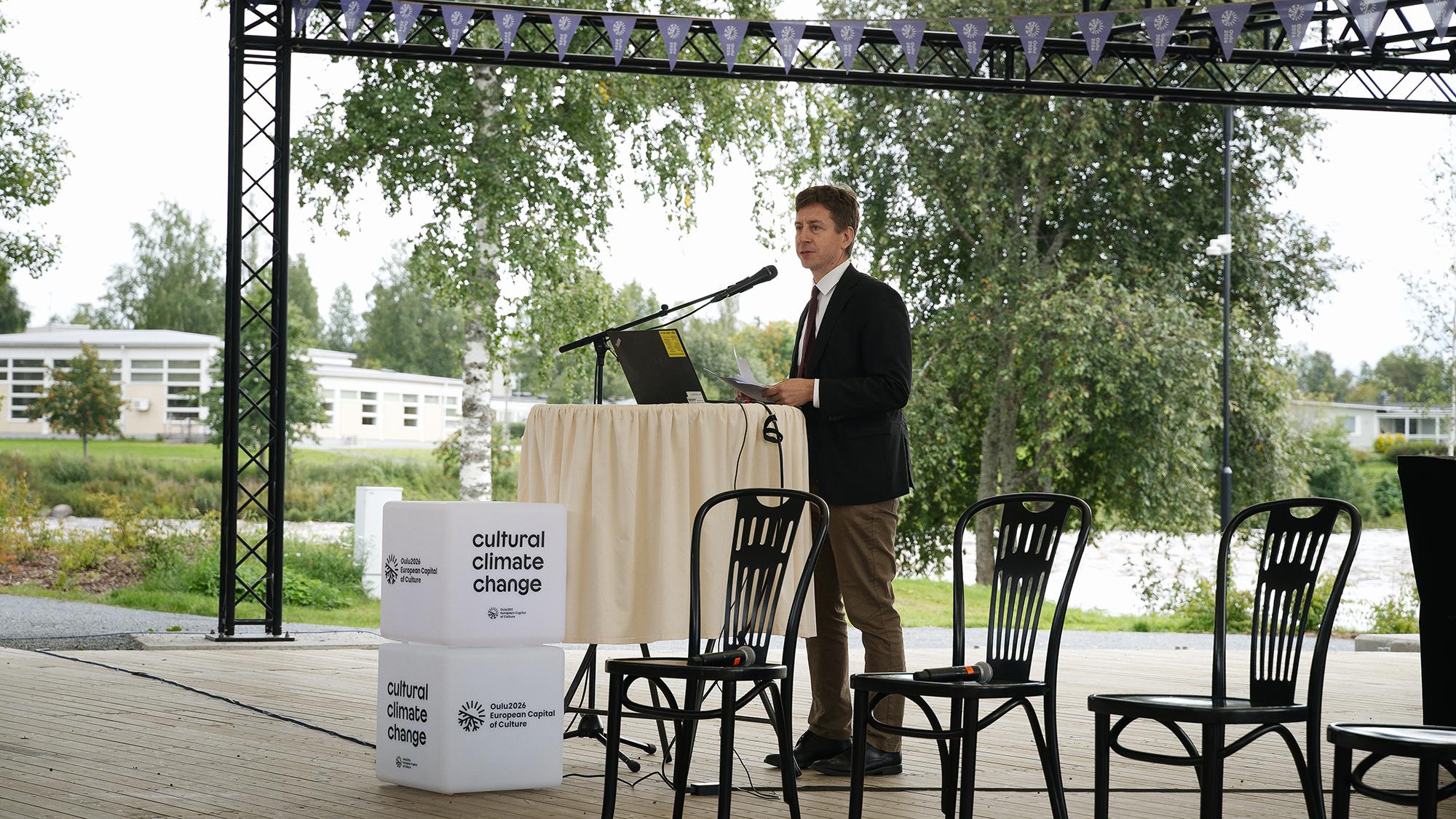
Sakari Puisto Kerttu Saalasti -seminaarissa
Minister of Economic Affairs Sakari Puisto

Professor Matti Muhos, Director of the University of Oulu’s Kerttu Saalasti Institute and Executive Director of the Kerttu Saalasti Foundation, noted in his opening remarks that geopolitics, technological transformation and sustainability requirements are currently reshaping both societies and economies. Responding to these changes requires new knowledge, bold initiatives and collaboration between research, business and the public sector. Northern Finland’s strong industrial expertise, business base, critical natural resources and energy potential are also significant assets for Finland’s competitiveness as a whole.

Petteri Alahuhta, Rector and Vice Rector for Cooperation at the University of Oulu, highlighted three perspectives in his speech: security, technology and entrepreneurship. According to Alahuhta, security of supply is not built solely on stockpiles but also on expertise and the ability to put new technologies into practice. Rapid technological development challenges both research and industry, while also creating opportunities to develop solutions together. Universities contribute an understanding of technological development, while industry provides knowledge of concrete application needs.

Finland must renew itself

Minister of Economic Affairs Sakari Puisto examined the future of Finnish industry through the development of Oulu and Northern Finland. According to Puisto, the establishment of the University of Oulu and the growth of the region’s technology industry demonstrate what can be achieved through long-term decisions, expertise and collaboration between public and private actors. The central message of his speech was the ability to renew: success does not come from avoiding change, but from being able to adapt and renew alongside it.

Puisto highlighted the adoption of advanced manufacturing technologies, the renewal of industry based on clean energy and high value-added production, and crisis-resilient growth as key factors for Finland’s future. Artificial intelligence, robotics, digital twins and additive manufacturing are transforming manufacturing, but their ultimate impact will be determined in practical production environments.

According to Puisto, interest in industrial investment alone is not enough. Investment intentions must be converted into decisions and ultimately into production. In addition to financing, investments require smooth permitting processes, sufficient grid capacity and skilled professionals.

From the perspective of security of supply, Puisto emphasised the ability to maintain critical functions and rapidly launch necessary production. Advanced manufacturing technologies and distributed production support this by enabling, for example, critical components to be manufactured close to where they are needed, even during disruptions.

3D printing brings flexibility to manufacturing and security of supply

Eetu Kivirasi, Research Engineer at Patria, discussed the potential of additive manufacturing particularly from the perspectives of the defence industry and security of supply. 3D printing makes it possible to manufacture parts without relying on traditional long supply chains and large inventories. The production of necessary components can be digitalised and manufacturing capability verified in advance, allowing parts to be produced close to where they are needed when required.

Kivirasi emphasised that technology alone cannot ensure security of supply. A functioning industrial ecosystem, expertise and collaboration are also needed. Once a manufacturing chain has been tested and proven to work, it can also create scalable business opportunities and exports.

From research to business

Associate Professor Antti Järvenpää from the Future Manufacturing Technologies (FMT) research group at the Kerttu Saalasti Institute and Santeri Varis, Chief Technology Officer at TRIDIAM, illustrated collaboration between research and business through a dialogue between academia and industry.

Metal additive manufacturing can save material and enable structures that are difficult or impossible to produce using conventional methods. However, new technologies should not be adopted simply for the sake of technology. Instead, there should be a genuine business problem that the new method can help solve.

One of the roles of research is to reduce the risks companies face when adopting new technologies. At the Kerttu Saalasti Institute, for example, extensive research data has been produced on the mechanical properties of 3D-printed metals. According to Varis, research projects offer companies a cost-effective opportunity to conduct initial experiments and gain access to knowledge that could be expensive to acquire independently.

The discussion also highlighted the need for expertise. Finland has strong expertise in steel, metals, welding and robotics, but more education and training in additive manufacturing is needed.

New manufacturing technologies are already being put into practice

Associate Professor Antti Järvenpää and Project Manager Terho Iso-Junno from the Kerttu Saalasti Institute introduced the panel discussion by presenting research and business collaboration carried out by the FMT research group.

In his presentation, Järvenpää examined the broader potential of future manufacturing technologies. Additive manufacturing enables, for example, lightweight and material-efficient lattice structures as well as customised solutions ranging from industrial components to medical applications. New manufacturing methods also challenge conventional design approaches: the key is not simply to manufacture an old product using a new method, but to take advantage of entirely new types of structures made possible by the technology.

Iso-Junno presented concrete examples of research and business collaboration. FMT projects have included developing a laser-welded rally car frame, building an electric vehicle prototype and electrifying a cable reel trailer. The electrification of machinery is a growing trend that can improve not only energy efficiency but also user comfort. It also responds to changing emissions requirements at worksites, as the use of combustion engines is already restricted at some sites.

Panel: new technologies should be tested, not feared

The seminar panel explored how Finland can succeed in the industrial transformation of a changing world – through technology, networks or resilience. The discussion featured Juhani Niiranen, Business Director at HANZA AB; Eetu Kivirasi, Research Engineer at Patria; Niina Merilaita, Funding Expert at Business Finland; and Antti Järvenpää.

Finland’s strengths were identified as including expertise in metals and special steels, a strong work ethic, and the ability of companies and research organisations to collaborate. Particularly in smaller communities, close cooperation between companies can become a competitive advantage. However, Finland has fallen behind other parts of Europe in some emerging technologies, such as 3D printing.

A shortage of skilled professionals emerged as one of the key challenges. Industry needs professionals who understand new technologies while also possessing strong practical skills. According to the panellists, education should ensure that students have sufficient opportunities for hands-on training. Technological transformation also highlights the importance of continuous learning, and people may need to retrain several times during their careers. Skills can be updated at any age, provided there is a willingness to learn.

The panel also discussed opportunities for small and start-up companies to obtain funding for experimenting with new technologies. Merilaita noted that Business Finland funding is competitive and governed by legislation, strategy and funding criteria. Opportunities for small companies can be created through ecosystems built around large companies as well as joint research and development projects.

The panel viewed new technologies primarily as an opportunity for employment as well. Automation and 3D printing are changing job descriptions, but competitive and growing companies also safeguard existing jobs and create new ones.

Distributed manufacturing can also create new opportunities across Finland. The 3D-printing production chain includes not only printing itself but also design, post-processing, measurement and machining, and these functions do not all need to be located in the same place. Kivirasi also highlighted mobile manufacturing chains, which can be utilised, for example, to meet security-of-supply needs.

The panel’s message ultimately centred on having the courage to experiment with new technologies. Companies do not have to bear the risks of adopting new technologies alone: research organisations, companies, funders and various ecosystems can share both risks and expertise.

Even modest financing can enable a major leap in growth

The 2026 Kerttu Saalasti Award was also presented at the seminar. The award went to Timo Liuksila, Elisa Sipponen and Anne Laaksonen, the team responsible for developing Finnvera’s micro-enterprise loan. The award is presented annually in recognition of a significant achievement in research, education or societal impact that promotes micro-entrepreneurship or an entrepreneurial culture.

The new financing instrument has enabled micro-enterprises to grow, employ people and renew themselves in situations where other financing channels have not been available.

According to the award recipients, the impact of financing can be seen in turnover, investments and jobs, but above all in entrepreneurs gaining the confidence to take the next step. Every large company once started small. The recipients emphasised that even a relatively modest investment can represent substantial growth for a small company. For a solo entrepreneur, hiring the first employee means doubling the company’s workforce.

Industrialised rural areas are an asset for Finland

Päivi Keisanen, Mayor of Oulainen, noted in her closing remarks that the technology industry is a key driver of Finland’s economic growth. In the southern part of Northern Ostrobothnia, the metal and engineering industries have a particularly strong position, and the region forms a significant concentration of sheet metal industry.

The region also has considerable investment potential related to the clean transition. In addition to wind power, plans include biogas and hydrogen plants, data centres and battery storage facilities. Keisanen described the area as an industrialised rural region where domestic production capacity, technological expertise and renewable energy come together. Keisanen also highlighted the added value that municipalities bring to promoting industrial and manufacturing business. In the region, research organisations, businesses and the public sector work together to build competitiveness for today and the future.

After the seminar, participants stayed at Väinölänranta Event Park for coffee and networking accompanied by music from Juha Seppänen, aka DJ Junna.

The seminar programme was rganized by the Future Manufacturing Technologies (FMT) research group at the University of Oulu’s Kerttu Saalasti Institute. The event was rganized by the University of Oulu’s Kerttu Saalasti Institute, the Kerttu Saalasti Foundation, the City of Oulainen and the University of Oulu Society.

The Kerttu Saalasti Seminar was part of the Oulu2026 cultural programme and the cultural climate change. Oulu is the European Capital of Culture in 2026.

Author: Minna Kilpeläinen, MA, M.Ed., Communications Specialist, University of Oulu Kerttu Saalasti Institute. AI tools were used in the preparation of this text.

Photo: Juha Seppänen

Created 8.9.2026 | Updated 8.9.2026