Sensing the Essential – From Information to Data-Driven Management for Smarter and More Sustainable Mining

How are satellites, drones, sensors and artificial intelligence changing the way mining environments are understood, monitored and developed throughout their entire life cycle? Mining is undergoing a technological transformation. Society’s dependence on the raw materials required for renewable energy systems, batteries, digital infrastructure and the broader green transition continues to grow. At the same time, expectations towards mining are evolving.
avolouhos

Mining operations are expected to become safer, more sustainable, more transparent and better aligned with environmental and societal needs. In this transition, new sensing and observation technologies, such as satellite remote sensing, drone-based sensors and advanced AI-assisted data analytics, play a central role.

Mining inherently involves the continuous identification and measurement of natural resources, the management of extraction processes, and the control of production and associated risks. Sensors and analytical tools enable us to better understand the processes occurring within both the environment and the materials we utilise. Technological development in this field has accelerated rapidly in recent years, with methods that were previously confined largely to research applications now becoming part of everyday mining operations.

The University of Oulu and VTT Technical Research Centre of Finland have participated in several European research projects investigating how new technologies can be applied throughout different stages of the mining life cycle. We are now pleased to contribute to the forthcoming volume Earth Observations and Proximity Sensing Technologies: Enhancing Safety, Sustainability and Efficiency in Mining Operations, which will be published online and later as a printed edition. The book brings together the latest scientific findings and practical experiences generated through these collaborative projects.

Satellite imagery, radar observations and drone-generated datasets together create a multi-layered information environment through which mining areas can be examined both at broad regional scales and in highly detailed local contexts. This enables more effective life-cycle management of mining operations, from mineral exploration and production to closure and post-closure monitoring. Ultimately, the challenge is not simply about acquiring more data, but about identifying what is truly essential within an increasingly complex operational environment.

The central question is straightforward: how can mining be improved in practice?

This question formed the foundation of the Horizon 2020 GoldenEye project and subsequently the Horizon Europe AGEMERA and GoldenRAM projects, where research organisations, universities, companies, SMEs and technology developers joined forces to develop and validate new sensing and monitoring solutions for mining environments. Within these projects, the University of Oulu and VTT have carried out significant pilot studies and field trials both in Finland and across Europe.

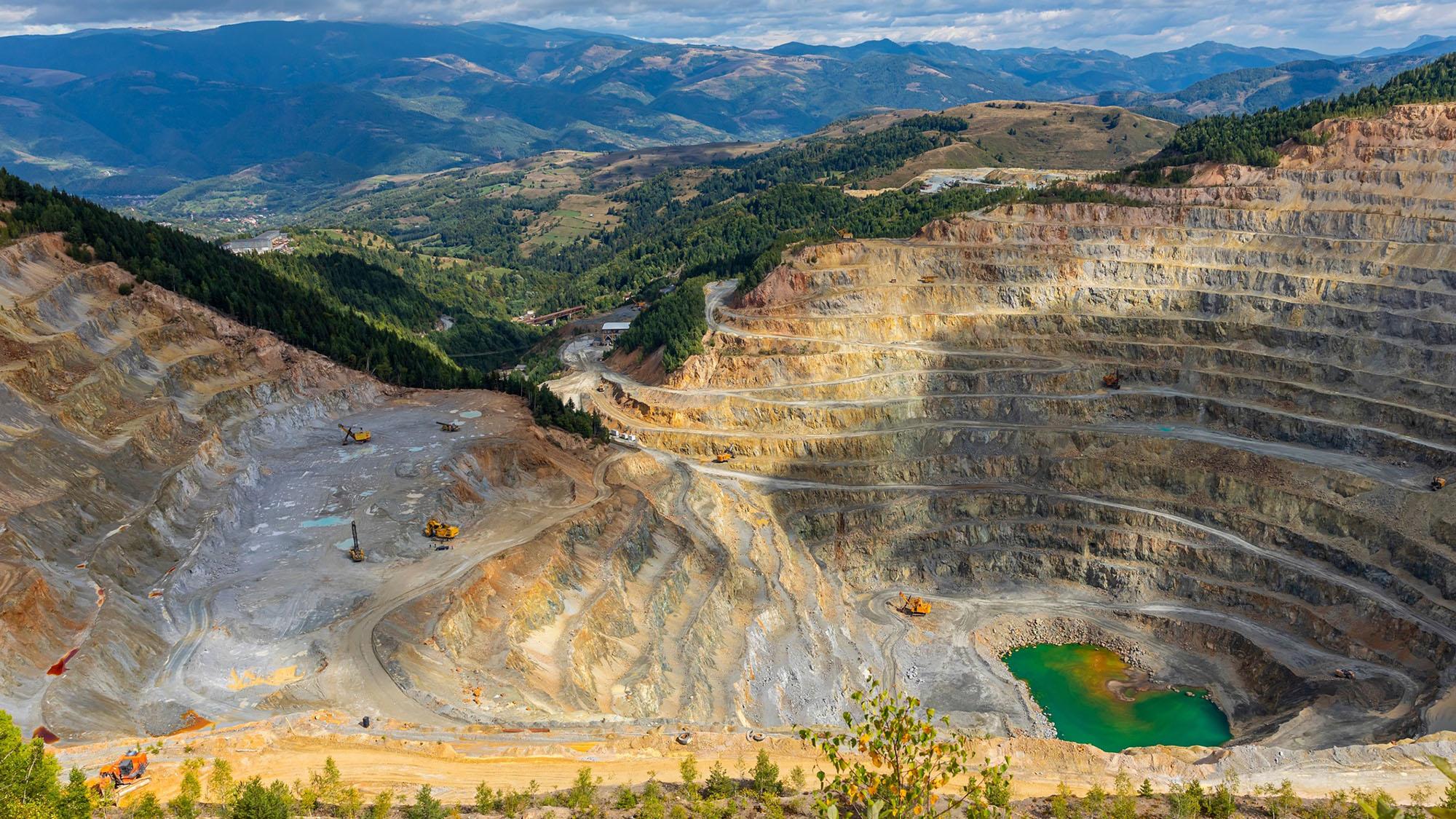
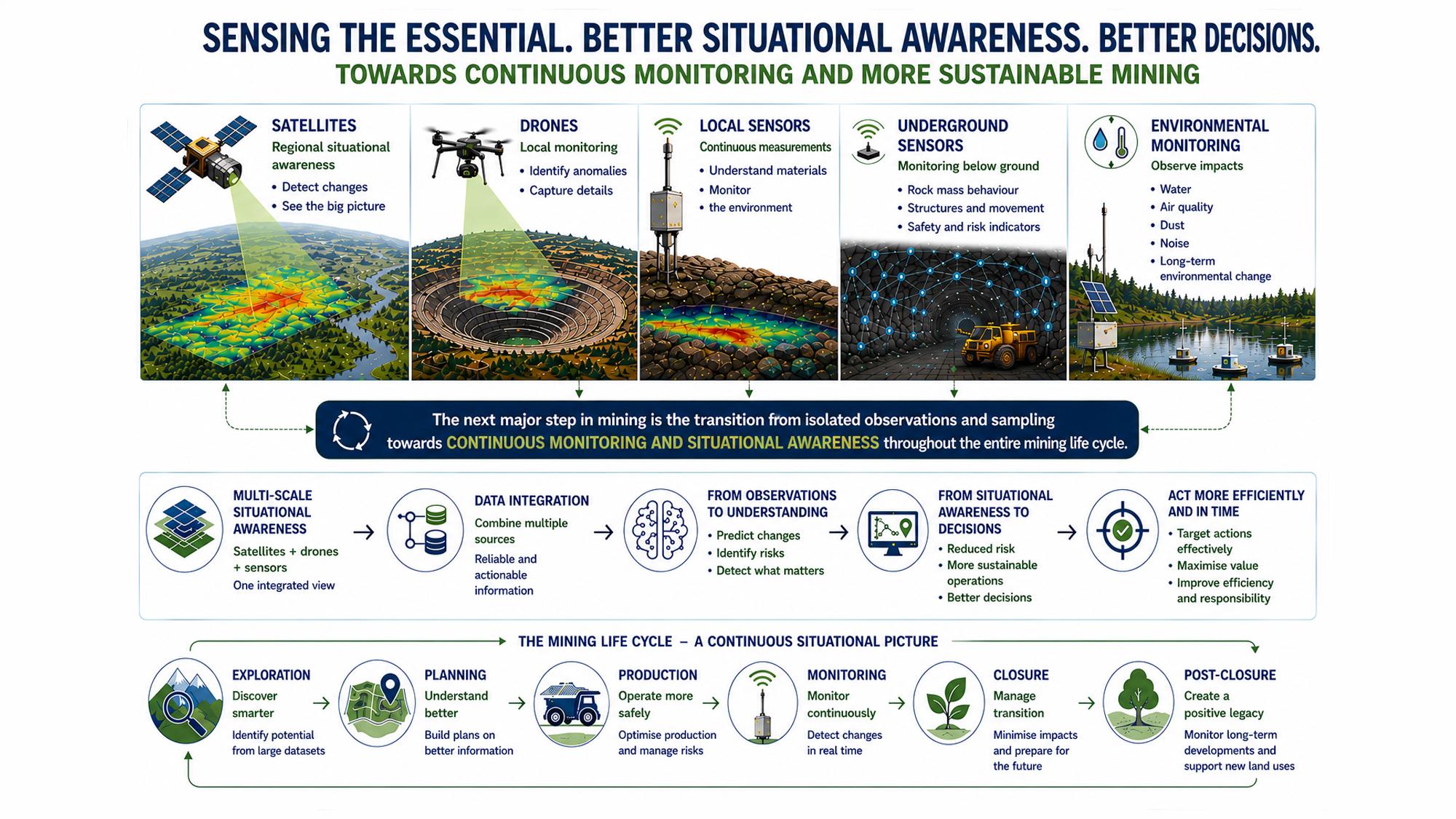
Utilisation of satellite- and drone-based observations, local sensor systems and associated data analytics for monitoring, data-driven management and life-cycle control of mining operations and mining environments. (AI-generated illustrative visualisation of the technologies and application environments discussed. ActualOriginal methodology and results figures are presented in the individual articles of the book.)

The GoldenEye, AGEMERA and GoldenRAM projects also highlight a broader and often overlooked perspective: universities and research organisations are not merely scientific institutions, but valuable partners for companies, SMEs, NGOs and other organisations seeking to engage in European cooperation and innovation activities. Within international consortia, organisations of very different sizes can contribute specialised expertise, access testing and demonstration environments, and collaborate in developing solutions that would be difficult to achieve independently.

Wide-ranging situational awareness rather than individual observations

From a technological perspective, the central idea of these projects can be summarised in a single sentence: the next major step in mining is the transition from an operational model based on isolated observations and sampling towards continuous monitoring and situational awareness of both production and the environment, extending even into the post-closure phase of mining. This reflects a growing understanding that mining should not be viewed merely as a single industrial activity, but rather as a long-term system whose environmental, technological and societal impacts extend far beyond the extraction phase itself.

Traditionally, mining decisions have relied on relatively sparse observations, such as drilling campaigns, individual measurements and periodic monitoring activities. While these methods remain essential, they often provide only momentary insights into complex geological and environmental processes.

Through numerous research cases and practical applications, the book explores how satellite- and drone-based measurements, underground and local sensor systems, hyperspectral technologies, GNSS positioning and AI-assisted analytical methods can be combined to create a more continuous and comprehensive understanding of mining environments. The objective is not to replace traditional investigation and measurement methods, but to complement them by building a continuously updated, multi-layered situational picture rather than relying on isolated snapshots. Such an approach enables earlier identification of risks, more efficient targeting of investigations, improved environmental monitoring and better-informed decision-making throughout the entire mining life cycle.

Responsible Mining Through Deeper Understanding

The publication combines scientific research, technology demonstrations and real-world mining case studies from across Europe. Particularly valuable is its focus not only on the theoretical capabilities of emerging technologies, but also on their practical applicability and the conditions required for successful implementation in operational environments.

The topic was recently presented at the European Geosciences Union (EGU) General Assembly in Vienna, where discussions highlighted how rapidly mining technologies are evolving towards integrated and data-driven operating models.

A clear message emerges from both the projects and the book: responsible mining increasingly depends on better observations, better integration of data and a deeper understanding of the environments in which mining takes place. The future of mining will rely less on isolated measurements and more on continuous observation, where satellites, drones, sensor networks and artificial intelligence together create a comprehensive situational picture that supports safer, more efficient and more sustainable mining throughout its entire life cycle.

The project activities also demonstrated that innovation is most effective when research organisations and companies collaborate across disciplinary, sectoral and national boundaries. For organisations seeking solutions, research collaboration offers access to new technologies, joint development opportunities and European projects that address technical, environmental, digitalisation, monitoring and sustainability-related challenges.

Whether in mining, environmental monitoring, energy systems, digitalisation or circular economy solutions, collaboration can transform practical challenges into internationally connected development opportunities.

Publication

Paavola, M., Kotavaara, O., Bogdanov, K., Knobloch, A., Gusat, D., & Joutsenvaara, J. (Eds.) (2026). Earth Observations and Proximity Sensing Technologies: Enhancing Safety, Sustainability and Efficiency in Mining Operations. Geological Society, London, Special Publications, 559(1).

Authors

University of Oulu Kerttu Saalasti Institute, Regional Excellence Research Group
Jari Joutsenvaara, M.Sc., Development Manager
Ossi Kotavaara, PhD, Adjunct Professor, Research Director

VTT Technical Research Centre of Finland, Optical Measurements, Finland
Marko Paavola, D.Sc. (Tech.), Adjunct Professor, Principal Researcher

Created 3.6.2026 | Updated 3.6.2026