
Who owns the music of the future and who profits from it?

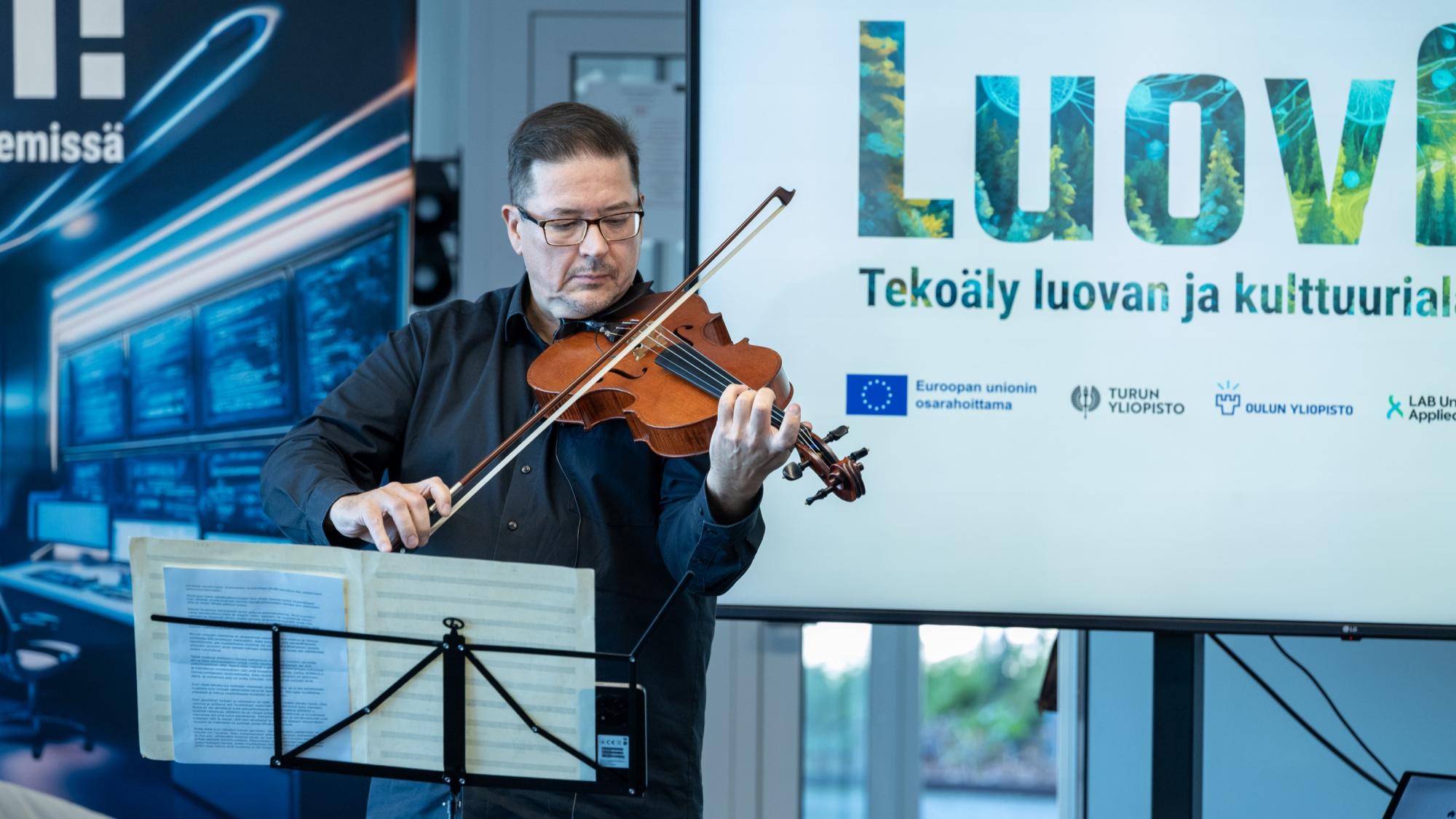
We pondered this question on Tuesday, September 22nd, at Musiikin Satama in Espoo during the LuovAIn! project's roadshow, this time in collaboration with Teosto. The speakers included University Lecturer Anton Ylikallio from the University of Helsinki, Executive Director Jari Muikku from the Finnish Music Publishers Association, Lawyer Herkko Hietanen from Reson Oy, and violist Max Savikangas, who also performed a piece he created with artificial intelligence, AI Viola?.
Max Savikangas soittaa alttoviulua
Violist Max Savikangas also added his own ingredient to the AI mix, performing the AI-assisted work AI Viola? together with sound designer Anders Pohjola. Photo: Minna Kilpeläinen

The main themes of the day were copyright, its creation, and its economic utilization in the age of AI. We were introduced to the event's theme by Vappu Aura, Director of Communications and Public Affairs at Teosto. According to Aura, people's attitudes and expectations regarding AI transparency and creators' rights have strengthened. Yet, people do not oppose the technology itself; rather, they want it to develop in a direction that does not erase humans or render them meaningless.

If you hear echoes of the early 19th-century Luddites who destroyed spinning machinery, you are not alone. Cultural anthropologist Giles Crouch writes that the Luddites were not opposed to technology itself, but to what it did to them and the social order. At Musiikin Satama, there seemed to be a reasonable consensus that the AI genie can no longer be put back in the bottle, nor is it necessarily even necessary to do so – as long as humans, human creative work, and its value are not swept under the doormat of a data center.

Closer to protection through iterative prompting

According to University Lecturer Anton Ylikallio, the exclusive protection meant by the Copyright Act requires the result of a natural person's independent and original intellectual creation. Therefore, an AI model as such cannot be considered an author under the law. Iterative prompting, where the AI model is asked to make changes based on user prompts, brings the result closer to the spirit of the law and the establishment of protection.

But at what point has a human prompted enough to claim the work as their own? The line is blurred, and judicial systems around the world are searching for answers to this question as well.

Nothing new under the sun

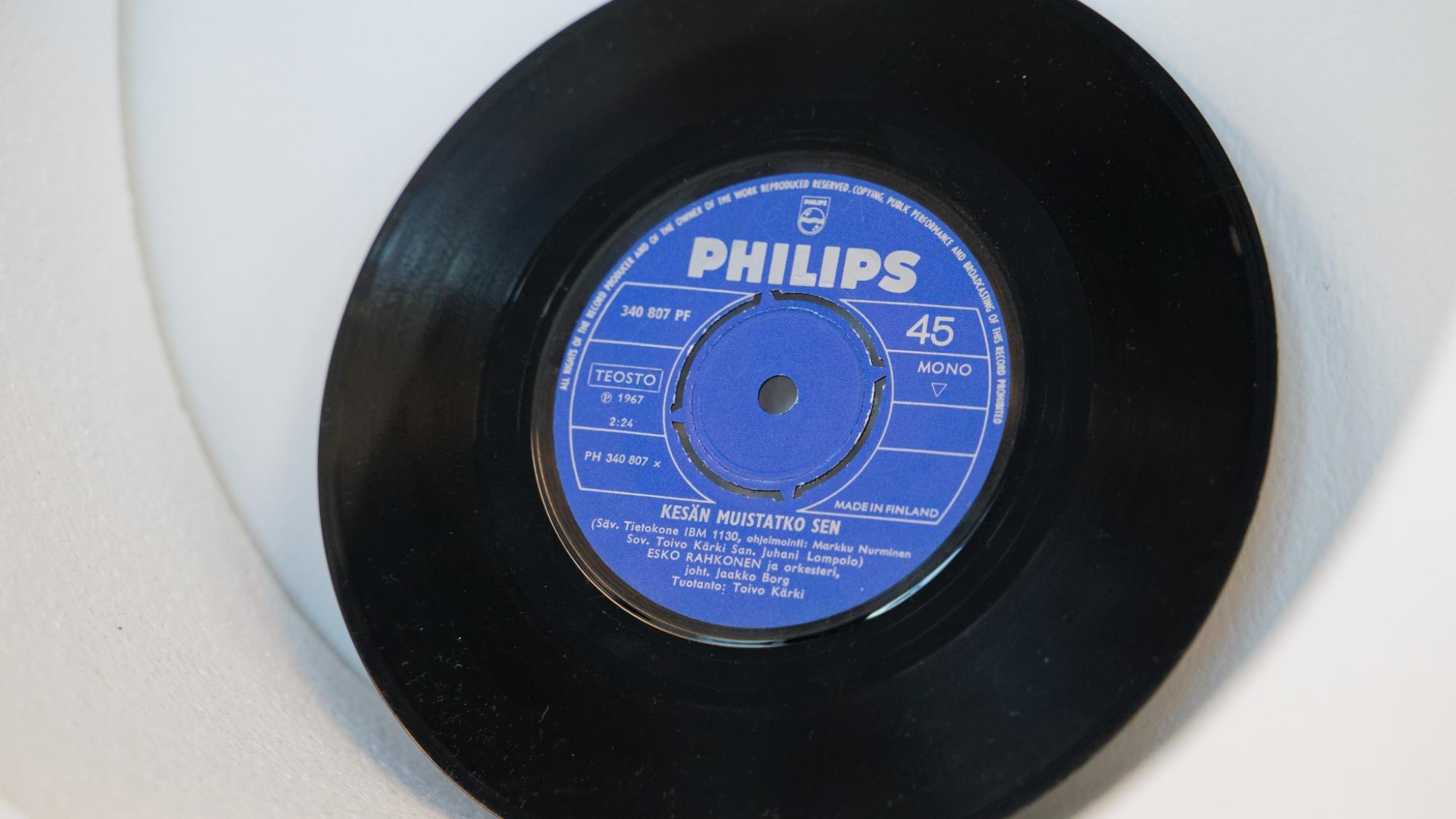
According to Jari Muikku, Executive Director of the Finnish Music Publishers Association, stories about the relationship between humans and artificial intelligence in art can be found dating back decades. For example, Finland's first AI composition was created at the Department of Applied Mathematics at the University of Turku: Programmer Markku Nurminen fed Toivo Kärki's music into an IBM 1130 computer. By arranging the IBM's outputs, the tango Kesän muistatko sen? was born and released in 1967.

Today, however, the scale of things is significantly larger than a single composition. What makes the current transition different, according to Muikku, is that the questions are genuinely global.

vinyylilevy
In Toivo Kärki's opinion, the arrival of computers in music creation was only a good thing: "The worse composers can stop composing, and the better ones can retire." Pictured is the record featuring the track Kesän muistatko sen, performed by Esko Rahkonen and composed by the Computer IBM 1130. Programming by Markku Nurminen and arrangement by Toivo Kärki. Photo: Juha Seppänen.

Muikku also highlighted an interview given in May 2026 by Andrew Sanchez, CEO of the AI music creation platform Udio. In the interview, Sanchez states that over 90 percent of Udio's users utilize the platform to create music similar to their favorite artists or songs. According to Muikku, there is also a massive discrepancy in music streaming: half of the songs uploaded to the services are AI-produced, but only 1% of the listens go to AI music.

The song is owned by the one who can prove they made it

According to lawyer Herkko Hietanen, the Copyright Act considers the author to be the one whose name is on the work – unless proven otherwise. In the age of AI, a mere name is no longer necessarily enough, and personal assurances ring hollow without evidence.

Therefore, it is advisable for music creators to keep evidence of their creative process. This evidence can include DAW projects and their version history, voice memos on a phone, or demos and rough mixes. Conversely, if one uses an AI service to make music, it is good practice to export the prompt history from the service and supplement it with a memo detailing exactly which decisions were made by the human.

Two slightly weird colleagues

Composer-musician Max Savikangas started his segment by performing the piece AI Viola? together with sound designer Anders Pohjola. In this improvisation-based piece, Savikangas plays as a trio with two AI violists trained on his music. This experimental approach is made possible by the IRCAM Somax2 software, which was fed Savikangas's own works as data. During the performance, Savikangas didn't feel like he was playing with a machine, but rather with two slightly weird colleagues. He believes that the AI colleagues' musical memory is his own, but their way of navigating the music is their own unique way.

Even my bad works are my own works

How proud can an individual be of a work that (an AI) created with a few clicks, instead of honing their skills for decades? And that all this is made possible by the unauthorized use of humanity's collective cultural property, the fruits of which are ultimately reaped by the semiconductor manufacturer Nvidia?

I remember when, before COVID, you only heard whispers of AI in the hallways, and AI in music making meant neural network-based mixing and mastering tools. On professional forums, these tools were generally liked and were seen as assisting, not as usurpers of one's job.

I have also been guilty of fooling around with AI. Out of techno-curiosity, I grabbed a new tool and made various "Will Smith eating spaghetti" versions, among other things. However, the end results were still such abstract fever dreams that my conscience remained clear. A lot of water has flowed through the cooling pipes of data centers since then.

For now, I keep AI out of my own art. Not because I fear the judgment of others, but because I end up facing eternal questions: what am I if I don't get to experience the agony of creation? What am I if I don't get to experience the daily rollercoaster of "I am a worthless worm – I am the king of gods"? At least even my bad works are my own works – but then again, an artist never lives in a vacuum.

Of course, there are many degrees of AI use, from assistive to fully generative, but I would still rather have it wash my laundry than compose my songs. But what would, for example, hotel cleaners say – would they be bitter about robots taking their jobs?

The only thing I am certain of is that change is the only constant. And that I will fall off the wagon of progress less than halfway to retirement age if I bury my head in the sand. But when I do touch AI, I also remember to thank it. May Skynet and the Terminators remember my politeness.

Author: Juha Seppänen, Musician, Bachelor of Culture and Arts, Communications intern, University of Oulu Kerttu Saalasti Institute

Photos: Minna Kilpeläinen ja Juha Seppänen

Sources:

Giles Crouch: The Four Luddites of the AI Age. Medium.

Richard M. Assmus, Brian W. Nolan: Supreme Court Denies Cert in AI Authorship Case – Updated with Comments from Dr. Thaler. Mayer Brown.

Tim Ingham: Gardens’ in AI music, Warner-Suno, and why he’s skeptical of attribution engines. Music Business Worldwide.

Laura Michelle Davis: Nvidia’s $150 Billion Buyback: A Lifeline for AI Hype, Not Everyday Investors. cnet.com

Co-funded by European union logo
Created 12.10.2026 | Updated 12.10.2026