
Hydrogen transition requires transdisciplinary cooperation

One of the current struggles of the hydrogen transition is the fragmentation of the field where expertise is often highly specific to certain aspects of hydrogen. Therefore, it is difficult to maintain an understanding of all the phases of hydrogen production in its different forms, in addition to appreciating all the different fields which have a stake in hydrogen research.

This is why there is a need for transdisciplinary cooperation.
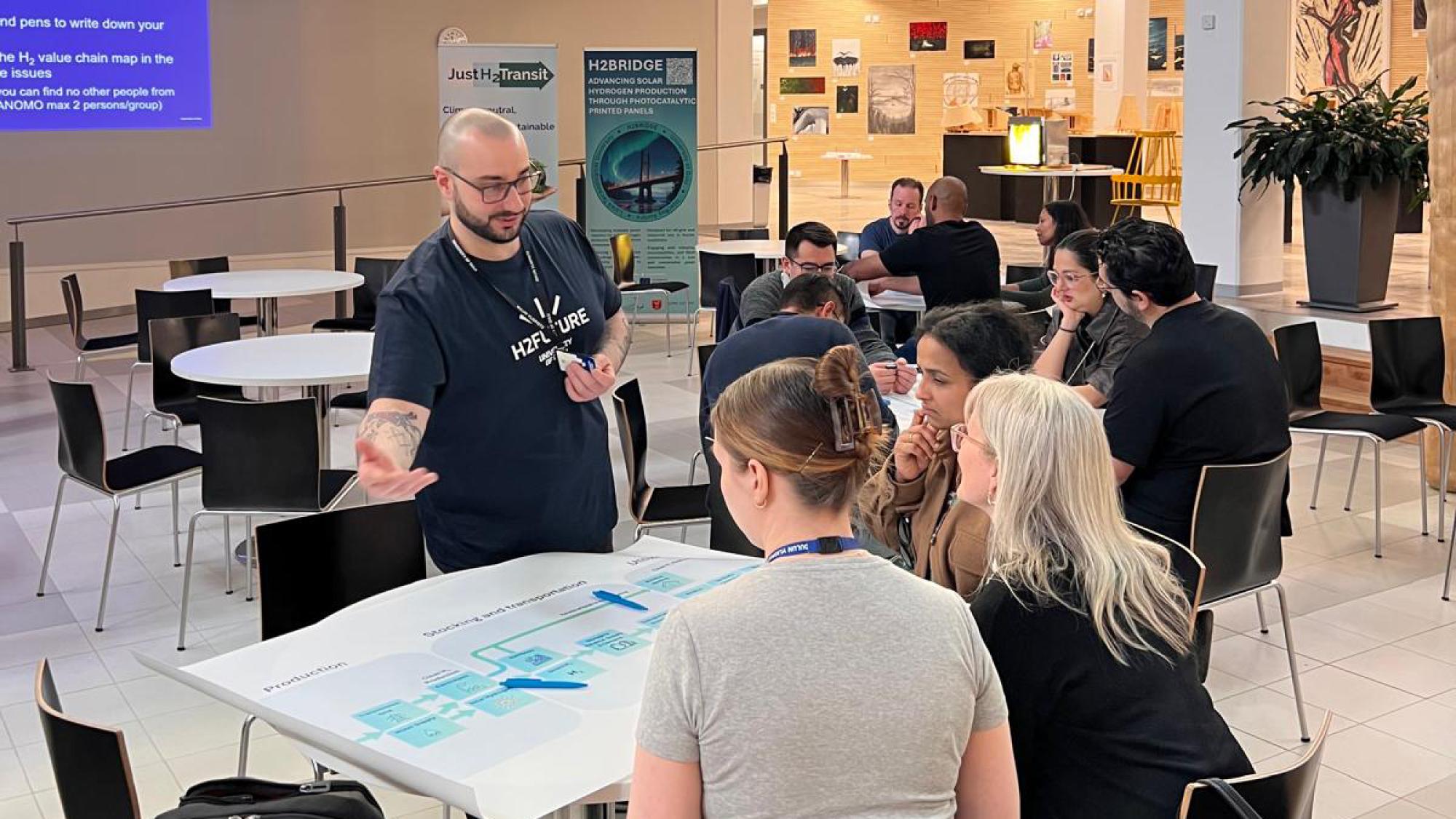
People discussing and working together in small groups.
Mapping the challenges ahead: Dr Marco Pinna guides participants as they begin identifying key bottlenecks in the hydrogen transition.

The University of Oulu is known for its hydrogen research. Hydrogen is not only about physics or chemistry, but there is a need to understand the societal values along the industrial processes as has been said by the head of Nano and Molecular Systems Unit (NANOMO) Marko Huttula. In addition to the different fields of physics, expertise from the social sciences is also needed to support a socially acceptable and just transition. Environmental sciences are required to assess environmental impacts, and legal experts are needed to understand the legal aspects surrounding the transition. But how can we look beyond our own field of expertise and come together to form a more coherent and collaborative path towards hydrogen transition?

At the UniOulu Science Day in April 2026 three hydrogen projects came together to organise a workshop with the aim of establishing cross-disciplinary conversations on hydrogen. H2BRIDGE, H2FUTURE and JustH2Transition’s workshop “Green Hydrogen Transition: From Molecules to Mindsets – Bridging Technology and Society” inspired discussions about the hydrogen transition. It reinforced the argument, that green hydrogen transition doesn’t happen only once the technology is ready, but to make this transition a reality we need to come together for transdisciplinary collaboration.

Why we need hydrogen and how can we use it?

The need for the energy transition drives from the fact that global emissions keep rising and the energy sector is the largest producer of emissions. There is a clear link between rising CO2 emissions and rising temperatures. These will have detrimental effects on the welfare of our planet, as the rising temperatures drive sea levels to rise, cause more extreme weather events including droughts, wildfires, intensified storms and heatwaves, while air-quality will drop and permafrost lost. This is why there is a need to seek alternatives in the energy sector, especially in areas of heavy industry.

There is no shortage of hydrogen as it makes up 75 % of all visible matter in the universe. On earth hydrogen exists mainly as part of water (H2O) and organic compounds. Not all hydrogen production is green however, since about 68 % of today’s hydrogen is produced by steam methane reforming, which produces 10 kilograms of CO2 emissions per kilogram of hydrogen as was explained by Dr. Manoj Kumar Ghosalya. More emphasis is therefore needed to be targeted towards production of green hydrogen. One of the methods University of Oulu specialises in is producing green hydrogen by the process of photocatalysis, in which a semiconductor photocatalyst absorbs light and creates an electron hole pair, thus splitting water into hydrogen and oxygen, reserving solar energy in the hydrogen molecules.

The Bothnia area is currently a major emitter of CO2, due to high concentration of industry in the area. One way to reduce emissions in the Bothnia area is to switch to producing green steel. This means using cleaner technologies instead of traditional, fossil‑fuel‑based methods. Hydrogen can play an important role in this transition.

Hydrogen can be used as a fuel, in advanced plasma technologies, or to directly remove oxygen from iron ore during steel production. For example, hydrogen can replace coal‑based materials in blast furnaces or be used in shaft furnaces, where it allows steel to be produced with much lower carbon emissions. Professor Pasquale Cavaliere works with the Centre for Advanced Steel Research - the largest steel research community in the Nordics, which collaborates with a large number of institutions and enterprises. So, while the Bothnia area is an industrial heartland for steel production, it is also most advanced in the process of decarbonising of its production.

An essential part of developing hydrogen and green steel technologies is the ability to observe what happens inside materials while these processes are actually taking place. This is enabled by synchrotron radiation, an exceptionally bright and precise form of X‑ray light that allows scientists to study chemical reactions and structural changes under real operating conditions. In hydrogen production, this means faster measurement, and the possibility to study tiny details and looking for specific elements, as explained by Dr Marco Pinna.

Together, these themes highlight that the transition to green hydrogen is not driven by a single technology or field of expertise, but by the interaction of many forms of knowledge. Understanding why the energy transition is necessary, how hydrogen exists and behaves, how green hydrogen can be produced through processes such as artificial photosynthesis, and how it can be used in applications like green steel all require input from chemistry, physics, materials science, engineering and industrial research.

Additionally, tools such as synchrotron radiation further show that progress depends on advanced research infrastructure and deep fundamental insight into what happens inside materials under real conditions. The green hydrogen transition is therefore as much a knowledge challenge as it is a technological one, relying on collaboration across disciplines to turn scientific understanding into scalable, low‑carbon solutions.

From a technological transition into a social transition

Now, all this technological advancement is necessary, but the physics alone will not secure a just and functioning energy transition. A functioning energy transition is one, which is socially just and accepted. Media plays a great role in spreading information and influencing public perception. A recent study by JustH2Transit introduced by Professor Eva Pongracz found that hydrogen discourse in Finnish major daily newspapers is highly positive. While this sounds like good news to the hydrogen industry, it is not without its potholes.

If the media portrayal paints an overly positive picture of the benefits while steering clear from any of the struggles of the transition, then trust in the transition may faulter as soon as any problems arise or the overly positive promises are not delivered. No transition occurs without its challenges, and for these reasons realistic communication is the key to managing public perception. Trust from the public is needed for a successful hydrogen transition. As Professor Pongracz said, “losing trust is easy, gaining it is a long cumulative process” and if the trust is lost once, it is much harder or even impossible to re-build that trust.

The relationship between the Sámi people and state institutions, including parts of the scientific community, has been characterised by a long-standing lack of trust rooted in historical and ongoing practices. That is why a special attention needs to be paid to secure that the energy transition is socially just and accepted by the Sámi people.

Climate change is a double-edged sword to the Sámi, since the impacts of climate change are already felt in the Sámi homeland, since Arctic areas are warming at least four times faster compared to non-Arctic. Many of the Sámi traditions are related to being in the landscape, which is why it is important to preserve it from changes driven by the climate change. Simultaneously however, the Sámi homelands are of interest to many who see them as vast and empty areas of land. Different land use interest such as tourism, mining and energy transition are competing in the Sámi homeland. So, while climate change may alter the landscape, climate change mitigation efforts are taking over the land. This is why the so-called green transition is often seen as green colonialism in the Sápmi.

I, Sara Vanhanen, recounted an alarming example of what may happen when the Sámi rights are ignored in the energy transition. In the Fosen case in Norway a wind power park was built on the lands of the Southern Sámi. Though the park faced objection from the Sámi from its planning, it was up and running by the time Norway’s Supreme Court announced the building license was invalid. Even after this it took several years and major demonstrations for the state to react. To avoid similar conflicts, the FPIC principle should be followed. FPIC stands for free, prior and informed consent. The principle is based on international law but has also been adapted to national laws in many countries including Finland.

Towards a functioning hydrogen transition

During the joint discussions at the UniOulu Science Day workshop, participants identified five major bottlenecks affecting the hydrogen transition: costs, risks, natural resources, technological development, and political will, alongside social acceptance. A key takeaway from the workshop was the recognition that the hydrogen transition is deeply multifaceted. It is not merely a technological shift, but also a social transformation, requiring transdisciplinary collaboration rather than isolated technical solutions.

One topic that sparked particularly lively discussion was land use, as changes in land-use practices will be unavoidable in the development of a hydrogen economy. These changes intersect with multiple disciplines raising concerns ranging from environmental impacts and displacement issues to biodiversity loss, CO₂ removal, and broader cultural, political, and value-based perspectives. The discussions also touched on governance-related questions, such as whether hydrogen pipelines should be regarded as societally critical infrastructure or primarily as business infrastructure, illustrating how technical decisions are closely intertwined with societal values and policy choices.

When considering the expertise needed to address such complex issues, environmental sciences, environmental engineering, physics, legal studies, and economics were identified as particularly central disciplines. Alongside these, the role of the social sciences was emphasised as critical for understanding societal impacts, governance questions, public perception, and issues of justice and acceptance related to the hydrogen transition. At the same time, interest in engaging in hydrogen-related research extended far beyond these core areas. Researchers from communications, industrial engineering, supply chain management, sustainable business also expressed strong interest, underlining the broad and genuinely interdisciplinary relevance of hydrogen transition research.

The workshop discussions reinforced that technological expertise alone is not sufficient. Addressing these challenges requires environmental experts to assess ecological impacts, legal and policy specialists to ensure alignment with existing frameworks and support their development, and business capabilities to enable companies to adopt hydrogen technologies scale new solutions.

Finally, sustainability cannot be understood solely in material or technological terms. Ensuring a socially sustainable hydrogen transition requires translating technological solutions into concrete, socially just practices that foster public understanding, trust, and acceptance. Meaningful progress therefore depends on cross-disciplinary collaboration to shape a transition that is not only innovative and efficient, but also fair, inclusive, and environmentally responsible.


In H2BRIDGE, Interreg Aurora-funded project in collaboration between the University of Oulu and Luleå University of Technology (2025-2028), we do our best to work towards a just hydrogen transition. H2BRIDGE is developing solar hydrogen panels and collaborating with small and medium sized enterprises. Our project is also supported by the Saami Climate Council. We value transdisciplinary collaboration and coming together to build our understanding of hydrogen from a multidisciplinary perspective. We are grateful for JustH2Transit and H2Future on collaborating with us at the UniOulu Science Day.

Created 27.5.2026 | Updated 27.5.2026

Authors

Sara Vanhanen
communications specialist, PhD researcher (University of Lapland)
Nano and Molecular Systems Research Unit

Sara Vanhanen työskentelee Oulun yliopistossa viestintäasiantuntijana H2BRIDGE-projektissa. Osa-aikaisen viestinnän tehtävänsä rinnalla Vanhanen työskentelee väitöskirjatutkijana Lapin yliopistossa. Väitöskirjassaan Vanhanen tutkii Saamenmaan militarisaatiota erityisesti ontologisten erojen kautta.

Maisterintutkielmassaan Vanhanen tutki Norjan Foseniin sijoittunutta tuulivoimakonfliktia ontologisen konfliktin ja vihreän ekstraktivismin näkökulmasta. Tutkielma palkittiin joulukuussa 2025 Anatol Rapoport -rauhantutkimuspalkinnolla.

Vanhasen asiantuntijuus käsittää laajalti erilaisia maankäyttöön liittyviä ongelmia energiasiirtymästä militarisaatioon erityisesti saamelaisten kotiseutualueella.