
Weak signals on the horizon – insights from the university community to support foresight

In a rapidly changing world, it is increasingly important for higher education institutions to identify factors that may shape the future. Foresight helps to steer research and education activities and develop solutions for future needs. But how could the thoughts and observations of the university community be used more broadly to support foresight work? From these reflections, a flexible pilot was launched at the University of Oulu, inviting the university community to participate in collecting weak signals.

Can the thinking of the whole university community be made visible?

Sometimes, a small seed of an idea that emerges during everyday work can quickly grow into an agile pilot without lengthy project planning, budgeting, or heavy organizational structures. A concrete example of this is the weak signals word cloud pilot carried out this spring at the University of Oulu to identify emerging phenomena and anticipate future competence needs.

The idea originated from a reflection on how the expertise of a multidisciplinary university could be better utilised in foresight work. Would it be possible, in some way, to peek into coffee table conversations, project meetings, and researchers’ thoughts, and bring together observations from different perspectives? The idea was to develop a tool for capturing everyday observations with a low threshold and sharing them for the benefit of the whole community.

Weak signals as a foresight tool

One of the key methods in foresight work is to identify weak signals in the operating environment – signs, events, or phenomena that may point to significant changes in the future (see, for example Weak signals from the future – Sitra). We wanted to harness the collective intelligence of the university community specifically for identifying these signals.

For the pilot, we brought together a small and enthusiastic group whose aim was to develop a solution that would be as simple and quick to implement as possible, making use of platforms already in use at the university.

Implementation of the pilot

The pilot moved quickly from idea to implementation, following the spirit of the Plan–Do–Check–Act model. The chosen solution was a word cloud created on the Howspace platform, and the target group was the staff and students of the University of Oulu, with access to the platform through university credentials.

Weak signals were collected in phases:

  • in March, in connection with the Science Leadership course, in a facilitated format for a limited group of participants
  • in April, at the Science Day event, in a more informal pop-up style
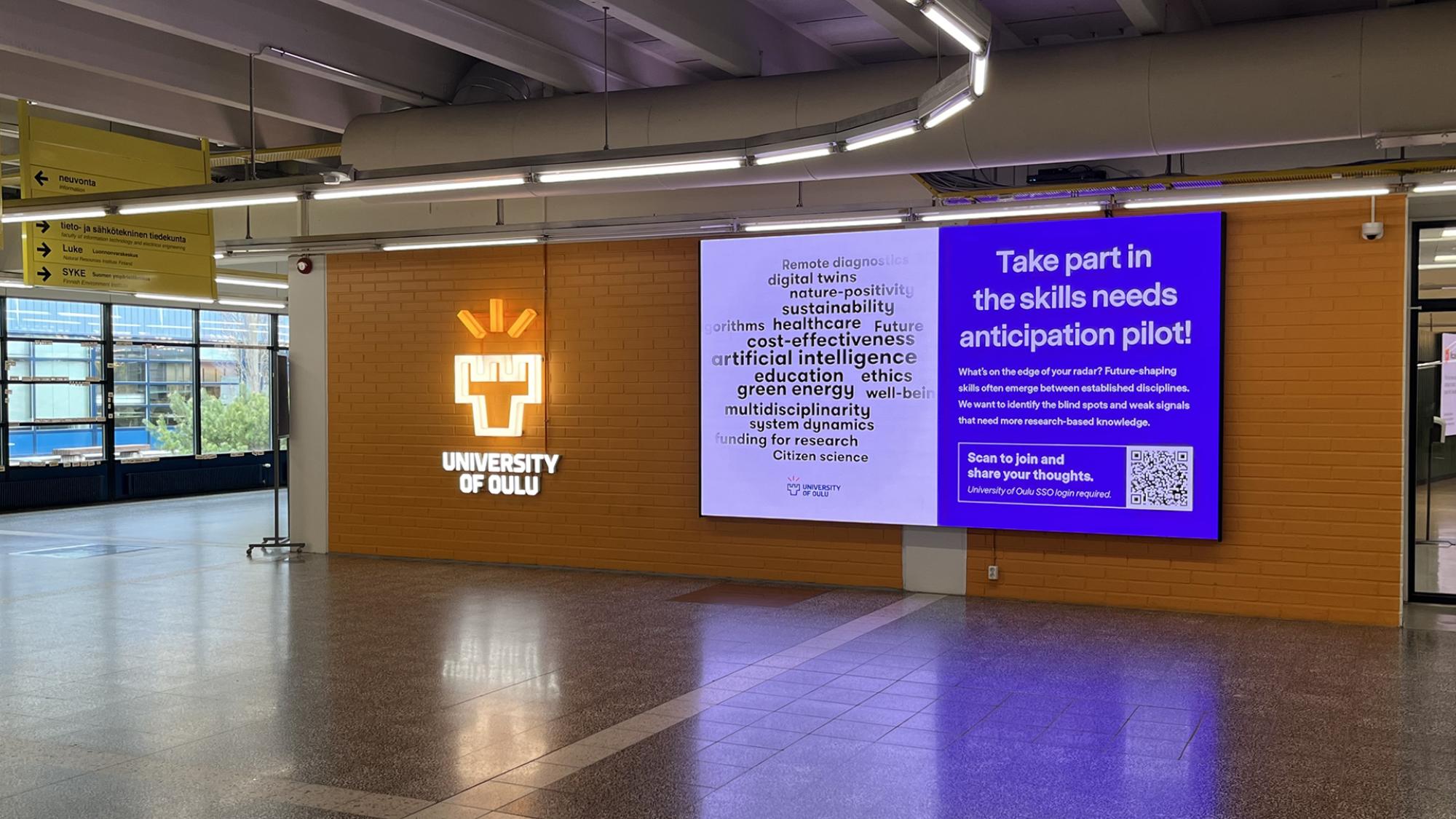
  • finally, on campus displays, completely without facilitation

Each time, the word cloud interface and instructions were iteratively simplified based on the experiences and feedback received. Every round of implementation helped refine the solution, making it clearer and easier to approach.

Campus screen in a lobby. A word cloud in the screen.
The university community was invited to participate in identifying weak signals through campus screens.

What did we learn from the pilot?

During the short pilot, we collected a total of 58 phenomena in the word cloud. The weak signals particularly highlighted:

  • technological understanding (AI, data, and analytics)
  • systems thinking (complex phenomena, sustainable solutions, and the green transition)
  • human and ethical capability (values, interaction, and meaningfulness)

As a conclusion, one might think that future competence does not arise from individual skills alone, but from the combination of these three dimensions. The responses also pointed to a need to combine deep specialist expertise with broad-based understanding.

Feedback from the word cloud pilot showed that the experiment was a curiosity-sparking and lightweight way of working. The simpler the implementation and instructions, the better. In the future, the collection of weak signals could also be tested without requiring identification. On the other hand, during the pilot we also considered opportunities to involve participants further in developing phenomena that interested them and in creating new openings, in which case identification would be needed.

The development suggestions also highlighted a wish to make the connections between words more visible and to explain more clearly how the recorded phenomena could be utilised in the future.

Sand in the eyes, but looking toward the horizon

At the pilot working group’s closing coffee meeting, the pilot lead, Päivi Kuuva, collected feedback on the pilot through a playful survey. Almost all members of the preparatory group described our pilot project with the response option: “Nallikari beach on a windy day – sometimes there is sand in your eyes, but the view is beautiful.” This mental landscape, familiar to people in Oulu, nicely reflects not only the approach of agile development but also foresight work itself. Even if there really is sand in our eyes at times, it is good to look towards the horizon. Foresight is about wanting to shape the future and taking action to make it happen.

The multidisciplinary pilot group included: Päivi Kuuva (Services for Continuous Learning and Teaching), Tellervo Kivistö (Faculty of Information Technology and Electrical Engineering), Juuso Kojo (Faculty of Education and Psychology), Tuomas Mäkelä (Faculty of Information Technology and Electrical Engineering), Jussi Paakkari (Kvantum Institute), Annu Perttunen (University of Oulu Graduate School), and Minna ’t Lam (Unit for Strategy and Operations Management)

Created 23.6.2026 | Updated 23.6.2026

Authors

Minna ’t Lam
Minna ’t Lam
Strategy and Operations Management Unit

Minna ’t Lam works as a Development Manager at the University of Oulu, focusing on the strategic development of education, digitalisation, and foresight. She also serves as the University of Oulu’s change coordinator in the national Digivisio 2030 project. Minna is inspired by learning communities, creative experimentation, and participatory methods.