AI-related misconduct shows in student works – individual serious cases have been reported in faculties

In many degree programmes, artificial intelligence itself is a subject of study. This is the case, for example, in learning sciences, where students develop an understanding of AI, its various applications, and its use as a resource for learning and expert work.
"At the same time, of course, we practise using AI in studies, for example through writing assignments, experimenting with tools, and guided exploration of AI's features. A key focus is the critical evaluation of AI interaction and the content it produces," says University Lecturer and Postdoctoral Researcher in learning sciences Anni Silvola.
"We want to ensure that students have the ability to operate sustainably in AI-mediated environments. This means not only being able to utilise AI in advanced ways for different tasks, but also to assess and recognise its ethical and practical limitations."
Traffic lights indicate usage rules
At the University of Oulu, the categorical ban on AI applies only to the maturity test – otherwise, the teacher may instruct on restrictions of use for their own course.
The university has implemented a traffic light system, which allows the use of AI to be restricted for specific assignments or courses. The traffic light colours are:
- Blue – use of AI required
- Red – use of AI prohibited
- Yellow – use of AI must be reported
- Green – use of AI allowed
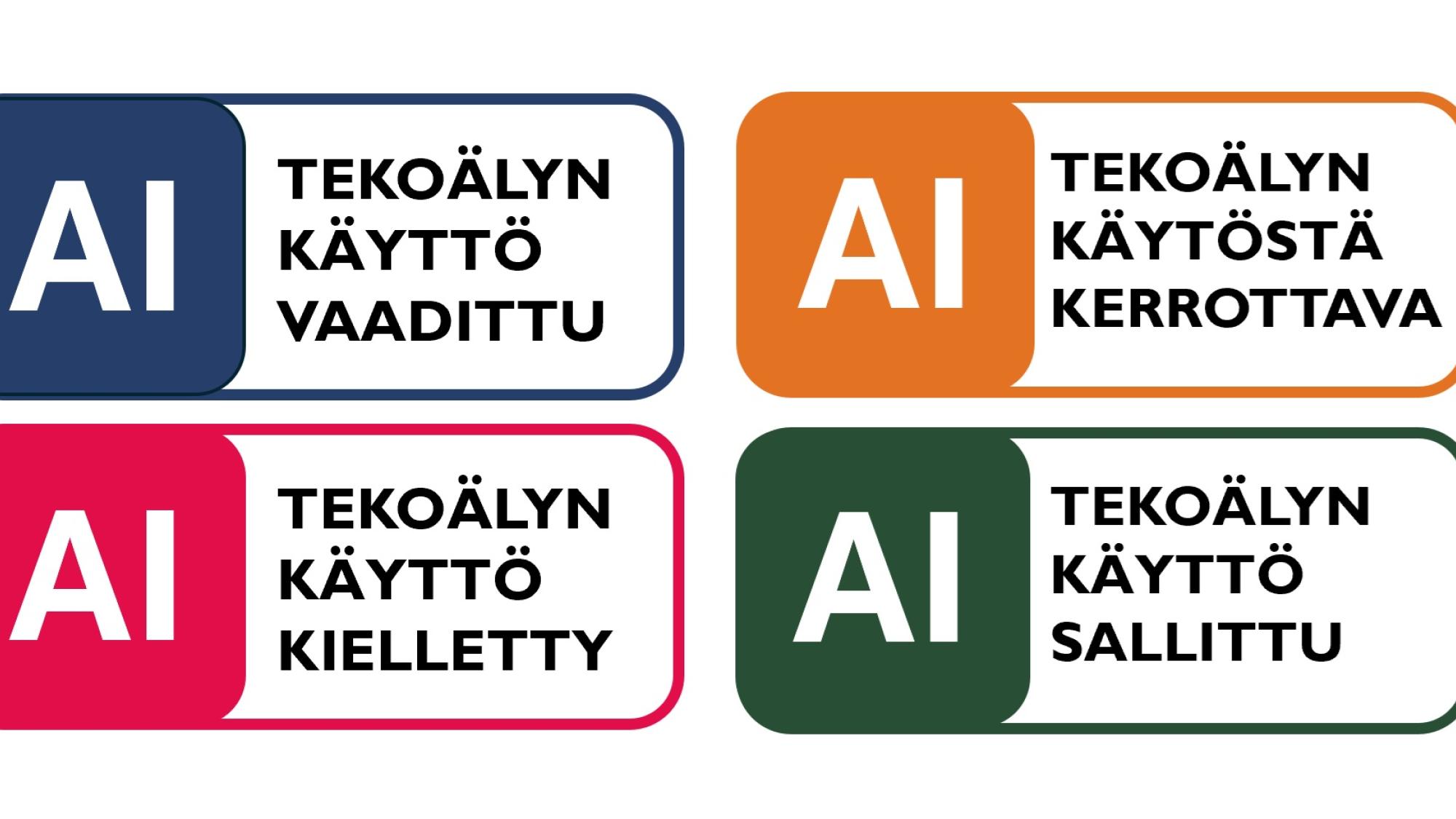
The AI traffic lights have received positive feedback from students. Next autumn, all new students will have an AI orientation as part of their induction, where the principles will be described.
"The AI traffic lights are good and clear. Requiring students to disclose their use of AI fosters genuine honesty between students and teachers," comments one student.
"I have instructed that the guidelines and, for example, the AI traffic lights must be communicated more strongly to students," says Dean of Education Marika Iivari from the Oulu Business School.
"This also applies to the fact that the use of AI in essays and other assignments may be interpreted as misconduct. This will also be taken into account in the future when assessing theses," Iivari continues.
"Cases of misconduct in studies are most often handled as guidance discussions between teacher and student, or as a verbal warning. In cases of serious suspicion or disagreement, the teacher may document the suspicion and submit it for investigation by the Dean of Education," states Service Manager Paula Vaskuri from the University of Oulu.
Suspicions of misconduct in faculties vary
According to information provided by the Deans of Education in the faculties, some of the suspicions of misconduct reported in 2025 are related to the misuse of AI or use contrary to guidelines. The highest number of AI-related cases has been recorded in the Faculty of Education and Psychology, while in three faculties no AI-cases have been processed officially.
Many faculties emphasise that not all suspicions are necessarily brought to the Dean of Education for consideration if the matter is resolved through guidance between teacher and student.
"I have encouraged teachers to report all suspicions, even though proving misconduct is difficult," says Dean of Education of the Faculty of Science Saana-Maija Aho.
Suspicions related to AI have mainly concerned essays, course assignments, and theses. Observations have been made, for example, based on writing style or non-existent references found in bibliographies. In some cases, students have admitted misconduct.
Based on the summary provided by the faculties, the Faculty of Education and Psychology has recorded 17 cases of misconduct in 2025, 10 of which were related to prohibited, incorrect or undisclosed use of AI. These cases concerned bachelor's theses, course assignments, and final reports. The consequences have included failing of parts of the work or the thesis itself; one case was taken to the Rector.
"In our faculty, AI is also a research topic, so we are well aware of its possibilities and 'dangers'. Many of our students will work in roles in the future where it is important to recognise the limits of AI use and also to guide and teach others in its ethical use," says Docent Sari Harmoinen, who served as the faculty's Dean of Education until 2025.
Also in the Faculty of Information Technology and Electrical Engineering, suspicions related to AI have been reported: of the six reported suspicions, two concerned theses. According to the faculty, suspicions arose due to non-existent sources and extensive use of AI tools in text production and reference searching. In both cases, students were instructed to revise their work according to supervisors' guidance.
Faculty of Technology has processed five suspicions of misconduct, two of which were related to suspected incorrect reporting of AI usage in project work. Clarification requests and warnings were issued, but academic credits were not failed as misconduct could not be proven. The faculty estimates that there may be more suspicions and warnings, as not all cases reach the Dean of Education.
Faculty of Humanities has had four cases of misconduct, one of which was related to the use of AI contrary to assignment instructions. The consequence was the failing of the essay, and the student had to retake the assignment. There have also been a few suspicions of misconduct which were not substantiated.
Oulu Business School has reported three official cases of misconduct related to Exam examinations. According to the faculty, in two cases the use of AI was possible, but its extent remained unclear.
In faculty-specific responses, the Faculty of Science, Faculty of Medicine, and Faculty of Biochemistry and Molecular Medicine reported no AI-related cases of misconduct processed by the Dean of Education in 2025.
Policies for the use of artificial intelligence in teaching at the University of Oulu were last updated in December 2025. At present, faculties and some units are conducting AI mapping to strengthen the university's AI strategy and to obtain an accurate overview of the situation.
AI guidelines and the traffic light system are updated regularly. Responsibility for updates lies with the educational AI working group.
Guidelines for the Use of Artificial Intelligence in Education