Braking distances of heavy-duty vehicles tested in winter conditions in Pudasjärvi, Northern Finland – measurements and weather services enhance winter traffic safety
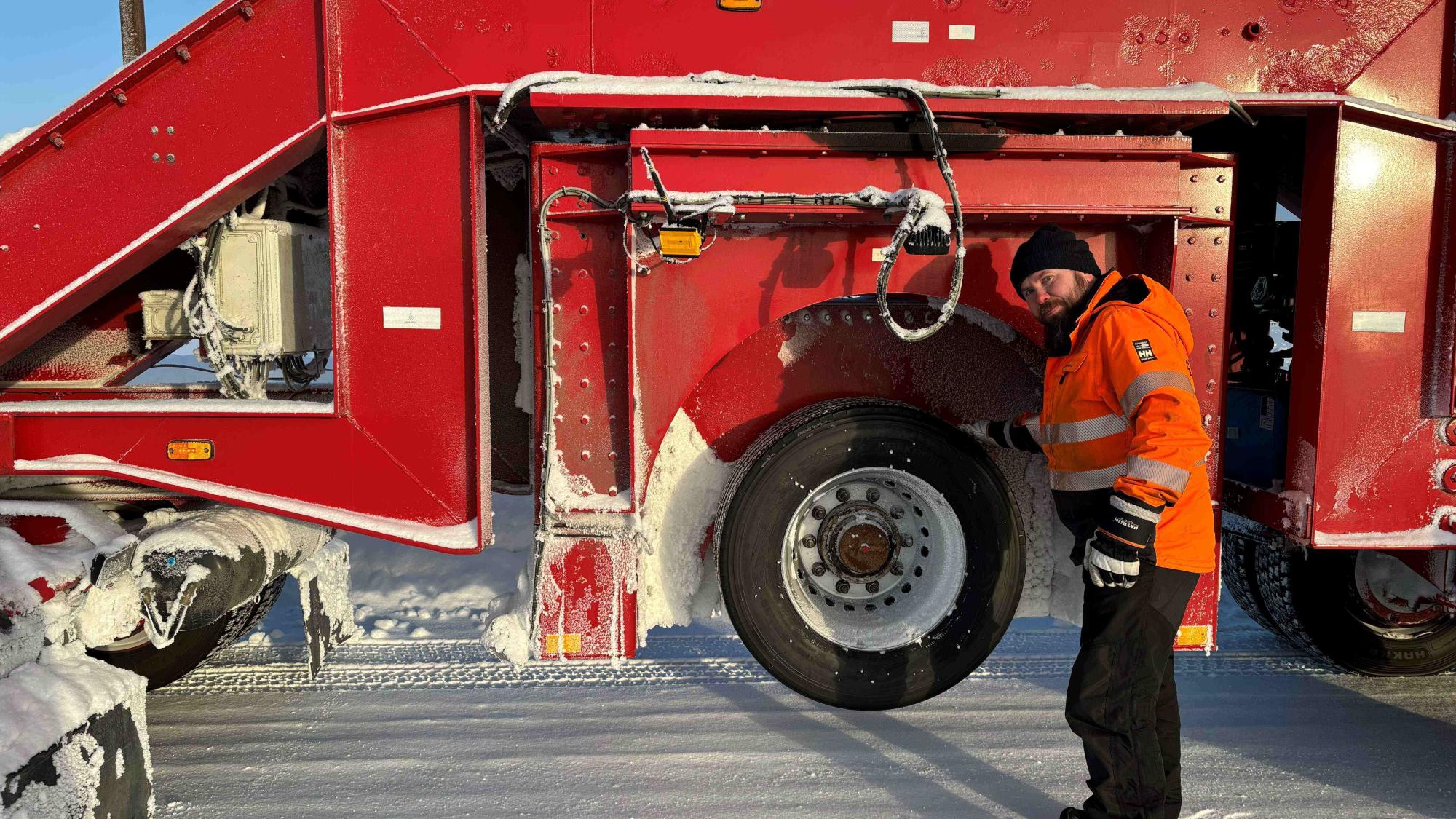
The core of the SafeTrucks test event consisted of braking distance tests on a wintry, low-friction surface. On a dedicated test track, researchers examined how different vehicles and vehicle combinations behave during braking manoeuvres and how real-time condition information supports safe driving.
Solutions developed within the project were also presented during the day. These integrate real-time condition data collected from vehicles, road surface friction measurements and enhanced local road weather forecasts.
The tests were carried out in temperatures dropping below –20°C on a track prepared at Pudasjärvi Airport. Tyre and friction measurements were conducted using various heavy-duty vehicles and vehicle combinations, with vehicle mass and speed as key variables. The results provided measured reference values for braking distances at specific speeds under defined winter conditions.
Developing advanced weather and safety services is a central objective of the project. Determining threshold values for friction and slipperiness through controlled testing makes it possible to generate vehicle-specific warning services when road weather forecasts and vehicle-generated data indicate significant changes in conditions.
“Demonstrating heavy traffic warning services alongside the braking tests clearly illustrated the core objectives of the research project. Improving safety for heavy-duty traffic has a multiplied positive impact on the entire transport system,” says Project Coordinator and Senior Research Scientist Timo Sukuvaara from the Finnish Meteorological Institute.
The SafeTrucks research project and the development of its services are led by the Finnish Meteorological Institute. The practical implementation of the test event was carried out by Nokian Heavy Tyres and the Vehicle and Mobile Machinery Engineering Research Group of the University of Oulu, both of which have extensive expertise in tyre testing and road–tyre interaction research.
Braking distances measured with different vehicles and loads
Braking distances were tested on a slippery surface using several vehicle configurations. The measurements examined:
- road surface friction with different tyre types
- differences in braking distances between unloaded and loaded vehicles
- differences between a tractor unit and a full vehicle combination
- the role of vehicles as mobile sensors for collecting condition data
- improved forecasting of local road weather conditions
“Tyre testing is a key element of Nokian Heavy Tyres’ product development, and in all projects we place particular emphasis on improving safety. In this project, we have focused on developing the Intuitu smart tyre solution to meet the needs of heavy-duty vehicles,” says Teppo Siltanen, Senior Product Manager at Nokian Heavy Tyres.
Using the heavy-duty tyre measurement trailer developed by the University of Oulu, real-time road surface friction was measured both before and during braking events. Optical friction measurement devices installed in the project’s pilot vehicles were also utilised.
“With the tyre measurement trailer, we can study tyre force generation in real-life winter road conditions, for example during cornering and braking. The measurement results are used to validate friction measurement methods, compare tyre performance and develop tyre models that are essential for vehicle dynamics simulations. These simulations enable us to assess, for instance, the stability of different heavy vehicle combinations when exposed to sudden strong crosswinds in winter conditions,” says Miro-Tommi Tuutijärvi, Doctoral Researcher at the University of Oulu.
The tyre measurement trailer, designed and built at the University of Oulu, is a unique research instrument engineered to measure dynamic tyre forces. It measures lateral force (cornering), longitudinal force (braking) and combined slip (braking while cornering) in real time. The system enables comparisons between different tyres mounted on various axles and tested on different road surfaces. By conducting tests at varying slip ratios and slip angles, longitudinal and lateral friction curves can be generated for each tyre configuration.
Broad cooperation supports the development of traffic safety
Other project partners participating in the event included Ahola Transport, Neste and Taipale Telematics, which presented their ongoing research and development activities. Cooperation partners include Suomen Maa-autot, VR Transpoint and Lappia Vocational College. Lappia Vocational College has provided vehicles as platforms for the Finnish Meteorological Institute’s optical friction measurements, and its vehicles also participated in the braking tests.
During the test day, compacted snow ridges formed between tyre tracks became polished, causing variations in road slipperiness. Similar changes occur in real-world traffic, highlighting the importance of drivers’ ability to interpret road surface conditions. Modern heavy-duty vehicles maintain steerability even under full braking, enabling drivers to actively seek available grip beneath the tyres.
The braking distance tests were supervised and coordinated by the Finnish Road Safety Council (Liikenneturva).
“We are always pleased to be involved in activities that take concrete steps towards improved road safety,” says Toni Vuoristo, Planning Officer at Liikenneturva.