KNL transforms legacy shortwave into modern crisis communications networks
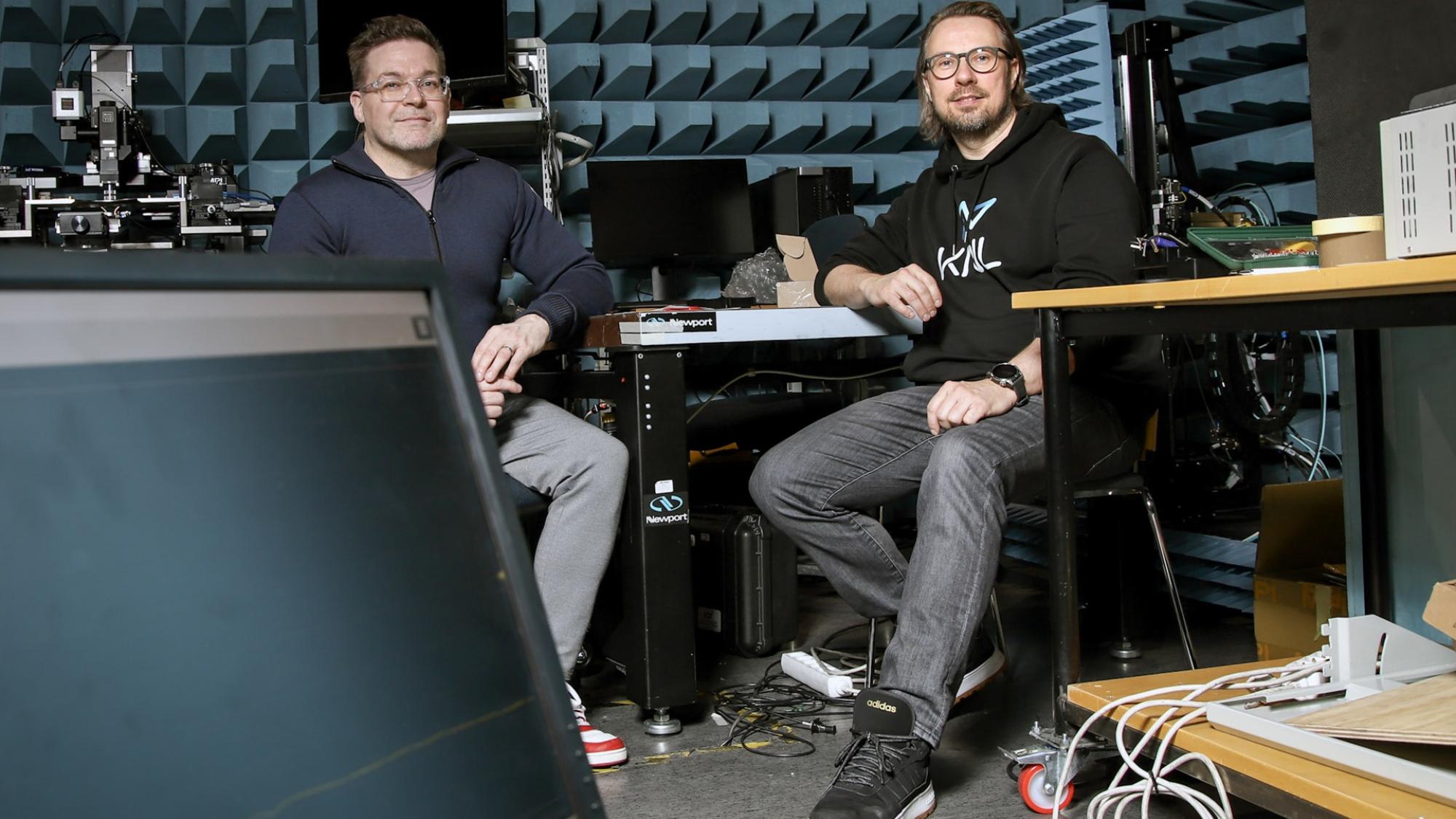
The Oulu-based company KNL is known as a developer of cognitive HF radio technology whose innovations have grown in significance alongside increased preparedness for crisis situations. The joint procurement order from the Finnish and Swedish defence forces alone in 2025 was worth a combined EUR 15 million.
Cognitive radio technology refers to the encrypted transmission of voice and data over high frequency — or HF — bands, which carry signals across distances of thousands of kilometres. KNL’s software-defined radios automatically identify available frequencies, and the network they form operates even under exceptional circumstances.
Founders Toni Lindén and Matti Raustia describe how they grew into the curiosity and open-minded development work that underpins KNL, as researchers at the University of Oulu’s Centre for Wireless Communications (CWC) during the first decade of the 2000s.
The company, founded in 2011 under the name Kyynel, built its profile as a reformer of global maritime radio and communications. It was not, however, a spin-off. Somewhat surprisingly, Kyynel emerged specifically from what was not being researched and where no commercial or developmental potential had previously been seen.
“The capabilities created by the university are evident in our ability to assemble a puzzle from existing building blocks. Combining the pieces made a leap of several generations from a systems technology perspective — a leap that the rest of the industry had not, for some reason, taken. That is how we gained the competitive advantage we still have today,” says Lindén.
Lindén compares the leap to the gap between landline telephones and 3G technology, which brought mobile internet to handsets. How was it achieved? Raustia explains that it comes down to multidisciplinary understanding: radio communications encompasses mathematics, physics, electronics, telecommunications engineering, and radio engineering.
“The broad-based expertise we received from the university has enabled broad-based thinking about the problem and the application of different technologies.”
Research projects shaped them into entrepreneurs
Raustia completed his Master’s thesis at CWC on military communications in 2001 and continued as a research director and project manager on CWC research projects funded by the Finnish Defence Forces. Lindén, an officer from the National Defence University, joined one of the research groups led by Raustia to work on his doctoral thesis in 2008.
“On the project side, we were looking at entirely different frequency bands. We started wondering about this strange, historical HF frequency band where no development was happening. Kyynel was born when we combined the technological foundation used in other frequency bands and applied it to the HF band,” says Raustia.
Raustia sums up that the HF market was divided among a handful of players, and technological development had stagnated in previous decades. In practice, communications were largely based on manually scanning through pre-agreed frequencies at regular intervals in case there were incoming messages.
“HF systems had long had a reputation for being unreliable, because the idea of trying to decide in advance which channel you want to use simply does not work in that kind of operating environment,” says Lindén.
Defence industry moved to the front line
Underlying the research and development work was a continuous second direction: communications for exceptional circumstances and the needs of the defence forces. Kyynel even takes its name from a Morse radio used by Finnish long-range reconnaissance patrols during the Continuation War.
At the end of 2020, Norwegian maritime communications company Telenor Maritime acquired KNL Networks. The global security situation changed when Russia invaded Ukraine in February 2022. During that same year, KNL was established under Telenor, focusing on defence industry customers.
Raustia says that experience from earlier software-defined radio projects had taught them how to manufacture cognitive HF radio. Even so, the amount of work and investment has been surprising. Lindén, on the other hand, says that it can be worth building a high-technology company rooted in innovation research even naively: he reflects that if Kyynel had defined its products and their capabilities at their current level from the outset, the development work would have collapsed at the start.
“We have probably imagined we were much further along than we actually were, and ten years from now we will likely look back at the present moment and think exactly the same thing.”
Shortwave radio capability rose to stand alongside satellites
Research groups and researchers at the University of Oulu have for decades been building radio technology that has transformed global communications. In a demonstration conducted in early spring 2026, KNL’s cognitive HF radios and the wideband radios of Bittium, another technology company with its roots at the University of Oulu, were used seamlessly within the same network.
The once-unreliable shortwave radios are now part of a broader communications infrastructure at a level where they are used automatically alongside state-of-the-art satellite communications.
Behind this lies 15 years of development work. Lindén and Raustia say that a successful idea does not need to be — and very rarely is — a Nobel Prize-worthy innovation.
“The vast majority of companies operate on a very simple idea: you just have to be able to do it a little better than others, or from a slightly different angle. In principle, all you need is the readiness for academic thinking that the university provides, curiosity, and an interest in entrepreneurship.”
Text and photo: Juha-Pekka Honkanen
Watch how Toni Lindén discusses resilient communication in modern crises