Research knows no age limits
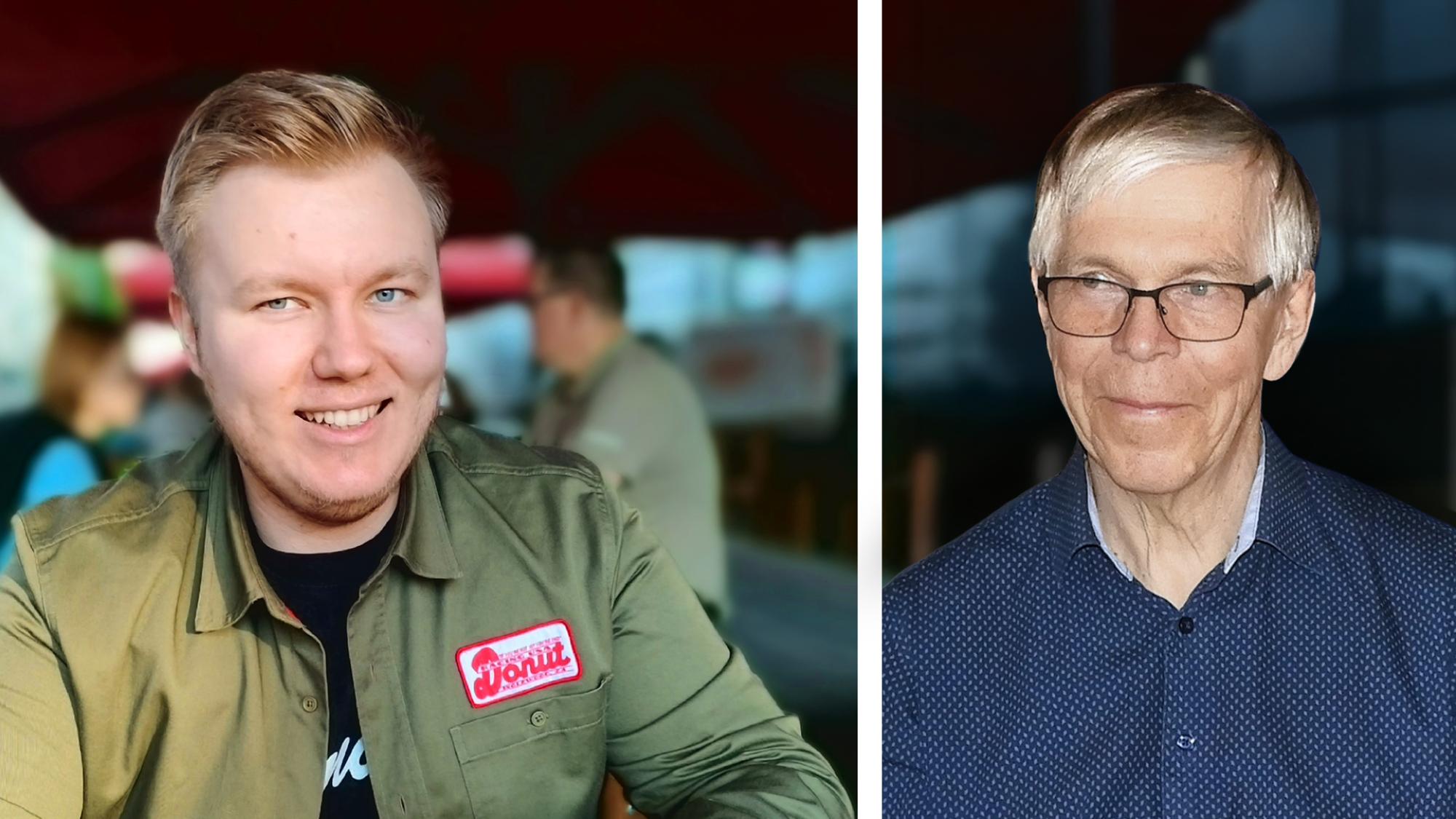
When someone finds their own path, it can take a dedicated person far. A prime example is Kimmo Kärkkäinen, who only recently turned 26 and thus defended his doctoral thesis at an exceptionally young age. In his dissertation in materials and mechanical engineering, Kärkkäinen studied metal fatigue using physical prediction models.
He entered the world of research already in the summer after his second year of studies, when Research Director Tero Frondelius announced via the student email list that he was looking for a research assistant for a metal fatigue research team.
“I had come across the phenomenon in my studies and knew it was topical and critical. I thought the work of a research assistant would be simple side tasks, but I ended up being deeply involved in real research and I’ve been in the same team ever since,” Kärkkäinen says.
Kärkkäinen completed both his bachelor’s and master’s theses on modelling metal fatigue, and writing a dissertation felt like a natural continuation of the research he had begun during his studies. By the time he graduated as a Master of Science in Technology, he had already published his first article.
His path toward doctoral research began in the eighth grade of lower secondary school, when he became enthusiastic about mathematics and science subjects.
“That’s when I started thinking that if I wanted a good future, I had to be good at something. Everyone said math, chemistry, and physics were difficult, so with an all-or-nothing attitude, I decided to invest in them.”
In upper secondary school, Kärkkäinen began to think seriously about his future. A moped-loving teen fascinated by machines, he concluded that a career in engineering would offer good employment prospects and opportunities for development, and decided to pursue mechanical engineering studies at the University of Oulu.
His choice of field proved to be the right one, and the enthusiasm for mathematics he developed in lower secondary school continued in university.
“To my delight, I noticed that in the field I had chosen, all the courses focused precisely on the things that interested me. There were hardly any courses that felt unnecessary.”
In Kärkkäinen’s view, youthful drive is an advantage for a researcher.
“When you’re young, you’re enthusiastic in a completely different way and capable of absorbing new things. You also have more time for research when you don’t yet have work and family obligations.”
That enthusiasm has been needed. During his bachelor’s studies, Kärkkäinen worked simultaneously at a design office and as a research assistant. Part-time research work continued throughout his studies. The flexibility of a researcher’s schedule made it easier to balance work and studies.
“During the busiest study periods, I could focus on preparing for exams and then catch up on work afterward. At no point has the workload felt overwhelming, even though the days have sometimes been long.”
Kärkkäinen wants to emphasize that an academic career can start from many kinds of backgrounds.
“I went to an ordinary upper secondary school in the small municipality of Paltamo, and I grew up in fairly modest circumstances with a single mother. I think it’s wonderful that in Finland you can go far in your studies regardless of your background.”
Learning throughout life – a long medical career brought depth to research
With a long career as a physician, Yrjö Perkkiö has worked on what eventually became his doctoral dissertation for more than four decades. In his thesis, he examined the connections between lifestyle, mental health, common diseases, well-being, and mortality among the residents of Muonio and Enontekiö.
Perkkiö knows the local population thoroughly. He began working at the Muonio–Enontekiö health centre in 1977 and retired in 2019. Originally from Kolari, he studied medicine in Helsinki and returned to Lapland immediately after graduating, as there was a shortage of doctors.
In the 1970s and 1980s, the Muonio–Enontekiö health centre investigated cardiovascular risk factors among local residents. After reviewing the screening results, Perkkiö became inspired to study the topic more closely.
“The studies revealed many factors that increase the risk of cardiovascular disease, such as smoking and high blood pressure. I thought it would be interesting to follow how the health of the participants develops over the years,” he says.
Perkkiö contacted the University of Oulu, and the screening results were stored in the university’s database. However, his demanding medical work left no room for further research, even though completing a dissertation remained at the back of his mind.
“Professor Sirkka Keinänen-Kiukaanniemi, who served as the custos at my dissertation defence, used to ask me from time to time when we would continue the research. In 2014–2015, the time was finally right to collect follow-up data from the people who had taken part in the original study. I was officially already retired then, even though I still worked as a general practitioner and travelled to Oulu to teach future physicians.”
Experience gained over time has been an advantage in his research.
“I’ve observed the healthcare system from every angle and learned to view health holistically. You simply can’t have that kind of understanding when you’ve just graduated,” he says.
The dissertation defence attracted great interest in the region, and hundreds of people gathered in the auditorium of Hotel Olos in Muonio on a November Saturday.
Doing research has helped Perkkiö view more objectively what truly matters in healthcare. He shares his deepened insights, for example, as the chair of the local heart association.
“I’ve gone from being a health educator to a full-fledged health preacher. It’s important for people to have meaningful hobbies and social connections. Lifestyle choices have an enormous impact on one’s health and well-being.”
Text: Terhi Suominen