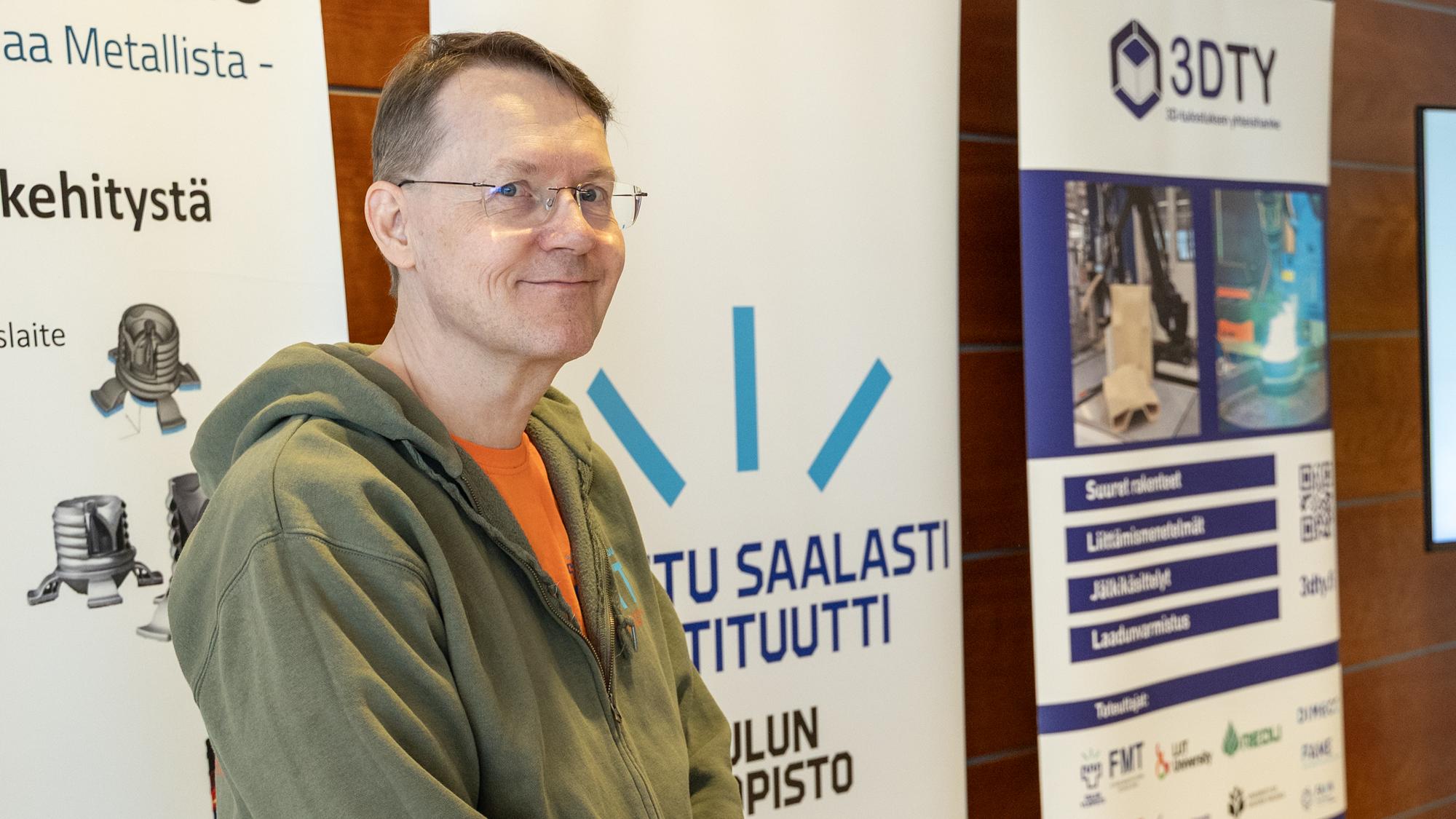
Robot-Based Manufacturing Accelerates Industrial Transformation – FMT Days 2026 Brought Together the Industry’s Future Makers

The 2026 FMT Days, organized by the University of Oulu Kerttu Saalasti Institute, once again brought together researchers, companies, and educational organizations to discuss the next leaps in industrial development. This year’s theme focused on robot-based additive manufacturing. The event demonstrated that the technology is no longer merely a vision of the future, but a rapidly growing part of Finnish industry.
Kari Mäntyjärvi

The two-day event held in Nivala in May highlighted how robotic printing and additive manufacturing are moving from research environments toward commercial production. According to Kari Mäntyjärvi, Development Manager of the Future Manufacturing Technologies (FMT) research group at the University of Oulu, the field is now at a turning point.

“When the 3DTY project started, there were no commercial service providers for large-scale plastic or metal printing in Finland. Now companies have emerged in both sectors,” Mäntyjärvi explained.

The FMT Days program covered robotic manufacturing from a broad perspective, including metal and plastic printing, programming, process simulation, materials research, automation, and practical industrial applications. According to Mäntyjärvi, usability, controllability, and programming were among the key themes.

Antti Alonen, RDI Specialist and Project Manager at Savonia University of Applied Sciences, noted that the field has now reached a stage where the technology is becoming genuinely accessible for companies.

“Hardware, software, and materials have evolved to the point where robotic 3D-printing is already a real manufacturing method. This is no longer just something for researchers,” Alonen said.

At the same time, he pointed out that the growing adoption of robotic 3D-printing fuels further development: the more service providers and applications emerge, the more new use cases are discovered. Training skilled professionals is therefore of critical importance.

Practical Solutions and Concrete Case Studies Through Collaboration

One of the key strengths of FMT Days was once again its practical approach. The event showed numerous concrete examples of how robotic manufacturing can be utilized across different industries, including the development of autonomous work machines.
The program featured, among other things, WAAM metal printing, robotic printing of large components, simulation of direct energy deposition processes, and various production automation solutions. For example, the KATI project has developed electric vehicles and battery recycling solutions.

The 3DTY project, in turn, has developed solutions such as molds for building snow castles in Northern Finland, boat impellers, motor solutions for vehicle components, and technologies related to high-end loudspeakers.

Dima Kangasoja, Design Engineer at KOME Oy in Haapajärvi, presented the company’s modular light bar solution, where cost-efficiency was a central factor guiding the development work. Kangasoja praised the collaboration with ELME Studio, particularly for its smoothness and the low threshold for testing new solutions.

“We were able to get the process started quickly, and the collaboration did not slow down product development — quite the opposite, it supported it,” Kangasoja described.

Jyri Peuru, Method Development Engineer at HT Laser, also emphasized the importance of long-term collaboration. The company has worked together with the University of Oulu for around 20 years.

“For example, the laser-welded sandwich panel developed through our collaboration is still a successful product at HT Laser. Once again, FMT Days provided plenty of new knowledge and ideas on how these technologies could be utilized in the future,” Peuru said.

Nationwide Networks as a Key Strength

One of the strongest messages of the event was the importance of collaboration. The event brought together a wide range of actors: universities, universities of applied sciences, vocational institutions, and companies from across Finland.

Collaboration between different levels of educational institutions was considered especially important because the adoption of new technologies requires expertise on many levels in the future — from research and applied development to practical production know-how. Within the 3DTY project, expertise is also being compiled into various guidebooks and manuals.

According to Mäntyjärvi, the networks created through the 3DTY project have been among its greatest successes.

“We no longer need to build collaboration networks — now we can make use of the strong cooperation that has developed over the years,” he said.

Maxim Narbrough, Project Manager at REDU, also sees the creation of a strong cooperation network as one of the project’s most significant outcomes.

“The synergy between companies and research organizations has been exceptionally strong. Perhaps the most impressive results are the side effects that emerged during the project — collaborations and ideas that nobody could have planned in advance,” Narbrough said.

According to Mäntyjärvi, research conducted at universities, combined with testing and applied development carried out in universities of applied sciences and vocational institutions, enables processes to progress smoothly from proof-of-concept solutions to prototypes and ultimately to commercial end products.

The Next Step: Artificial Intelligence and Production Efficiency

Although robotic additive manufacturing was the main theme of the event, attention was already turning toward the future — particularly the use of artificial intelligence in manufacturing.

At the event, Mäntyjärvi introduced the new PaJarvis project, which will explore the possibilities of AI in the manufacturing industry.
“The aim is to demonstrate how artificial intelligence can be used intelligently and efficiently in manufacturing companies,” he explained.

According to Mäntyjärvi, future developments will help strengthen and spread expertise related to safety, security of supply, and local manufacturing.

Alonen believes that the next development steps will focus especially on automation, sensor technology, and process control. He hopes that manufacturing can move beyond manual work phases and achieve greater process reliability through sensor-based monitoring. Commercialization and companies’ investment opportunities also require attention.

“We have now demonstrated that the technology works. The next challenge is figuring out how to turn it into commercially profitable and efficient production. We are now eagerly watching the success of the first pioneering companies,” Alonen said.

The Future Is Built Together

FMT Days 2026 demonstrated that Finnish robotic additive manufacturing is entering a new phase. The industry is no longer searching for its place — it is actively building new business opportunities, services, and expertise.

At the same time, the event served as a reminder that technological progress rarely happens in isolation. It is built through networks, shared experimentation, and the courage to combine research with practical implementation.

Author and photo: Minna Kilpeläinen, M.A., M.Ed., Communication Specialist, University of Oulu Kerttu Saalasti Institute

Created 22.5.2026 | Updated 22.5.2026