Oulu Business School
OBS staff and students discuss activities in the business school. Welcome!
"Construction and demolition waste is the second largest type of waste in Finland. The goal of the waste directive is to utilize 70 % of construction and demolition waste." (Ministry of the Environment)
Globally, the construction industry consumes nearly half of all natural resources and produces significant greenhouse gas emissions and waste. Circular economy provides the industry with powerful tools to mitigate climate change and protect biodiversity.
The new Construction Act (751/2023, in Finnish) aims to advance circular economy practices by requiring, among other things, more detailed material assessments in demolition projects. In line with circular economy principles, materials from demolished buildings can be reused or recycled in significant quantities, conserving natural resources, reducing emissions, and contributing to resource-efficient and long-lasting construction solutions.
In recent years, research on circular economy solutions has gained momentum both in Finland and internationally. Finland has promising examples of reusing building components and developing demolition material banks. The greatest opportunities for improving material reuse and recyclability have been identified to take place in the early stages of construction projects.
The joint PURKU project, conducted by the University of Oulu and Oulu University of Applied Sciences, aims to develop a new operating model to improve the utilization of demolished aggregate material in infrastructure and building construction. This model incorporates demolition into the early phases of a construction project’s life cycle and emphasizes on-site or nearby crushing of demolition aggregate to avoid transporting materials elsewhere for processing.
“It is important that demolition is no longer viewed as the end point of a building’s life cycle but its beginning. The PURKU project has identified several key factors that currently hinder the utilization of demolition waste. The project’s results help raise awareness while allowing us to test new operating models,” says Anne Tuomela, Project Manager of the PURKU project at the University of Oulu.
“Our goal is to enable demolition in planning areas to be carried out in a more economically and environmentally sound way, conserving natural aggregate resources. Initial results show that responsible solutions – such as local crushing and on-site or nearby material reuse – can reduce emissions while lowering overall project costs. Too often, projects are divided into segments that are too small, leading to poor consideration of overall cost efficiency. A shift in thinking and operating models is needed.”
One of the key challenges in circular construction relates to matching the supply and demand of demolition and construction projects – both in terms of quantity and quality of materials, as well as timing and location. To address these challenges and strengthen the visibility of circular economy in the built environment, the Circular Economy Group for the Built Environment (RYSKE) has been established in the Oulu region. Researchers from the Oulu Business School, as part of the PURKU project, have supported the establishment of the group.
RYSKE brings together relevant regional stakeholders from divergent industries and sectors to advance the utilization of demolition materials. The group shares a strong common interest to develop circular economy practices and operating models, aiming for practical examples of material reuse and new business opportunities emerging from circular solutions.
“The composition of the group has proven to be a well-balanced combination of company representatives, public sector actors, and research and development experts. The discussions capture a wide range of perspectives – but we would still welcome additional companies to join us,” notes Sanna Tyni from Oulu University of Applied Sciences, who participates in the RYSKE group.
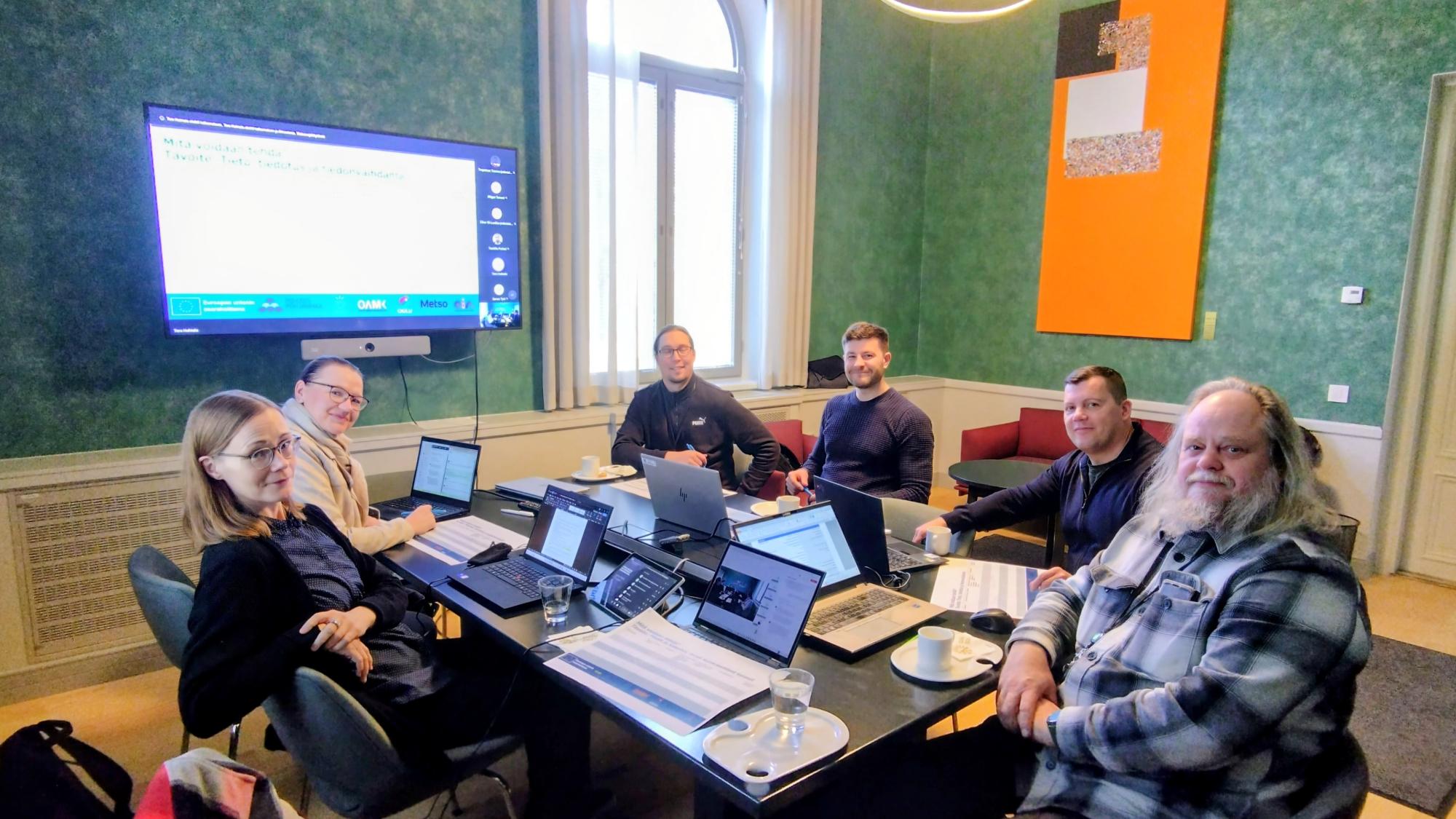
The fifth RYSKE meeting was held at Oulu City Hall on 13 October 2025. Participants included Lead Researcher Sanna Tyni (Oulu University of Applied Sciences), Circular Economy Specialist Petteri Tuuttila (City of Oulu), Project Engineer Teemu Turpeinen (Kiertokaari), Executive Director Janne Mäenpää (INFRA North), and Climate and Renovation Adviser Tommi Riippa (Building Supervision). The meeting was facilitated by researchers Tuula Lehtimäki and Tero Huhtala from Oulu Business School.
RYSKE is currently working to identify future actions and warmly welcomes new members interested in promoting circular economy in the built environment of the Oulu region. Through multi-actor collaboration, the group aims to advance the development and adoption of circular construction solutions.
Outi Keränen, Postdoctoral Researcher
Department of Marketing, Management and International Business
Oulu Business School, University of Oulu
Juho Rasmus, Postdoctoral Researcher
Fibre and Particle Engineering research unit
Leader of the OIA flagship programme: New solutions for waste and side streams
This blog post is partly based on an earlier publication by Oulu University of Applied Sciences and is linked to the joint PURKU project (Demolition as part of urban development - eco-efficient utilization of demolition materials in infrastructure and real estate construction) conducted by the University of Oulu and Oulu University of Applied Sciences. The project is funded by the European Structural Funds – Just Transition Fund (JTF), with co-funding from the City of Oulu, Oulu Innovation Alliance and Metso.
OBS staff and students discuss activities in the business school. Welcome!